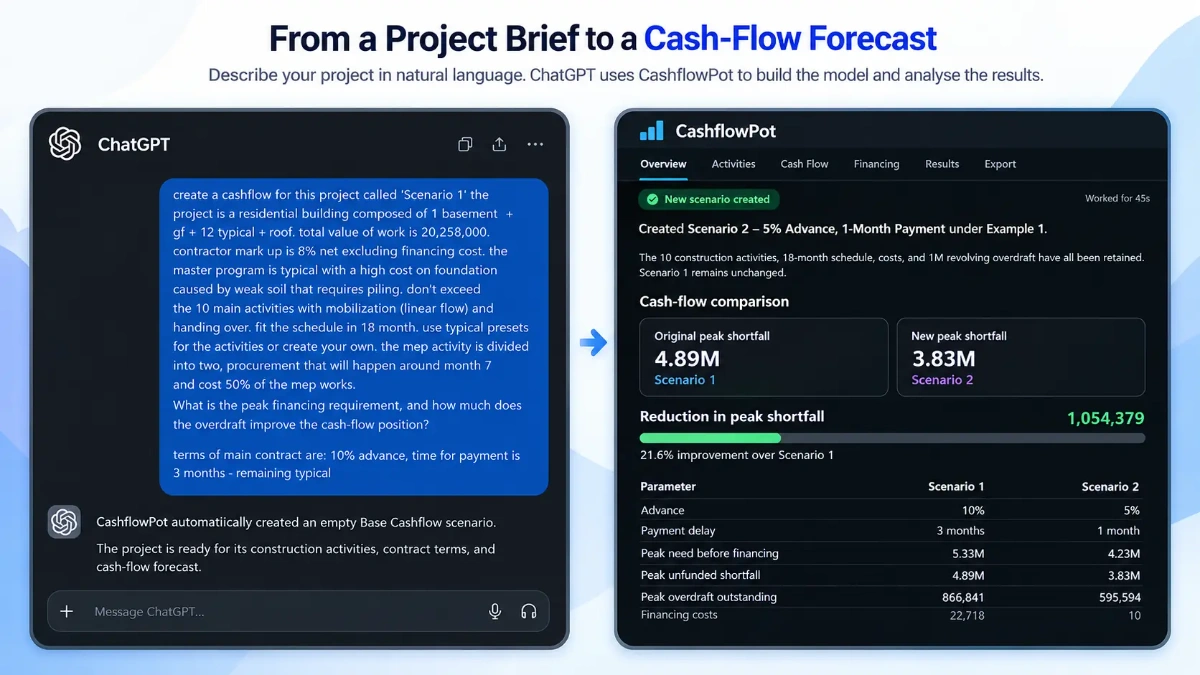
How to Create a Construction Cash Flow Forecast with AI and ChatGPT
AI construction cash flow forecasting with ChatGPT and CashflowPot lets contractors turn a natural-language project brief into a calculated construction cash-flow model. ChatGPT can create and revise scenarios through the authorized connection, while CashflowPot calculates receipts, payments, cumulative cash position, funding gaps and financing alternatives. Verify the project assumptions, payment terms and results before relying on the forecast.
See a complete project example before reading the steps.
Watch the CashflowPot + ChatGPT construction cash-flow demonstration (video).
You can also open CashflowPot in ChatGPT or use the CashflowPot web app. Plugin availability and connection steps depend on the ChatGPT account and current product interface.
Can AI Generate a Construction Cash-Flow Forecast?
Yes, provided the AI works with a construction-specific calculation tool rather than inventing a forecast in chat. With CashflowPot connected to ChatGPT, a contractor can describe a project in natural language, review the resulting activity and payment assumptions, calculate the peak cash shortage and compare the financial impact of different advance payments, employer payment periods or financing facilities. This AI-assisted workflow can accelerate preliminary tender and funding analysis, but it does not replace verified project inputs, a detailed programme where required, or bank approval.
What Does the ChatGPT Integration Actually Do?
The value is not that a chatbot types numbers into a spreadsheet. With the CashflowPot plugin connected and authorized, the user can describe a project, request a preliminary activity and cost structure, adjust commercial assumptions, create or copy cash-flow scenarios, obtain calculated cash-flow results, add eligible financing structures and request an Excel export. ChatGPT is the conversational interface; CashflowPot is the project model and calculation service.
| Responsibility | ChatGPT's role | CashflowPot's role |
|---|---|---|
| Project setup | Interpret the brief, propose missing assumptions, organize requested activities and call connected tools | Store project and scenario data supplied through those tools |
| Contract terms | Translate questions into explicit payment, advance, retention and subcontract inputs | Apply the stored scenario assumptions to project cash timing |
| Analysis | Ask targeted follow-up questions and explain differences between scenarios | Calculate the modelled inflows, outflows, net cash, cumulative balances and facility effects |
| Output | Summarize the result with assumptions and limitations | Generate the structured forecast and Excel export where supported |
This division matters: an AI-generated interpretation is not a substitute for the calculation engine, and a numerical output from the engine is only as reliable as the scope, timing, pricing and contract assumptions entered into it.
A Practical Demonstration: An 18-Month Residential Building
Consider a residential building with one basement, ground floor, 12 typical floors and a roof. The example below uses the project structure demonstrated in the CashflowPot/ChatGPT workflow, with an illustrative contract value of 20,258,000 project-currency units and a contractor markup target of 8% net, excluding financing costs. The currency should be selected in the real project; the example does not assume that the amount is automatically in USD or EUR.
| Project input | Example assumption |
|---|---|
| Building scope | 1 basement + ground floor + 12 typical floors + roof |
| Execution duration | 18 months |
| Contract value | 20,258,000, in the project's chosen currency |
| Markup | 8% net excluding financing costs; confirm the exact cost/price convention |
| Foundation | Higher-than-typical cost because weak soil requires piling |
| MEP procurement | Separate procurement activity around month 7, roughly half of MEP work |
| Activity structure | No more than 10 major forecast activities, including mobilization and handover |
| Initial employer terms | 10% advance payment and a three-month time for payment |
| Other terms | Retention, WIEB, subcontract payment terms and DLP release timing must be explicitly confirmed or labelled assumptions |
The goal is a financial decision model, not a claim that a short narrative contains all project information. A technical planner or commercial manager should check the proposed activity shares, duration, execution curves and major purchases before trusting the forecast.
Step 1 — Describe the Project Instead of Building Every Input Manually
Start with the main project and commercial facts. A useful first prompt states the scope, duration, cost drivers, desired activity count and payment terms. It also asks the assistant to disclose what has been assumed rather than invent precise values without warning.
Connect to CashflowPot. Create a project called “Residential Building — AI Cash-Flow Example”. Build Scenario 1 for an 18-month residential project: one basement, ground floor, 12 typical floors and roof; contract value 20,258,000; target net markup 8% excluding financing. Limit the financial plan to 10 major activities including mobilization and handover. Allow high foundation cost due to piling, and schedule MEP procurement around month 7 at about half the MEP package. Main contract: 10% advance, time for payment three months. Use typical starting assumptions where information is missing, but list those assumptions for review before relying on the results.
ChatGPT can help structure the instruction and use the connected CashflowPot tools. If an essential input is ambiguous—for example, whether the 8% markup is measured on sales value or cost—the assumption should be clarified and recorded. The output is a starting forecast, not a certified budget or construction schedule.
Step 2 — Review the Activity Model and Payment Assumptions
Review the forecast before adding borrowing. A project can be commercially attractive and still have a severe cash shortage when piling, procurement and subcontract payments occur before the employer pays. Foundation piling is a useful demonstration because a simple linear execution curve can conceal an early concentration of cost. Similarly, a procurement payment in month 7 should not be treated as if it were a uniformly distributed installation cost.
For each high-value activity, verify its start and finish, cost share, type of execution curve, subcontracted share, cash payment timing and billability. Advance payment, advance recovery, retention, work in excess of billings (WIEB) and the time between certification and payment must be accounted for separately. The construction cash-flow prediction guide explains those cost and billing curves in depth; the practical cash-flow methodology covers the underlying forecasting logic.
Engineering check: A building programme and a cash-flow model describe different layers. A detailed CPM schedule can inform timing, but CashflowPot's role is to simulate the financial consequences of execution, certification, receipts and payments—not to replace critical-path scheduling or contract administration.
Step 3 — Ask for the Peak Funding Requirement
Once the unfinanced project scenario is calculated, ask what happens to cash before bank facilities are added. The relevant output is the cash deficit implied by the lowest cumulative cash position, alongside when that low point occurs. It is important to differentiate pre-financing project exposure from the remaining cash requirement after financing.
Calculate Scenario 1 without financing facilities. Report the expected peak funding requirement, the period in which it occurs, and the assumptions driving it. Distinguish the lowest cumulative project cash position from the cash requirement after financing. Explain the largest early outflows and the effect of the employer's three-month payment timing.
The result should include the modelled amount and the period returned by CashflowPot, not an estimate improvised in the ChatGPT reply. If the plugin cannot retrieve a reliable result, do not substitute an unverified number.
Step 4 — Test an Overdraft, Then Compare Contract Terms
Financing should be modelled after the underlying unfinanced deficit is understood. Consider an illustrative revolving overdraft with a maximum face limit of 1,000,000 in the project currency and draw/repayment rules tied to progress payment certificates, subject to the facility's actual CashflowPot settings. Bank interest, facility fees, commitment rules and repayments can affect the total financing cost as well as monthly liquidity.
Add a revolving overdraft to Scenario 1 with a limit of 1,000,000. If the facility tools support these parameters, test funding up to 60% of the relevant progress payment certificate and repayment linked to 60% of the relevant employer payment. State exactly how each parameter is interpreted by CashflowPot. Recalculate the forecast and compare the new peak funding requirement, facility usage and financing cost with the unfinanced case.
An overdraft may reduce the size of the unfunded cash gap without improving the underlying project's earnings. In the model it may introduce interest and fees; it also cannot finance cash needs exceeding its available limit and drawing rules.
A contract negotiation can outperform a larger credit line
Next duplicate the cash-flow scenario instead of overwriting the original assumptions. Compare the initial 10% advance and three-month payment period with an alternative 5% advance and one-month payment period. The model should isolate the impact of the changed terms while retaining the same construction activity assumptions.
Duplicate Scenario 1 as “Scenario 2 — Lower Advance, Faster Payment”. Change the employer advance to 5% and time for payment to one month. Keep the project value, activity structure and other assumptions unchanged unless a linked calculation requires adjustment. Compare Scenario 1 and Scenario 2 before financing, and then under comparable financing terms. Which has the lower peak cash exposure and financing cost?
There is no universal rule that the scenario with the larger advance is better. Faster progress-payment receipts may offset or outweigh a smaller initial advance, depending on advance recovery, work valuation, retention, execution profile and payment delays. The comparison must come from the recalculated cash-flow curves.
Step 5 — Read and Challenge the Scenario Comparison
A useful analysis includes more than one large number. Before selecting a preferred financing structure, check the following outputs side by side.
| Decision measure | What to look for |
|---|---|
| Peak pre-financing cash exposure | Largest modelled negative cumulative cash balance before funding |
| Timing of the cash deficit | Month or reporting period where funding pressure is most severe |
| Peak residual funding requirement | Remaining shortfall after facility draws, subject to the model's convention |
| Bank facility usage | Drawings, available headroom, repayments and potential constraint breaches |
| Financing cost | Interest plus commissions and other configured fees; distinguish annual from period rates |
| Contract trade-off | How advance percentage, recovery, retention, WIEB and time for payment change receipts |
| Sensitivity | How assumptions change the answer if activity cost or certification timing differs |
If one scenario uses different activity costs or retention assumptions, identify that difference instead of describing the result as a pure advance-payment comparison. Project value, scope and the accounting basis for markup should remain consistent when only payment terms are meant to change.
Step 6 — Export the Forecast to Excel and Review It
ChatGPT can request CashflowPot's Excel export through the connected app. The workbook can be used for internal review with the project manager, commercial team, finance department, banker or investor. It should make it possible to inspect the timeline and challenge the assumptions behind the peak funding figure.
Before sharing the workbook externally, verify the currency, project duration, period numbering, executed-work assumptions, advance recovery, retention release, facility rules and all major financing fees. Compare the exported values with the results shown in the connected CashflowPot scenario. The detailed CashflowPot tutorial covers the underlying activity and cash-flow model and how to interpret the exported schedule.
Three Useful Roles for the Same ChatGPT Workflow
| User | Questions to ask |
|---|---|
| Contractor or tender manager | Can this tender be financed under the proposed payment terms, and which change reduces the funding peak? |
| Project commercial and finance team | How much working capital is needed before and after bank facilities, and when does repayment occur? |
| Bank or investment reviewer | Which cash assumptions drive the funding request, and how sensitive is the model to longer payment delays? |
The tool is useful precisely because a reviewer can ask another question after seeing the first cash-flow result, change a scenario and see how the calculated answer responds. This is an analytical workflow, not a promise that any AI model can independently approve a loan or certify a payment.
How to Start Using CashflowPot in ChatGPT
- Open CashflowPot in ChatGPT and check whether the plugin can be connected from your account and interface.
- Complete the required sign-in or authorization to CashflowPot. If the integration is not available to your account, use the CashflowPot web app for direct modelling.
- Ask ChatGPT to confirm the connected CashflowPot project context before creating or changing a scenario.
- Describe the project using the sample prompt above, inspect assumptions, run the model, compare scenarios and request the Excel export.
The demonstrated integration works through connected ChatGPT tools. It is different from a separate AI-assisted project-setup feature inside the standalone web application; feature availability and product interfaces can change. Confirm the current capabilities before following screenshots recorded with an earlier version.
What the Integration Cannot Guarantee
- It cannot infer every contract condition: retention, advance recovery, release dates, billing constraints and tax treatment require the actual project documents.
- It is not a substitute for a verified programme or BOQ: proposed activities and cost distributions must be examined by an engineer or quantity surveyor.
- It does not turn a forecast into a bank commitment: overdraft limits, interest, availability and repayment rules must be checked against financing offers.
- It does not validate an unverified output: always distinguish connected CashflowPot results from suggestions or assumptions written in the chat.
- It does not establish an OpenAI endorsement: CashflowPot is a separate construction-finance product connected to ChatGPT, not an OpenAI-built forecasting engine.
For project-specific retention mechanics and how they affect progress payment certificates, use the construction retention guide. For advance recovery and associated contractual provisions, read the advance payment guide.
Watch the Demonstration and Explore the Full Method
From project description to financing analysis
Watch the CashflowPot + ChatGPT demonstration video.
Connect or open CashflowPot in ChatGPT.
Read the detailed CashflowPot construction cash-flow tutorial.
References
CashflowPot — Construction cash-flow simulation and forecasting