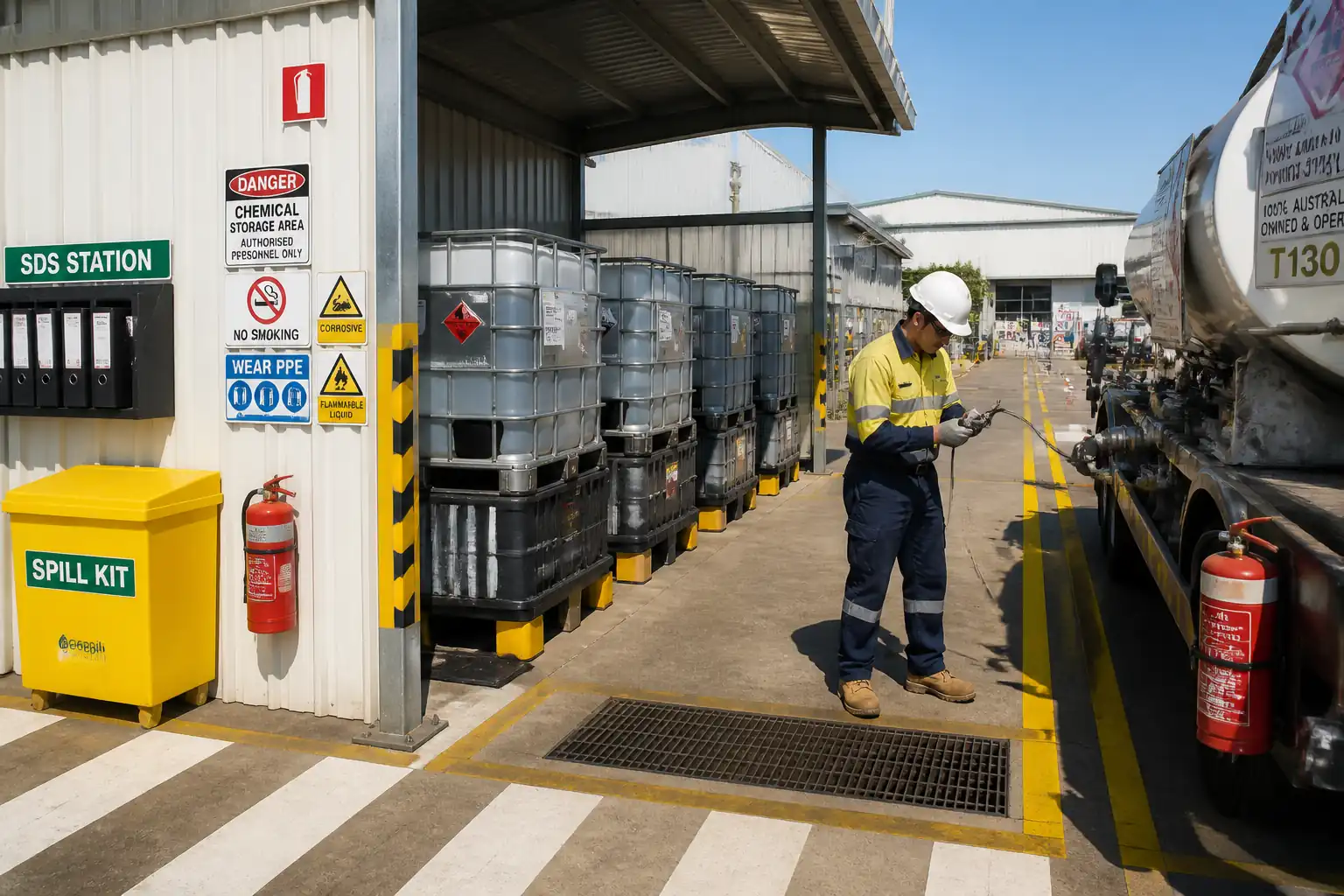

Method Statement: Hazardous Chemical and Fuel Delivery, Secondary Containment, and Storage Compound Management – Method Statement
AI-assisted method statement with matching ITP, PDF download, and Excel export.
More than a static template
Unlike a downloadable Word or PDF template, this method statement is an AI-assisted editable starting point connected directly to a matching Inspection and Test Plan. Every section is structured, project-adaptable, and ready to export.
- AI-assisted drafting — Customize every section with AI for your specific project scope.
- Linked ITP — A matching inspection and test plan is generated alongside the method statement.
- Multiple export formats — Download as a formatted PDF or editable Excel spreadsheet.
- Editable starting point, not a final document — Review, verify, and adjust all content against your project requirements before use.
Static template vs. Quollnet workflow
| Feature | Static template | Quollnet |
|---|---|---|
| Project-specific content | Manual fill-in required | AI-assisted customization |
| Linked ITP | Separate document, no link | Matching ITP included |
| Export formats | Usually PDF only | PDF and Excel |
| Structured sections | Free-form layout | 13 standardized sections |
| Saved to your account | Local file only | Cloud-saved, reusable |
| Content accuracy | You verify everything | AI-assisted, you still verify |
| Cost | Often free but time-intensive | Free to customize and download |
What you can customize
When you save this method statement to your account, every section becomes editable. The following 13 sections are included:
- Scope — Defines the activity and its boundaries.
- References — Standards, specifications, and drawings.
- Responsibilities — Roles and accountabilities.
- Resources — Labour, plant, and equipment summary.
- Materials — Materials and compliance requirements.
- Equipment — Tools and equipment details.
- Prerequisites — Hold points and pre-conditions.
- Method sequence — Step-by-step construction sequence.
- Safety controls — HSE risk controls and PPE.
- Environmental controls — Environmental mitigation measures.
- QA/QC — Quality inspection and test requirements.
- ITP — Inspection and Test Plan table (has its own page).
- Attachments — Referenced drawings and documentation.
Why this method statement is used
This method statement is used to define and communicate the approved procedure for carrying out method statement: hazardous chemical and fuel delivery, secondary containment, and storage compound management on site. It ensures the work is planned in advance, the correct resources and controls are in place, and all personnel understand responsibilities, sequence, quality requirements, and safety controls before work begins. It aligns site execution with the documented scope and acceptance expectations.
Who uses this method statement
This method statement is used by contractors, site supervisors, project engineers, QA/QC engineers, HSE officers, consultants, and client representatives. It serves as a shared reference for planning, execution, supervision, inspection, and approval of the activity on site.
When it is prepared and submitted
The method statement is prepared before the work activity starts and submitted as part of the pre-construction documentation package for review and approval.
Who reviews or approves it
The method statement is usually submitted to the client representative, consultant, resident engineer, or project management consultant for review and approval before the work commences.
Important approval note
This method statement is an AI-assisted editable starting point, not a pre-approved document. Before use on any project, all content must be reviewed and approved by the relevant parties (superintendent, principal contractor, or client representative) in accordance with your contract and project quality plan.
For example: if your specification requires a departure from a referenced standard, that departure must be documented and approved separately — this method statement will not capture that automatically. Always verify against your applicable drawings, specifications, and regulatory requirements.
Method statement content
Scope
Overview
This method covers end-to-end management of hazardous chemical and fuel delivery, secondary containment (bunds) setup and verification, storage compound operation, segregation of incompatible materials, Safety Data Sheet (SDS) availability, spill kit inspection and readiness, and fire extinguisher placement and upkeep.
Included Activities
- Pre-delivery planning, permits, and route control for fuel/chemical deliveries.
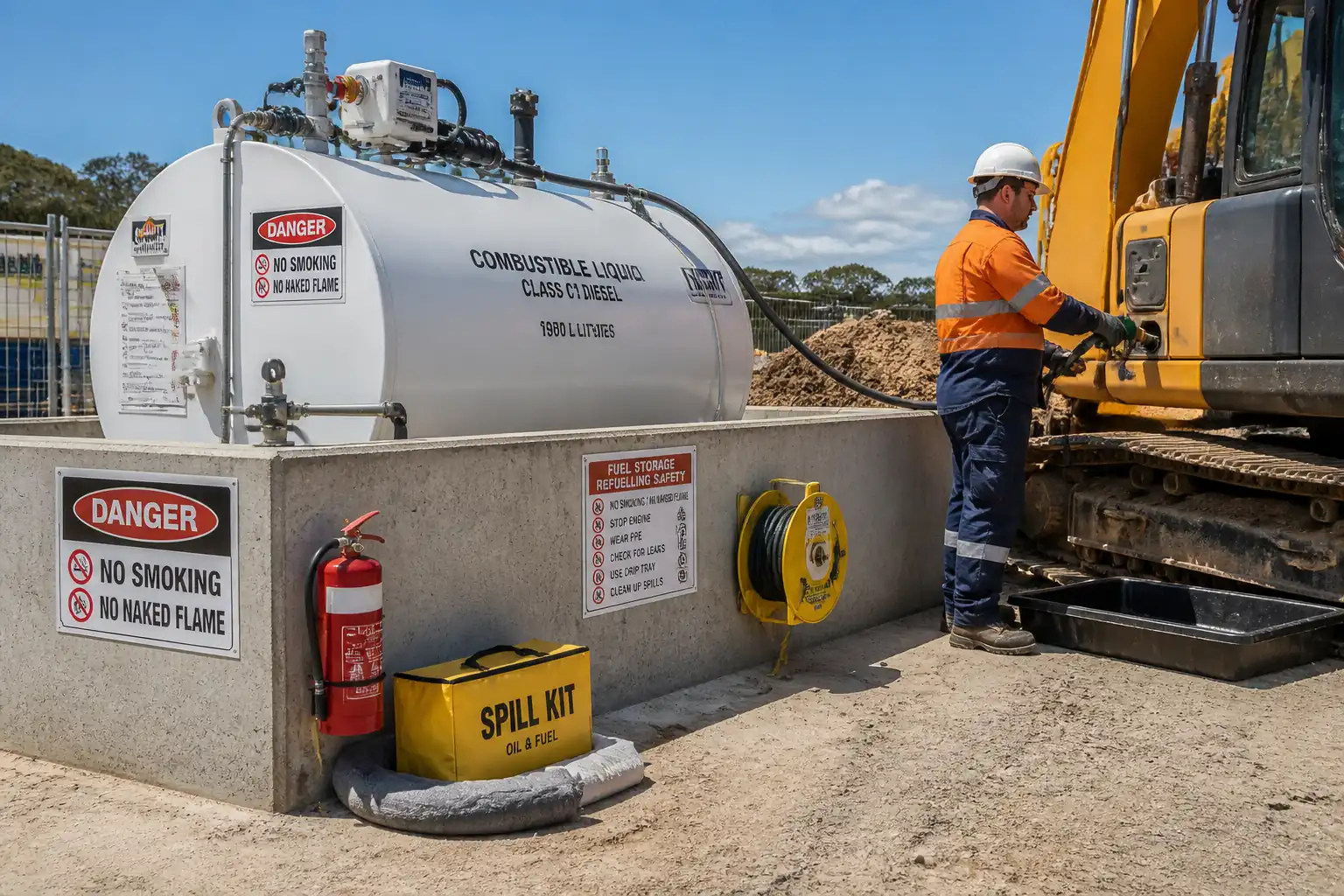
- Offloading controls, bonding/grounding during fuel transfer, use of anti-static hoses, and drip-tray management.
- Secondary containment (bund) capacity validation to 110% of the largest container or 25% of total stored volume, whichever is greater [Verify per project specifications].
- Storage layout, racking/palletizing, floor load limits, ventilation, lighting, and restricted access.
- Segregation of incompatible materials with a documented segregation matrix and signage.
- SDS station provision, access, and revision control.
- Spill prevention and response readiness, spill kit content controls, and logs.
- Fire extinguisher selection, placement, inspection, and servicing.
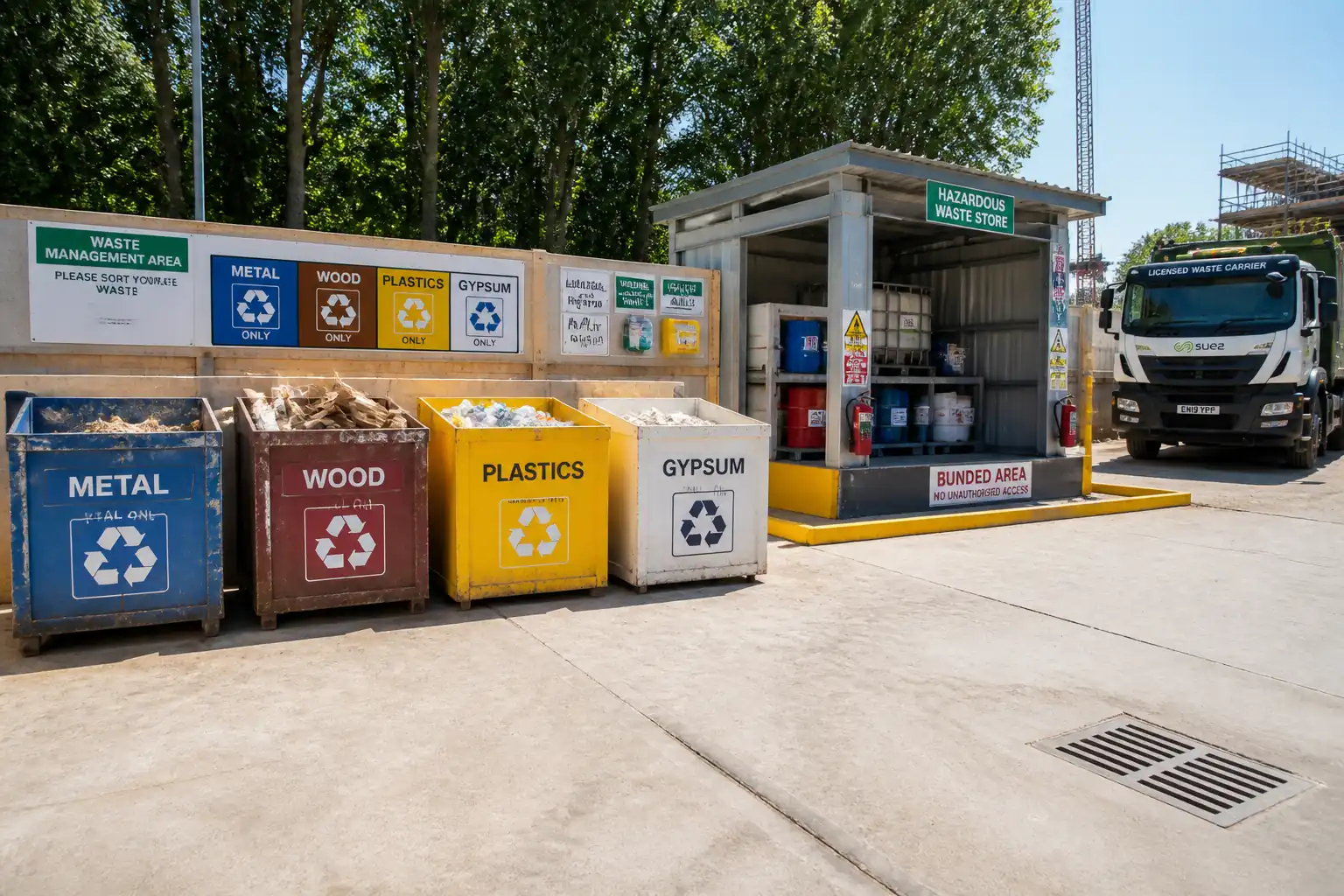
- Housekeeping, inventory control (FEFO), rainwater management within bunds, and waste disposal.
Exclusions
- Design of permanent storage tanks or pressure systems.
- Transport on public roads beyond site gate (handled by supplier per applicable regulations).
References
| Document Type | Reference / Number | Revision | Notes |
|---|---|---|---|
| Standard | ISO 45001 Occupational Health and Safety Management Systems | General OHS requirements; integrate with project HSE plan [Verify per project HSE plan and local regulations]. | |
| Standard | ISO 14001 Environmental Management Systems | Environmental controls, spill prevention/response. | |
| Standard | UN GHS / SDS 16-section format (per GHS Rev.) and CLP (EC) No 1272/2008 | Hazard communication, labelling, SDS content. | |
| Standard/Code | NFPA 30 Flammable and Combustible Liquids Code | Handling and storage of fuels/flammable liquids [Verify local adoption]. | |
| Standard | NFPA 10 Portable Fire Extinguishers / BS EN 3 Portable Fire Extinguishers | Extinguisher selection, placement, and maintenance [Verify per local code]. | |
| Recommended Practice | NFPA 77 Recommended Practice on Static Electricity | Bonding/grounding during transfer of flammable liquids. | |
| Standard | ANSI/ISEA Z358.1 (or EN 15154) Emergency Eyewash and Shower Equipment | Emergency decontamination facilities near chemical storage [Verify local requirement]. | |
| Guideline | UK EA PPGs/ GPPs: Pollution Prevention Guidelines (e.g., GPP2, GPP26) | Secondary containment and spill prevention principles [Verify applicability]. | |
| Standard | EN 12115 Rubber and thermoplastics hoses and hose assemblies for liquid chemicals | Chemical service hoses; specify conductive type for flammables. | |
| Test Method | ASTM F726 Standard Test Method for Sorbent Performance of Adsorbents | Spill sorbent selection/performance. |
Responsibilities
| Role | Responsibility | Name / Party |
|---|---|---|
| Project Manager | Overall delivery, approvals, resources, and coordination with Client/Authorities. | Contractor |
| HSE Manager | Develop and enforce HSE plan, permits (fuel transfer, hot work exclusion), emergency drills, and incident reporting. | Contractor |
| Environmental Officer | Environmental controls, bund capacity verification, rainwater testing/discharge approvals, waste classification. | Contractor |
| Stores/Compound Supervisor | Storage layout, segregation matrix, inventory, SDS station upkeep, daily/weekly inspections, housekeeping. | Contractor |
| Logistics Coordinator | Receipting deliveries, offloading supervision, bonding/grounding verification, spill kit deployment readiness. | Contractor |
| Chemical/Technical Officer | Chemical compatibility assessment, label verification, SDS completeness, advise on segregation distances/barriers. | Contractor |
| Fire Warden / Fire Safety Officer | Placement, type selection, monthly inspection, and coordination of annual service of extinguishers. | Contractor |
| Site Logistics / Traffic Marshal | Vehicle movement control at compound, banksman provision, exclusion zoning during offloads. | Contractor |
| Quality Manager/Engineer | Witness/hold points, audits, NCRs, and verification of ITP implementation. | Contractor |
Resources
| Resource Type | Description | Quantity | Remarks |
|---|---|---|---|
| Personnel | On-shift coverage during deliveries and decanting | 1 per shift [Verify per workload] | |
| Personnel | Permit issuing, monitoring, emergency readiness | 1 during delivery operations | |
| Personnel | Forklift operators / banksmen for drums and IBCs | As scheduled [Verify] | |
| Personnel | Spill team trained in first response | Min. 2 responders per shift [Verify] |
Materials
| Material | Specification / Grade | Quantity | Remarks |
|---|---|---|---|
| Secondary containment bunds | Capacity ≥110% largest container or 25% total; impermeability k ≤ 1×10^-9 m/s [Verify]. | ||
| Spill kits | Per ASTM F726 performance; kit size per risk assessment [Verify]. | ||
| Drums/IBCs | UN packaging codes per substance; compatible materials (HDPE, steel) [Verify]. | ||
| Portable fire extinguishers | Ratings and quantity per NFPA 10/BS EN 3; travel distances per code [Verify]. | ||
| Safety signage/labels | GHS/CLP compliant; weatherproof; multilingual where required [Verify]. | ||
| SDS (16-section) | Latest supplier issue; within 5 years or per local law [Verify]. |
Equipment
| Equipment | Capacity / Type | Quantity | Inspection Required |
|---|---|---|---|
| Bonding/earthing cables & clamps (spark-proof) | <10 Ω connection target [Verify]. | Yes | |
| Electric/air-driven transfer pumps | Flow rate as per supplier; initial fill velocity <1 m/s to limit static [Verify]. | Yes | |
| Transfer hoses & fittings | Pressure rating ≥ 1.5× operating [Verify]. | Yes | |
| Material handling equipment | Rated ≥ max load [Verify]. | Yes | |
| Gas detector (LEL, O2, H2S as applicable) | Alarm at 10% LEL typical [Verify]. | Yes | |
| Drip trays / portable bunds | ≥25 L at connection points [Verify]. | Yes |
Prerequisites
- Approvals: Method Statement, Risk Assessment, ITP approved by the Engineer.
- Permits: Fuel/Chemical Delivery Permit; Fuel Transfer Permit; Hot Work Exclusion in zone; Confined Space N/A unless specified; Traffic Management Plan approved. [Verify per project HSE plan and local regulations]
- Training: Induction; Hazard Communication (GHS/CLP); Spill Response; Fire Extinguisher use; Forklift operator certification; Bonding/grounding awareness.
- SDS: Latest SDS received from supplier at least 24 h prior to delivery; reviewed and accessible at SDS station.
- Compound readiness: Bund integrity inspected; drain valves locked closed; signage posted; segregation areas labelled; spill kits stocked; extinguishers in place; eyewash/shower operational where chemicals demand.
- Weather: Suspend outdoor transfers during electrical storms or high winds per risk assessment.
- Emergency readiness: Spill response plan, contact list, and muster point posted; emergency numbers displayed; spill containment drain mats staged.
- Layout: Approved storage layout drawing with designated zones for flammables, corrosives, oxidizers, compressed gases (if applicable), and segregation barriers/distances.
- Utilities/isolation: Nearby storm drains protected with covers; penstock/isolating valves closed and tagged during offloading.
- Calibration: Gas detector calibration valid; bonding continuity meter checked (if used).
Method Sequence
| Step | Activity | Description | Responsibility | Inspection / Hold Point |
|---|---|---|---|---|
| 1 | Pre-delivery planning | Confirm delivery date/time, vehicle type, material, SDS, quantity, UN number, and PPE/ADR compliance. Brief team. | Logistics Coordinator | Permit verified |
| 2 | Delivery reception and exclusion zone | Set cones and barriers to create a 5 m exclusion zone around offloading area; place drip trays at couplings; no ignition sources within 3 m. | Stores Supervisor | Visual check |
| 3 | Bonding/grounding setup | Stop vehicle engine unless PTO required; chock wheels. Connect earthing clamp to verified earth; bond tanker to receiving container/IBCs before opening any valve. | HSE Officer / Operator | Continuity check if available |
| 4 | Hose connection and leak check | Use EN 12115 conductive hose with dry-break couplings; verify gaskets; slowly pressurize and check for leaks. | Operator | Soapy water / visual |
| 5 | Controlled transfer | Start transfer at low velocity (<1 m/s initial) to minimize static; maintain continuous attendance; monitor gas detector if required; keep spill kit on standby. | Operator | Monitor gauges/levels |
| 6 | Post-transfer securing | Close valves; drain/blank hoses; place used absorbents in sealed waste bags; remove bonding last; update inventory. | Operator / Stores | Visual |
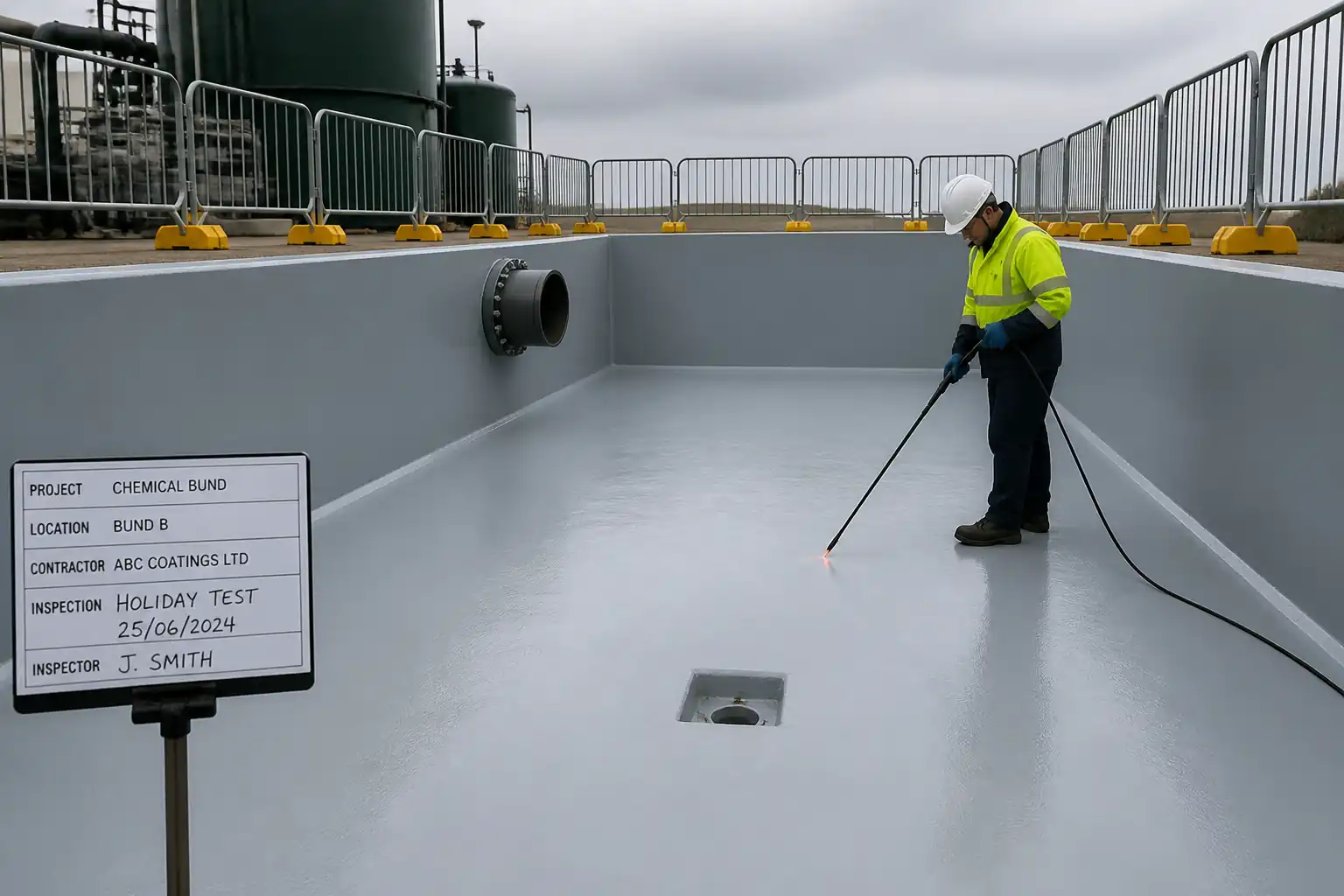
| 7 | Bund capacity validation (initial and after changes) | Calculate bund volume (internal dimensions minus displacement of plinths/racks). Verify ≥110% of largest container or 25% of total stored volume. Provide 100 mm freeboard. Hydro-test using clean water if new/modified. | Environmental Officer | Dimensional survey; hydrostatic hold (24 h) |
| 8 | Segregation and storage layout | Store by compatibility: acids away from bases; oxidizers separated from organics/flammables; fuels in flammables zone; use 60–120 min fire-rated partitions or ≥5 m separation where required [Verify]. No stacking of incompatible classes. Keep ignitions >3 m from flammables. | Chemical Officer / Stores | Layout check vs matrix |
| 9 | SDS station setup & control | Install weatherproof SDS station within 10–20 m of storage; index by product; ensure 24/7 access; maintain digital backup with QR code at racks. | Stores Supervisor | Document review |
| 10 | Spill kit placement and inspection | Provide spill kits sized to risk: at least one 240 L universal kit per compound plus satellite 60 L kits near transfer points. Weekly inspection and after each use; seal tags replaced. | HSE Officer / Spill Team | Kit inventory check |
| 11 | Fire extinguisher placement | Select types per hazard (AFFF/AR-AFFF for Class B, Dry Chem ABC, CO2). Place per NFPA 10/BS EN 3 travel distances (e.g., Class B 9–15 m typical depending rating) and at exits. Monthly inspections; annual servicing by certified vendor. | Fire Warden | Tag/checklist |
| 12 | Housekeeping and drainage control | Keep aisles clear; lids closed; funnels capped. Bund drains locked closed; rainwater tested (visual sheen, pH 6–9 [Verify]) before controlled discharge under permit or removed as waste. | Stores Supervisor / Environmental Officer | Weekly inspection |
| 13 | Training and emergency drills | Conduct induction and task-specific training; quarterly spill response and extinguisher drills; record attendance and outcomes. | HSE Manager | Drill evaluation |
Safety Controls (HSE)
Key Hazards and Controls
- Hazard: Flammable vapor ignition during fuel transfer
- Likely consequence: Fire/explosion causing severe injury and asset damage
- Engineering/procedural control: Bonding and grounding per NFPA 77; anti-static conductive hoses (EN 12115); initiate flow at low velocity; exclude ignition sources within 3 m; establish 5 m exclusion zone; continuous attendance and gas monitoring where required
- Required PPE: Anti-static footwear, flame-resistant coverall [Verify], chemical-resistant gloves suited to product, safety goggles/face shield
- Collective preventive measure: Zoned area classification and ignition source control; intrinsically safe equipment where required
-
Inspection/permit/supervision: Fuel Transfer Permit; bonding check recorded; Fire Warden/HSE Officer to supervise; extinguisher check prior to start
-
Hazard: Chemical splash during coupling/decanting
- Likely consequence: Eye/skin burns and inhalation injury
- Engineering/procedural control: Closed transfer systems and dry-break couplings; use of splash guards and drip trays; eyewash/shower within 10 s travel (ANSI Z358.1/EN 15154)
- Required PPE: Chemical goggles plus face shield; chemical-resistant gloves (per SDS permeation data); apron; long sleeves
- Collective preventive measure: Barrier screens at decant stations; segregation of pedestrian routes
-
Inspection/permit/supervision: Pre-use hose/coupling inspection; station checklist; HSE Officer spot checks
-
Hazard: Static build-up on plastic IBCs/drums during flammable transfer
- Likely consequence: Ignition source
- Engineering/procedural control: Use dip tubes with metal internal path; bonding to conductive insert; maintain low initial flow; humidity control where practicable
- Required PPE: Anti-static footwear/clothing
- Collective preventive measure: ATEX-rated pumps/flow meters in Zone-classified areas [Verify]
-
Inspection/permit/supervision: Equipment certification records; permit sign-off
-
Hazard: Vehicle movement and reversing in compound
- Likely consequence: Struck-by/crush injuries
- Engineering/procedural control: One-way system; banksman for reversing; wheel chocks; speed limit ≤10 km/h
- Required PPE: High-visibility vest, safety boots, helmet
- Collective preventive measure: Physical barriers and marked walkways
-
Inspection/permit/supervision: Traffic Management Plan; daily walk-through by Supervisor
-
Hazard: Manual handling of drums/IBCs
- Likely consequence: Musculoskeletal injuries, crush injuries
- Engineering/procedural control: Use drum trolleys/forklifts; no freehand rolling; secure loads; observe SWL limits
- Required PPE: Gloves, safety boots
- Collective preventive measure: Mechanical aids and training
-
Inspection/permit/supervision: Equipment pre-use checks; operator certification
-
Hazard: Falls into open bunds or from vehicles
- Likely consequence: Fractures/head injury
- Engineering/procedural control: Maintain bund grates/walkovers; use three-point contact on vehicles; lighting ≥100 lux
- Required PPE: Helmet, non-slip footwear
- Collective preventive measure: Guardrails where feasible; signage
-
Inspection/permit/supervision: Weekly inspection; night-work permit if applicable
-
Hazard: Incompatible chemical mixing due to mis-storage
- Likely consequence: Violent reaction, toxic gas release, heat/fire
- Engineering/procedural control: Segregation matrix; barcode-based location control; double-check by Chemical Officer before placement
- Required PPE: As per SDS
- Collective preventive measure: Physical partitions/fire-rated cabinets for corrosives/oxidizers
-
Inspection/permit/supervision: ITP hold point on initial setup and after layout change
-
Hazard: Noise from pumps/vehicles
- Likely consequence: Hearing damage
- Engineering/procedural control: Maintain equipment; restrict exposure time
- Required PPE: Hearing protection where levels >85 dB(A) [Verify]
- Collective preventive measure: Acoustic signage and barriers
-
Inspection/permit/supervision: Noise assessment records
-
Hazard: Night operations/poor visibility
- Likely consequence: Increased incident risk
- Engineering/procedural control: Task lighting; reflective PPE; suspend operations under inadequate visibility
- Required PPE: High-visibility clothing
- Collective preventive measure: Temporary lighting towers, emergency lighting
- Inspection/permit/supervision: Lighting lux checks; supervisor authorization
Note: Implement all controls per project HSE plan and local regulations [Verify per project HSE plan and local regulations].
Environmental Controls
- Secondary containment: Provide bunds sized to ≥110% largest container or 25% aggregate volume with 100 mm freeboard [Verify]. Impermeable lining (k ≤ 1×10^-9 m/s) and sealed joints.
- Drainage protection: Keep bund drains locked closed. Use drain covers at nearby gullies during offloading. Install penstock valves for isolation where practicable.
- Rainwater management: Inspect bund water weekly and after rainfall. If no sheen and pH 6–9 [Verify], discharge under permit; otherwise, pump to IBC for off-site disposal as hazardous waste.
- Spill prevention: Fit drip trays at all static connections; maintain hose integrity; schedule preventive maintenance.
- Spill response: First contain (booms, socks), then absorb (pads, granules), then collect and label as hazardous waste. Protect surface water with booms/drain mats.
- Waste management: Segregate hazardous waste; use UN-rated containers; label with content, hazard, and date; store in waste bunded area; arrange licensed disposal with consignment notes.
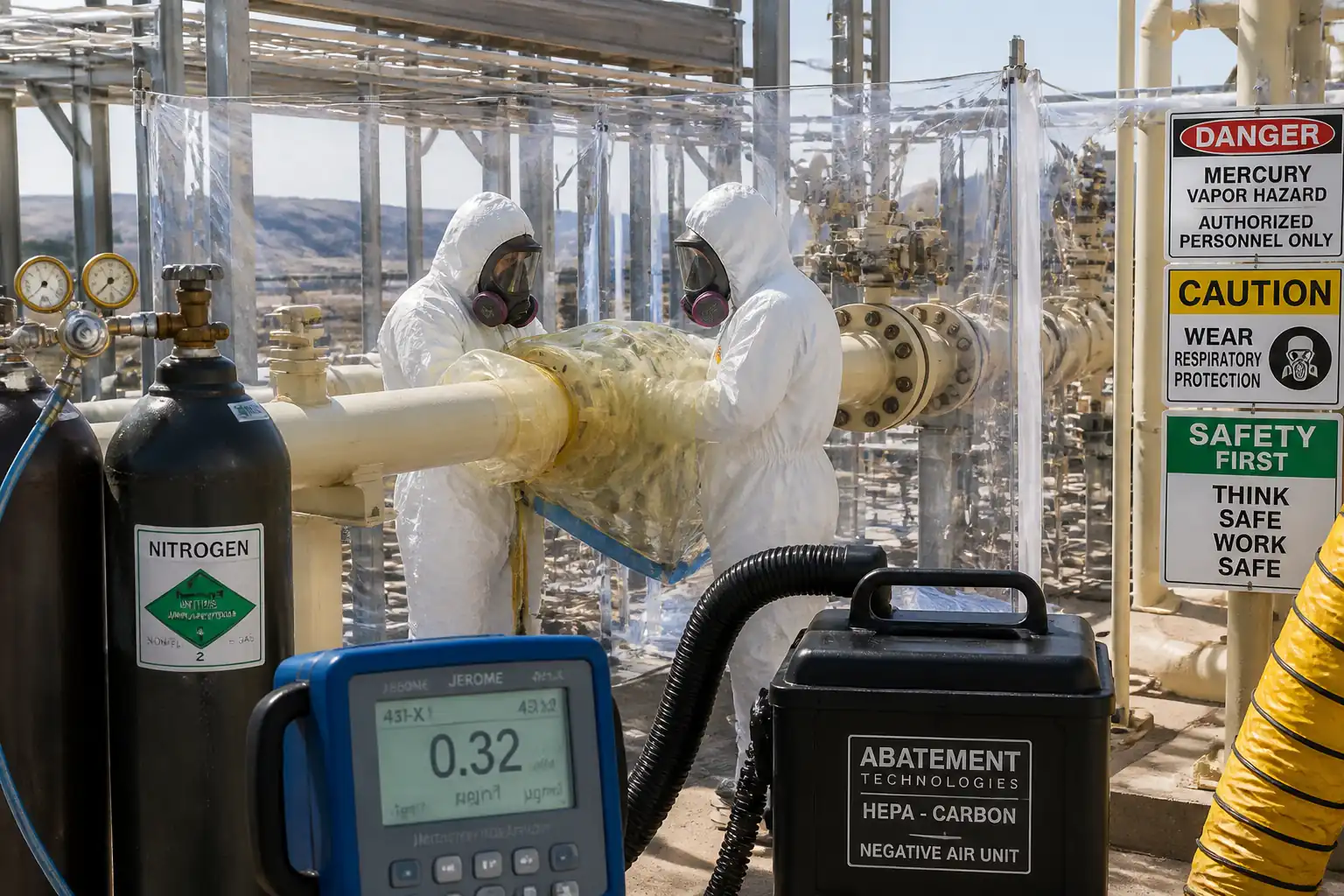
- Air emissions: Minimize open transfers; keep lids closed; use low-VOC products where feasible; employ carbon filters/fume extraction if indicated by risk assessment.
- Soil/groundwater: No storage directly on bare ground; use intact slabs; immediate remediation of stained areas.
- Housekeeping: Daily inspection for leaks, corroded drums, or degraded labels; rectify within 24 h.
- Records: Maintain logs for bund inspections, spill kit checks, rainwater discharge permits, and waste consignments (retain ≥5 years or per law).
Quality Assurance / Quality Control
- Document control: All SDS, permits, inspection forms, and layout drawings controlled per project quality procedures.
- Competency: Verify training and certification of operators, forklift drivers, Fire Wardens, and spill responders before assignment.
- Equipment verification: Calibration/bump test records for gas detectors; inspection tags for hoses, pumps, and slings; extinguisher service certificates.
- ITP compliance: Hold/witness points implemented for bund capacity validation, segregation setup, first delivery, and fire equipment placement.
- Nonconformance: Record NCRs for any deviations (e.g., missing SDS, incompatible storage, overdue extinguisher service); implement corrective actions and verify closure.
- Audit: Monthly internal audit of the compound including segregation, records, and emergency equipment readiness; report with action tracker.
- Change management: Re-validate bund capacity and segregation when storage configuration or inventory changes beyond 10% volume or product classes change [Verify].
- Traceability: Delivery to disposal traceability maintained via batch numbers, inventory logs, and waste consignment notes.
Attachments
- Bund capacity calculation template (include dimensions, displacement, freeboard allowance).
- Storage compound layout drawing (showing segregation zones, exits, eyewash/shower, spill kit stations, extinguisher locations, and travel distances).
- Chemical compatibility/segregation matrix (GHS classes, examples: acids/bases/oxidizers/flammables).
- Delivery and offloading checklist (permit, bonds, hoses, drip trays, PPE, supervision, emergency equipment).
- Spill kit weekly inspection log (inventory, seal numbers, replenishment actions).
- Fire extinguisher inspection tag template and register.
- Rainwater testing and controlled discharge form (visual sheen, pH, permit reference).
- Training matrix and drill record forms.
- Emergency contacts and spill response flowchart.
This content is a read-only public reference. Download or customize to get an editable version.
ITP preview
The first inspection activities from the linked ITP for Method Statement: Hazardous Chemical and Fuel Delivery, Secondary Containment, and Storage Compound Management:
| Activity | Inspection / Test | Acceptance Criteria | Responsibility | Record |
|---|---|---|---|---|
| Pre-delivery documentation review | Permit approved; SDS received and reviewed; delivery plan endorsed. | Logistics Coordinator / HSE | Permit-to-deliver; SDS receipt log | |
| Offloading setup (exclusion, signage, drip trays) | Barriers in place; trays positioned; extinguishers available within code travel distance. | Stores Supervisor | Offloading checklist | |
| Bonding/grounding verification | Secure bonds; resistance to earth <10 Ω target [Verify]. | HSE Officer | Transfer log; checklist |
Showing 3 of 11 inspection activities. View full ITP →
Related Inspection and Test Plan
An Inspection and Test Plan (ITP) is available for Method Statement: Hazardous Chemical and Fuel Delivery, Secondary Containment, and Storage Compound Management. The ITP defines the inspection activities, acceptance criteria, hold and witness points, responsible parties, and records required to verify the work described in this method statement.
View the Method Statement: Hazardous Chemical and Fuel Delivery, Secondary Containment, and Storage Compound Management ITP →Frequently asked questions
Continue with related Quollnet resources connected to this method statement.