Defects Liability Period (DLP): Notifications, Repairs and Final Handover
The Defects Liability Period (DLP) is the post-handover period used to identify, notify and remedy qualifying construction defects under a contract. FIDIC uses Defects Notification Period (DNP), JCT uses Rectification Period, and NEC distinguishes the defects date from each defect correction period. The expiry of a notification deadline does not necessarily end the duty to repair validly notified defects or automatically release retention and guarantees.
What is the Defects Liability Period?
The Defects Liability Period (DLP) is the familiar construction term for contractual post-handover defect management. Following taking-over or practical completion, the employer can report qualifying defects in workmanship, materials or other contractor-responsible work, and the contractor must address them under the applicable contract. The objective is to deliver a functioning asset and provide a defined mechanism for defects that become apparent during occupation and operation.
The DLP is not an alternative to completion inspections. A contract may permit some minor outstanding work at taking-over, but serious noncompliance, incomplete testing or unsafe systems should not simply be relabelled as routine future snags. See open NCRs at taking-over for the distinction.
There is no universal DLP of 12 or 24 months. The duration, start date, applicable sections, notices, rectification and release conditions must be checked in the signed contract and its amendments. Equipment warranties and statutory liabilities may run on different schedules.
DLP, DNP, Rectification Period and Defect Correction Period: what is the difference?
The terminology matters because it identifies different deadlines and obligations, not just different names for a universal defect warranty.
| Term | Common contract setting | Primary purpose |
|---|---|---|
| DLP (Defects Liability Period) | General usage and older forms | Broad label for the post-handover defects process |
| DNP (Defects Notification Period) | FIDIC 1999 and 2017 | Ordinary period during which qualifying defects or damage may be notified |
| Rectification Period | Modern JCT | Period governing notified defects and making good under the chosen form |
| Defects date | NEC Engineering and Construction Contract (ECC) | Cut-off for its ordinary defects notification procedure |
| Defect correction period | NEC | Time permitted for correcting a particular defect |
None of these expressions necessarily means that the contractor becomes free of all defect liabilities when a calendar date passes. The ability to notify a new defect, the obligation to finish a previously notified repair, and latent-defect liability must be assessed separately.
FIDIC: Defects Notification Period (DNP)
FIDIC Red Book 1999 and 2017 use Defects Notification Period. In the published FIDIC 2017 definition, the period in the Contract Data applies; where no period is stated, the default is one year. The applicable start date is linked to completion of the relevant Works, Section or Part. The agreed Particular Conditions may change how the mechanism operates.
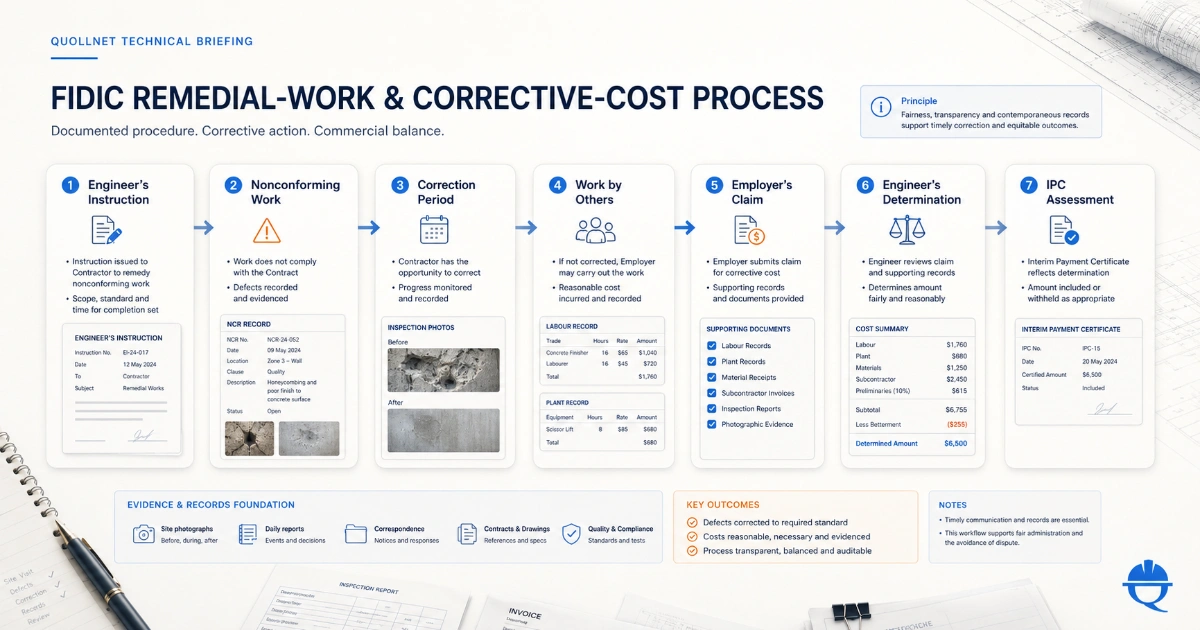
FIDIC Clause 11 addresses completion of outstanding work, remedying notified defects, the cost of rectification, possible extension of the DNP and the Performance Certificate. A defect validly notified toward the end of the DNP may require repair afterward. A few outstanding minor snags do not automatically extend the DNP; an extension requires a valid contractual basis and procedure. The Performance Certificate is a separate contractual milestone, not automatically issued just because the original DNP end date has arrived.
JCT: Rectification Period and Certificate of Making Good
Modern JCT forms commonly use Rectification Period. The contractor may have to return and make good defects notified under the contract, while the employer's representative administers the required notices and certificates. Certain JCT forms, including arrangements discussed under the 2016 editions, permit a schedule of defects within a specified 14-day period after Rectification Period expiry. This is not a rule to apply indiscriminately to every form or edition; check the actual signed conditions.
The Certificate of Making Good follows the relevant completion-of-rectification process and can affect retention and final-certification timing. The end of the Rectification Period is not necessarily the date all money becomes payable.
NEC: defects date and defect correction period
NEC4 ECC does not use DLP as the principal contractual term. It specifies a defects date and one or more defect correction periods. The Supervisor and Contractor notify defects in accordance with the relevant terms, and the correction period governs the time allowed to address an individual defect. NEC's guidance explicitly separates the defects date from the correction obligation.
Deadline warning: NEC's own interpretation of its defined defects date treats a defect notified on the defects date as too late for the ordinary notification process: notification should be before that date. Do not transfer a casual “on the last day of DLP” assumption into an NEC notice. The Supervisor's defects certificate may record defects that were notified but remain uncorrected, and the contractor's liability does not simply vanish when the defects date passes.
When does the defects period begin after handover?
The correct trigger may be a Taking-Over Certificate, practical completion or contractually defined completion of the relevant section. The date a property manager takes possession or residents begin occupying the building is not necessarily the contractual start date. For phased developments, separate towers, building sections or systems may have distinct timelines. NEC also illustrates how early taking-over of part of the works need not shift the defects date set in Contract Data for the whole works.
At handover, prepare a dated record showing the relevant completed sections, open permitted items, as-built and operations manuals, commissioning and testing records, certificates, keys, training, warranties and contacts for formal notices. Distinguish an outstanding work item already known at handover from a new defect arising during use.
What is the role of a property management company during DLP?
Large residential, commercial, healthcare and mixed-use projects are frequently operated by a property or facilities management company after handover. The facilities team may receive complaints from occupants and identify leaks, equipment failures, poor finishes or operational problems. Its records can be valuable evidence, but the property manager does not automatically have authority to issue binding contract notices, approve variations, certify repairs or order a guarantee call.
| Party | Typical responsibility |
|---|---|
| Occupant / facilities operator | Report issues, preserve evidence, document usage and maintenance, arrange access |
| Employer | Exercise employer rights through authorized procedures and representatives |
| Engineer / contract administrator / Supervisor | Issue or administer required notices, verification and certificates within assigned authority |
| Contractor | Investigate, respond, coordinate access, remedy qualifying defects and submit close-out evidence |
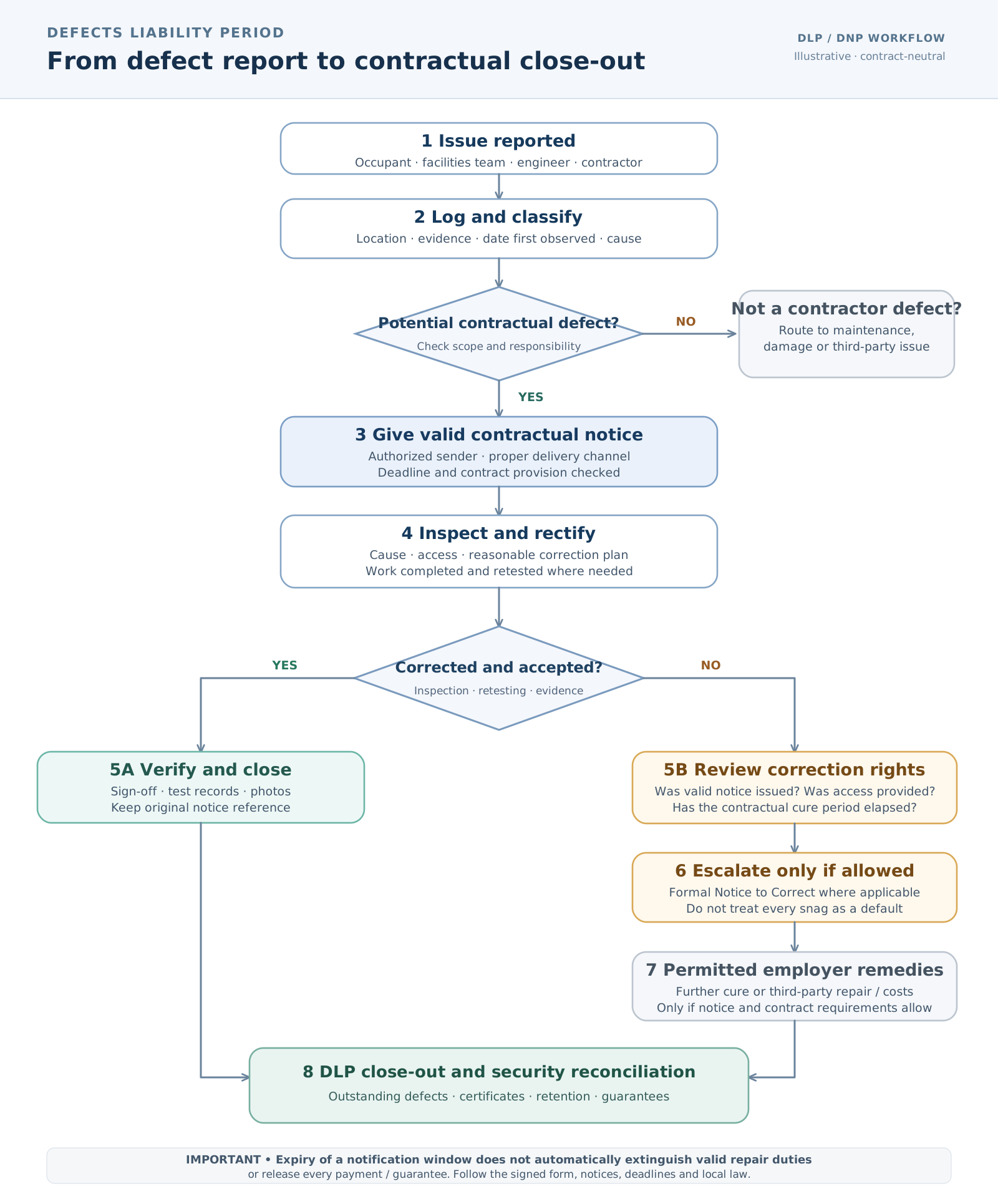
Set up an explicit escalation rule: service request → technical investigation → authorized contractual notification → rectification and verification. A maintenance ticket is not necessarily a valid contract notice just because it was entered before DLP expiry.
Is every snag a construction defect?
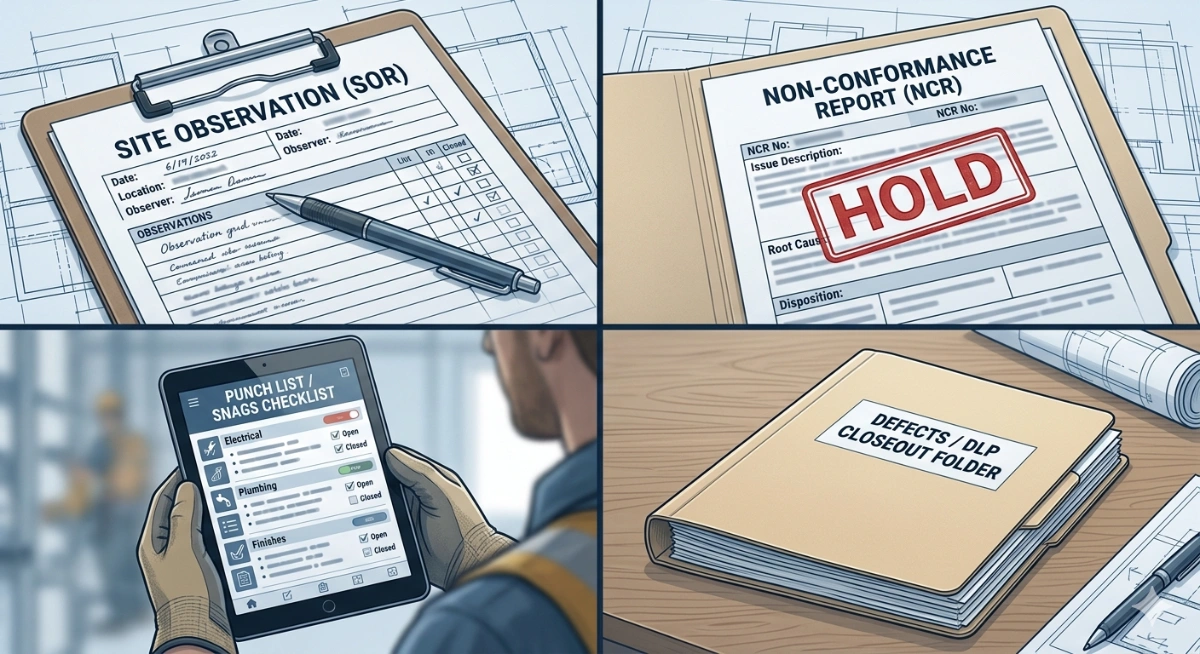
No. Snags can be incomplete finishing items, service complaints, true contract defects, damage after occupation or ordinary maintenance problems. A defect must be evaluated against the contract's technical requirements and allocation of responsibility. See Observation vs NCR vs Snag vs Defect for the record distinctions.
| Reported issue | Investigation | Possible finding |
|---|---|---|
| Leak at roof waterproofing | Membrane workmanship, penetrations, later-trade damage, testing history | Contract defect or subsequent damage, depending on cause |
| Air-conditioning performance problem | Installation, commissioning, filters, controls, maintenance and training | Contract defect or improper operation |
| Door damaged months after occupation | Hardware fault versus occupant impact | Defect or user-caused damage |
| Incomplete fire-stopping at taking-over | Previously recorded outstanding item or unresolved noncompliance | Not merely a new cosmetic snag |
Photographs alone may not establish cause. Record location, first observation, test results, maintenance logs, specification, access history and both parties' technical responses. Contractors should not dismiss every report as misuse; employers should not assume every failed component is defective workmanship.
The right workflow: continuous notification and rectification
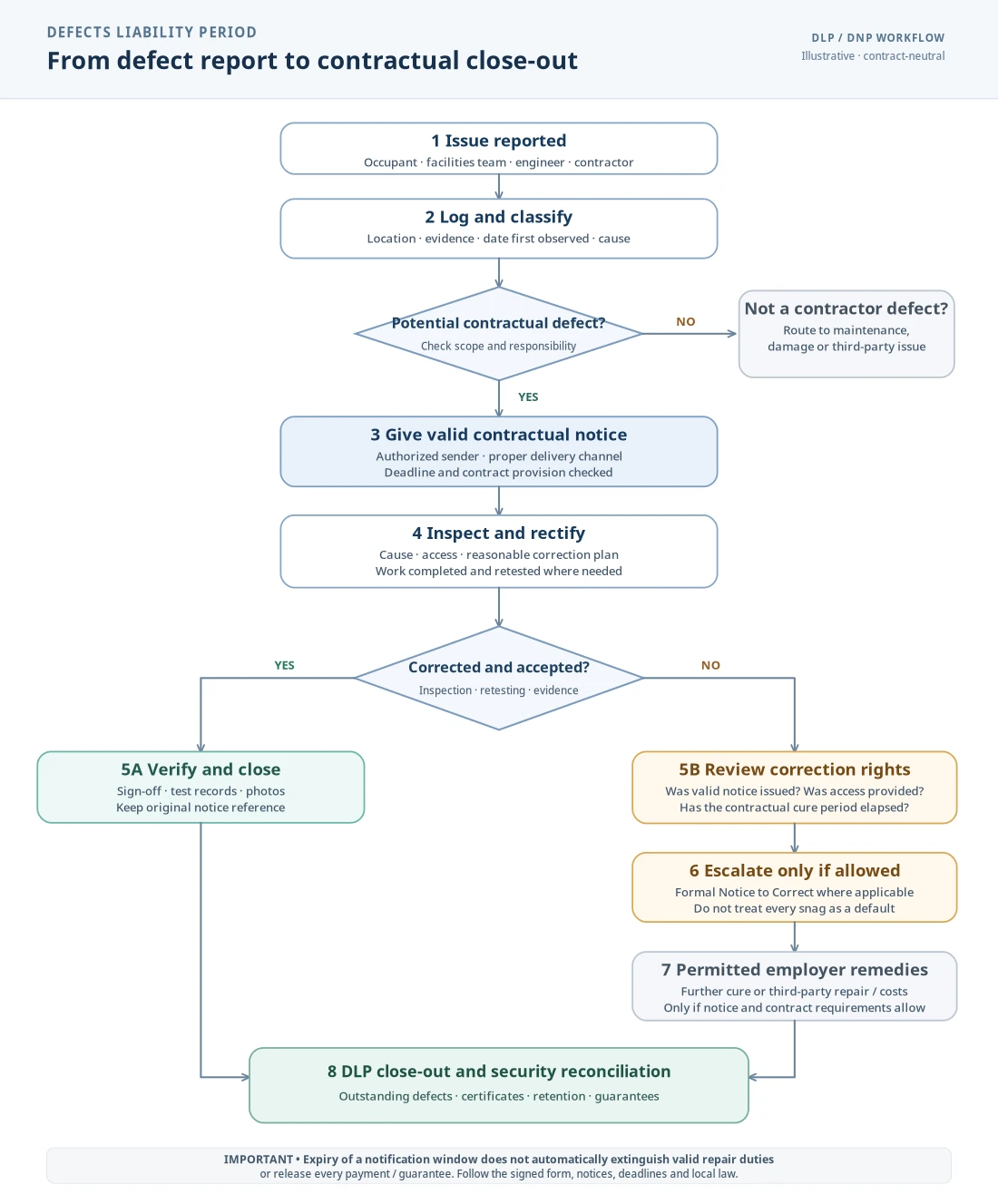
The DLP should function as an ongoing defect management process, not as eleven months of silence followed by a large final-day snag list. A shared defect register protects employer operations while giving contractors a reasonable chance to diagnose and repair issues efficiently.
Which register should be used? Maintain a DLP defects register for complaints, locations, notice dates, contractor responses, rectification and acceptance. Where an issue is a formal technical nonconformity, also record it in the NCR register and cross-reference the relevant defect ID rather than assuming that an NCR automatically constitutes a contractual defect notice. The Quollnet NCR Log Template (Excel/PDF, with a completed example) provides a practical register for those nonconformance records. The contract determines who must issue formal notices and how they must be delivered.
- Record the incident: location, date first noticed, description, photos, affected systems and operational risk.
- Screen the issue: classify possible contract defect, unfinished work, maintenance need or occupant/third-party damage.
- Send the proper notice: authorized person, correct recipient, prescribed channel and time limit.
- Inspect together: determine likely cause, required tests, responsibility and site-access arrangements.
- Agree a repair programme: safe method, materials, shutdowns, timing and interim mitigation if needed.
- Carry out and verify repairs: keep photographs, tests, warranties and signed inspection records.
- Close the defect: record verification outcome and any disagreements without obscuring the original notification history.
A joint pre-expiry inspection is good practice, but it does not override the actual notice deadline. A monthly register review and a formal close-out review before expiry are preferable to relying solely on a final inspection.
Can the employer notify defects on the last day?
Potentially yes, if the actual contract and notification rules permit it. A timely defect notice can require the contractor to complete repairs after the ordinary notification window closes. The fact that repairs take longer does not by itself extend the time for issuing new ordinary notices.
But the detail matters. Under NEC, published guidance treats notification on the defects date itself as outside the normal deadline. Under certain JCT forms, a defined short post-expiry mechanism may apply. Under FIDIC the DNP is the relevant notification period, with extension only in qualifying circumstances and according to the chosen edition's provisions.
Illustrative 12-month DLP of a residential tower
| Stage | Work to be done | Critical check |
|---|---|---|
| Taking-over | Handover documents; identify outstanding items and dates | Has the relevant part genuinely been taken over? |
| Months 1–10 | Log, notify, investigate and repair defects continuously | Were formal notices issued correctly? |
| Month 11 | Joint inspection and review of outstanding defects | Are access, responsibility and correction plans agreed? |
| Near expiry | Issue final timely notices, reconcile register | What precisely is the contractual cut-off? |
| After expiry | Finish notified repairs and issue required close-out certificates | Are any extensions or payment/security conditions valid? |
The purpose of an end date is to set contractual certainty about ordinary notifications. It is not permission to ignore an existing valid defect; nor is it permission to extend notification indefinitely by relabelling every late complaint a snag.
Contractor's rights and employer's rights during rectification
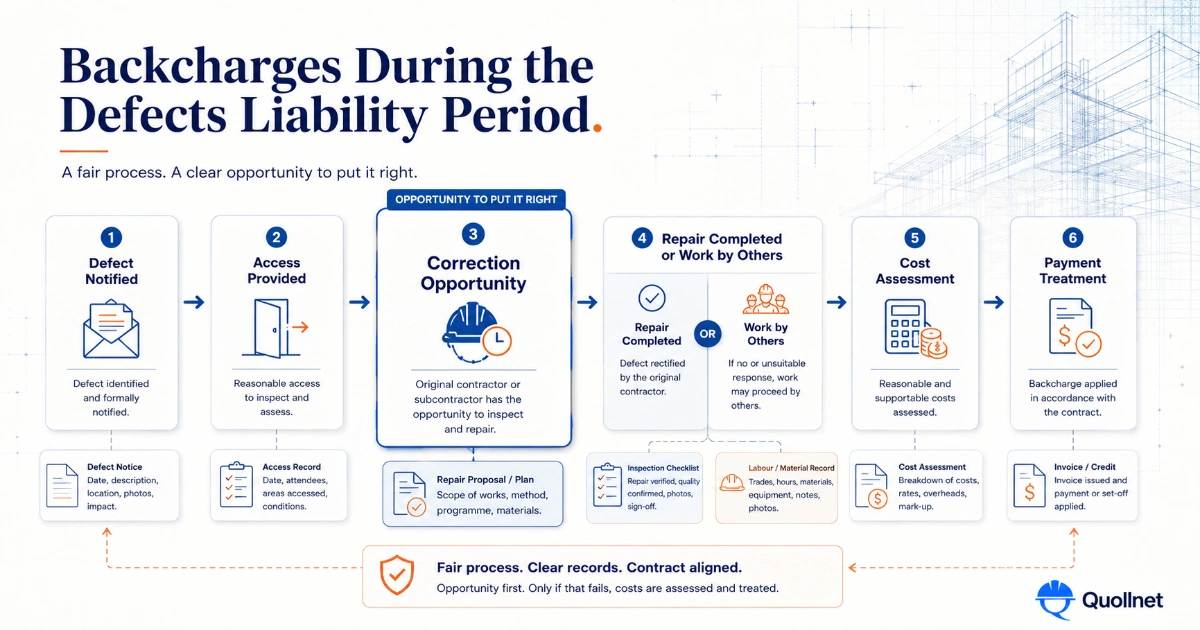
Where a defect is genuinely attributable to the contractor, the contractor should respond and rectify in accordance with its contractual obligations, even when the repair continues after the notification cut-off. A contract may provide the contractor an opportunity or right to make good before the employer engages others. The contractor should document notice dates, responses, site access, attempted repair, retesting and reasons for disputed responsibility.
The employer is entitled to the agreed standard of work and the contract's remedies for defects or failure to repair. But normal wear, damaged components through third parties, unsuitable maintenance or operating misuse should be investigated before assigning cost. If a property manager denies the contractor access to an occupied apartment or plant room, record the restriction rather than presuming every delay is contractor-caused.
Emergency intervention to protect life, property or continuity of essential services may be justified, but causes, evidence, necessity, notices and recoverable costs must still be evaluated under the contract.
If the contractor does not rectify, can the employer repair and backcharge?
Sometimes. The employer may be entitled to engage others and recover properly assessed corrective costs following the contractual notice, reasonable opportunity to repair and failure-to-remedy procedure. It is not automatic simply because the facilities manager has produced a list of open tickets. Cost causation, scope, documented expenditure and payment notice requirements may matter.
See Backcharges During the Defects Liability Period: Who Has the Right to Repair? and Notice to Correct in Construction for these separate remedies.
What does DLP expiry actually close?
Four dates are often wrongly treated as one: the ordinary defect-notification deadline, the deadline to finish an individual repair, issue of the relevant defects or making-good certificate, and payment or discharge of security. These events may occur weeks or months apart. Under FIDIC, the Performance Certificate process is important; under JCT, the Certificate of Making Good may affect payment; under NEC, the Defects Certificate can identify defects notified but not yet corrected.
Some forms permit limited extensions of the ordinary notification period. Such extensions must be justified by their terms; outstanding minor snags do not automatically reset a full year. Separately, latent defects and statutory claims may survive the contractual window. Those possible rights depend on applicable law and contract terms and should not be confused with an unlimited right to add new routine DLP notices.
Retention, performance security and bank guarantee release
Expiry of a defects period is not necessarily the date the contractor receives retained money or has its guarantee discharged. Some contracts make certification or completion of specified outstanding works a separate condition. The employer cannot simply assume that any minor snag justifies withholding every dollar or calling the entire security instrument; equally, the contractor cannot assume the bank guarantee is discharged merely because the intended period ended.
For example, if a retention guarantee for $50,000 is expected to be discharged at the end of 12 months but legitimate close-out is delayed, an extension may generate bank commission and consume facility capacity. An uncalled guarantee usually expires without repayment of its face value; a guarantee paid on a valid full or partial call can require reimbursement to the bank. The contract and guarantee wording determine the actual obligations. See Construction Retention: Caps, Guarantees and Cash Flow for the worked payment and financing examples.
DLP close-out checklist
- Verify the contract edition, definitions, start and expiry dates for each section.
- Check which persons can issue defect notices and certify correction or close-out.
- Carry forward handover punch-list items separately from newly discovered defects.
- Maintain a defect register with dates, formal notice references, evidence and repair status.
- Investigate causes and distinguish actual defects from normal maintenance or user damage.
- Coordinate safe access for repairs to occupied buildings and operational systems.
- Schedule joint inspections early enough to allow practical rectification.
- Check the exact contractual deadline, particularly for NEC and JCT forms.
- Document justified extensions, unresolved repairs and the responsible party.
- Reconcile certificates, retention release, guarantees, bank fees and actual payment dates.
Key conclusion: Manage the defects period continuously; respect the notification cut-off; finish validly notified repairs; and treat formal close-out and security release as separate contractual steps.
References
FIDIC Terms — Defects Notification Period definition, 2017
FIDIC — Questions and answers on DNP and Performance Certificate
NEC Contracts — Determining the defects date
NEC Contracts — Last day to search for or notify defects