Review Façade Performance Test Matrix and Responsibilities
Definition: Review façade performance test matrix and contractual responsibilities equips construction teams to validate required building-envelope tests, align roles, schedule witness points, and capture calibrated evidence for air, water, structural, movement, thermal, and acoustic performance.
Verify complete test coverage with clear acceptance criteria and hold points
Assign accountable parties and notification periods to prevent missed witness tests
Standardize procedures, instruments, and evidence to reduce retests and disputes
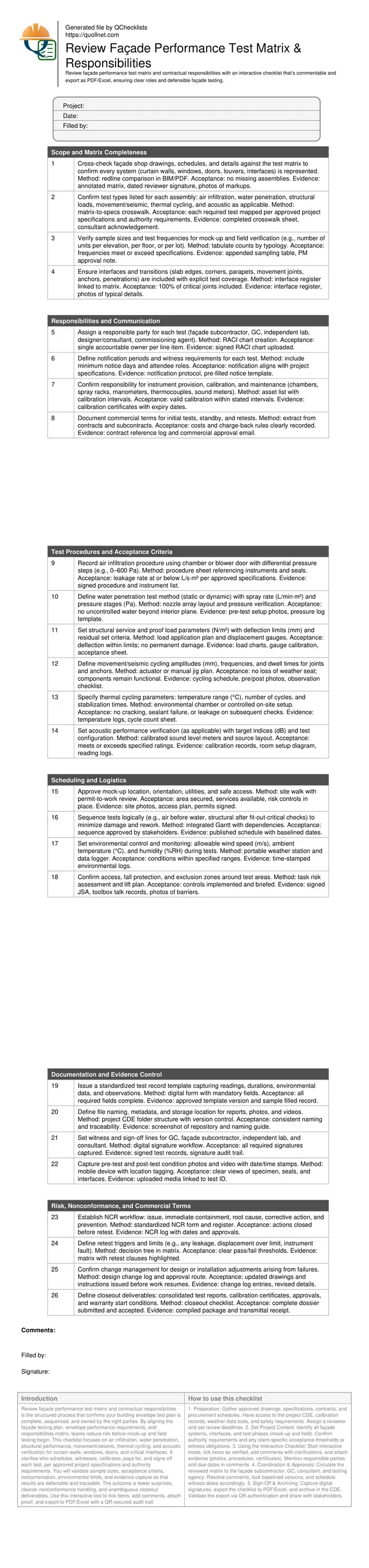
Interactive, commentable checklist with export and QR code-secured sign-offs
Start Interactive Checklist
Review façade performance test matrix and contractual responsibilities is the structured process that confirms your building envelope test plan is complete, sequenced, and owned by the right parties. By aligning the façade testing plan, envelope performance requirements, and responsibilities matrix, teams reduce risk before mock-up and field testing begin. This checklist focuses on air infiltration, water penetration, structural performance, movement/seismic, thermal cycling, and acoustic verification for curtain walls, windows, doors, and critical interfaces. It clarifies who schedules, witnesses, calibrates, pays for, and signs off each test, per approved project specifications and authority requirements. You will validate sample sizes, acceptance criteria, instrumentation, environmental limits, and evidence capture so that results are defensible and traceable. The outcome is fewer surprises, cleaner nonconformance handling, and unambiguous closeout deliverables. Use this interactive tool to tick items, add comments, attach proof, and export to PDF/Excel with a QR-secured audit trail.
Establishes a complete façade performance test matrix that covers all relevant systems, interfaces, and conditions, with defined acceptance criteria, calibrated instruments, and environmental limits to ensure results are valid, repeatable, and defensible across mock-up and field testing phases.
Clarifies contractual responsibilities by mapping who prepares plans, pays for tests and retests, provides access, issues notifications, witnesses, and signs off, minimizing disputes and enabling timely, coordinated execution across the project supply chain and stakeholders.
Reduces rework and program risk by sequencing tests logically, locking down sample sizes and frequencies, and setting explicit thresholds for nonconformances, retest triggers, and design changes, while maintaining a clear, version-controlled evidence repository for all parties.
Interactive online checklist with tick, comment, and export features secured by QR code. Field teams capture readings, photos, and signatures; managers receive structured records aligned with approved project specifications and authority requirements for smooth closeout.
Scope and Matrix Completeness
Responsibilities and Communication
Test Procedures and Acceptance Criteria
Scheduling and Logistics
Documentation and Evidence Control
Risk, Nonconformance, and Commercial Terms
Interpreting the Façade Test Matrix with Practical Acceptance Cues
A robust façade test matrix starts by mapping each assembly and interface to the exact tests, parameters, and acceptance criteria. For air infiltration, confirm the differential pressure range in pascals and the allowable leakage rate in L/s·m². For water penetration, verify spray rate in L/min·m², exposure duration, and pressure stages. Structural checks should include service and proof load levels in N/m², plus deflection limits in millimetres and residual set. Movement testing needs amplitudes, cycles, and allowable distress, while thermal cycling must define temperature range and stabilization times. Where acoustic verification applies, ensure target indices in decibels and measurement positions are defined. Acceptance should be objective and measurable, not descriptive; tie every parameter to “per approved project specifications and authority requirements.” Include environmental bounds (wind, temperature, humidity) and instrument calibration evidence so results remain credible and repeatable. Seal the matrix with a crosswalk showing that no systems, corners, penetrations, or joints have been missed.
Define parameters with SI units and measurable thresholds
Set environmental limits and log them during tests
Attach calibration certificates with expiry dates
Include interfaces and atypical conditions explicitly
Crosswalk matrix to drawings and specifications
Clarifying Contractual Responsibilities to Avoid Test-Day Disputes
Responsibilities must be clear before test day. Assign who prepares procedures, provides and calibrates instruments, notifies witnesses, sets up access, runs tests, records results, and signs off. Use a RACI to show accountability and prevent overlaps. Notification periods and witness roles should reflect the specifications so observers arrive prepared. Document commercial terms for initial tests, standby, failures, and retests to avoid cost disputes. Lock down safety ownership for exclusion zones and fall protection. Agree on evidence standards: photos, videos, logs, and signatures. Finally, define the nonconformance pathway: how issues are recorded, contained, investigated, corrected, and retested. A clean chain of responsibility shortens cycles and removes ambiguity, allowing project teams to maintain program and quality while protecting commercial positions.
Publish a signed RACI for every test line
Set notification periods and witness lists
Codify retest and standby cost allocations
Define safety ownership and access controls
Standardize evidence and sign-off workflow
Evidence Management, Sequencing, and Closeout for Reliable Outcomes
Testing succeeds when logistics and records are tight. Approve mock-up locations and on-site setups with utilities and secure access. Sequence air before water and perform structural checks after sensitive finishes where practical. Monitor ambient conditions with a weather station and log wind speed, temperature, and humidity to confirm compliance. Use standardized digital forms so all readings, durations, and observations are complete, time-stamped, and easily retrievable. Pre- and post-test media should focus on seals, corners, and interfaces. Implement version-controlled storage so teams can trace revisions and calibration status. Define retest triggers upfront and link them to NCR processes. At the end, compile a complete dossier with reports, certificates, approvals, and warranty conditions—submitted and acknowledged. This discipline reduces retests, speeds acceptance, and leaves a defensible audit trail.
Approve setups and sequence tests logically
Log ambient conditions alongside readings
Use standardized, mandatory digital forms
Store media and reports in a versioned CDE
Submit a complete closeout dossier
How to Use This Façade Test Matrix Review Checklist
Preparation: Gather approved drawings, specifications, contracts, and procurement schedules. Have access to the project CDE, calibration records, weather data tools, and safety requirements. Assign a reviewer and set review deadlines.
Set Project Context: Identify all façade systems, interfaces, and test phases (mock-up and field). Confirm authority requirements and any client-specific acceptance thresholds or witness obligations.
Using the Interactive Checklist: Start interactive mode, tick items as verified, add comments with clarifications, and attach evidence (photos, procedures, certificates). Mention responsible parties and due dates in comments.
Coordination & Approvals: Circulate the reviewed matrix to the façade subcontractor, GC, consultant, and testing agency. Resolve comments, lock baselined versions, and schedule witness dates accordingly.
Sign-Off & Archiving: Capture digital signatures, export the checklist to PDF/Excel, and archive in the CDE. Validate the export via QR authentication and share with stakeholders.
Question: What tests should a façade performance test matrix typically include?
Most projects require air infiltration, water penetration, structural service/proof loads, movement or seismic cycling, and thermal cycling. Acoustic verification may apply where sound isolation is critical. Always align test types, parameters, and acceptance criteria with approved project specifications and authority requirements, and include critical interfaces and atypical conditions.
Question: Who is responsible for providing calibrated test equipment?
Responsibility should be assigned in the matrix and contracts. Typically, the testing agency or façade subcontractor provides equipment, while the GC ensures safe access and area controls. Calibration must be current at test time, with certificates uploaded to the record and dates matching stated validity periods.
Question: How do we decide how many units to test on-site?
Determine sampling by system typology, risk, and specification frequency requirements. Start from mock-up results, then apply field test percentages per elevation, floor, or lot. Document the rationale in a sampling table, confirm it meets or exceeds the specifications, and obtain the consultant’s written acknowledgement before scheduling.
Question: What evidence is needed to close out façade performance testing?
Provide signed test records, calibration certificates, environmental logs, photos and videos before and after, witness sign-offs, NCRs with closures, and a summary report confirming compliance with acceptance criteria. Export the final package to PDF/Excel, secure it with a QR-authenticated link, and store it in the project CDE.
Related Articles
Broader reading and guidance connected to this checklist topic.
I
en
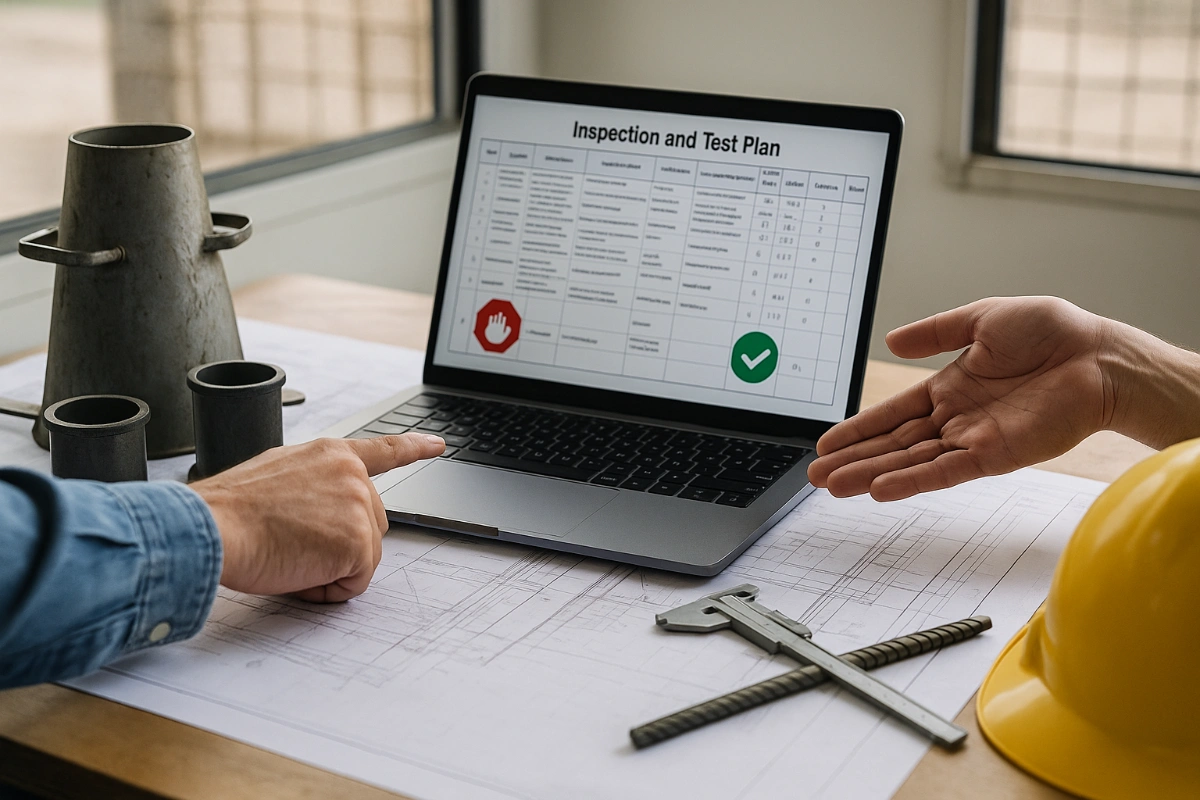
Inspection & Test Plan (itp) In Construction — Complete Guide, Templates & Legal Essentials
Learn how to write an ITP (Inspection & Test Plan) for construction—templates, hold/witness points, acceptance criteria, ISO 9001 alignment, and FIDIC...
Article2026-05-29
C
en
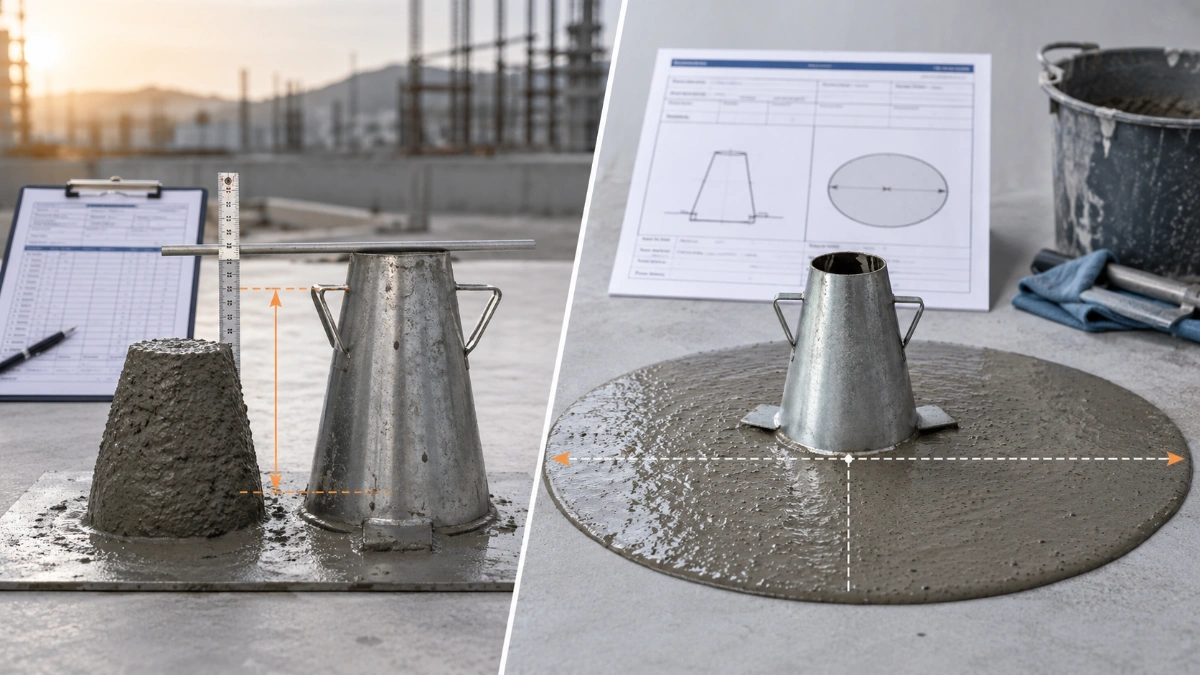
Concrete Core Test Guide: Astm C42, Aci 318-25 & Bs En 13791
Learn how to use QChecklists to create checklist templates, launch live checklist runs, add comments and attachments, collaborate with team members, o...
Inspect façade handover documentation and test certificates for completeness to close out the building envelope confidently and transparently. This ch...
Inspect façade O&M manuals, warranties, and maintenance guidance at closeout is the critical final quality gate for building envelopes. This checklist...
Inspect façade mock-up scope and acceptance criteria before fabrication. This checklist guides a comprehensive façade mockup review, aligning visual b...
Review façade handover deliverables, warranties, and O&M requirements in design establishes exactly what the contractor and suppliers must submit for ...
Façade Mock-Up Review Checklist helps teams verify that the façade performance mock-up and its acceptance criteria are clearly defined in the project ...