Review façade material compatibility before design release
Definition: Review façade material compatibility before design release for architects, façade engineers, and QA leads, verifying chemical, galvanic, fire, and hygrothermal fit across assemblies before issuing construction documents.
- Verify metals, sealants, membranes, and fixings will not interact adversely
- Prevent corrosion, staining, delamination, and fire performance downgrades
- Use manufacturer data, calculations, and mockups to prove compatibility
- Interactive, commentable, export with QR code for authenticated sign-off
Review façade material compatibility before design release is the critical gate that prevents costly rework and premature failures. This façade materials compatibility check focuses on how metals, sealants, gaskets, membranes, coatings, and fixings interact across the envelope. By conducting a thorough envelope interface review before drawings are frozen, teams mitigate galvanic corrosion, chemical attack, plasticizer migration, staining, loss of adhesion, and thermal or moisture traps. The checklist targets cladding system compatibility at contact points, bonded joints, interfaces with fire-stopping, and transitions to glazing and roofing. It standardizes evidence from manufacturer guidance, lab data, and calculations, ensuring selections meet performance criteria per approved project specifications and authority requirements. Outcomes include durable assemblies, fewer RFIs, faster submittal approvals, and a clear audit trail for sign-off. Use this interactive tool to assign actions, attach photos, record product data, and capture approvals. Start in interactive mode to tick, add comments, and export PDF/Excel with a QR-secured record.
- Validate chemistry, galvanic potential, and movement tolerance between metals, sealants, membranes, insulation, and fixings before issuing construction documents. Early verification avoids staining, corrosion, bond failure, and thermal bridging while aligning selections with manufacturer limitations and project performance criteria.
- Create a material pairings matrix linked to drawing details, datasheets, and calculation outputs. Document isolation layers, primers, joint dimensions, and temperature ranges. Require evidence such as pull tests, compatibility letters, and thermal analyses to support every approval decision.
- Coordinate fire and smoke containment systems with adjacent substrates so adhesives, coatings, or gaskets do not compromise tested ratings. Confirm UV resistance, operating temperatures, and moisture behavior for long-term durability in the project’s exposure category and climate conditions.
- Interactive online checklist with tick, comment, and export features secured by QR code.
Metals and Finishes Compatibility
Sealants, Gaskets, and Adhesives
Membranes, Insulation, and Moisture Control
Fire, Smoke, and Thermal Performance
Fasteners, Anchors, and Accessories
Documentation and Approvals
Why compatibility must be proven before design release
Material compatibility drives façade durability and compliance. Pre-release verification prevents galvanic corrosion between dissimilar metals, sealant staining on porous stones, plasticizer migration into gaskets, and adhesive failures on coated substrates. Early checks reduce RFIs and rework by locking selections to what manufacturers warrant in contact. This checklist centers on interfaces—panel edges, bracket stacks, perimeter joints, and membrane transitions—where chemistry, movement, and moisture converge. It requires objective evidence: datasheets, compatibility letters, adhesion tests, and movement calculations. Acceptance cues include isolated dissimilar metals, sealants matched to joint width and substrate, membranes separated where plasticizers may migrate, and firestops maintained as tested. By tying each drawing detail to a documented pairing and mitigation (e.g., separators, primers, or joint sizing), teams create an auditable trail for release per approved project specifications and authority requirements. The outcome is a coordinated façade package that resists weathering, maintains ratings, and performs across temperature cycles.
- Focus checks on real contact and bonded interfaces
- Capture evidence, not opinions or assumptions
- Size joints from movement, not aesthetics
- Preserve tested fire assemblies at transitions
- Isolate dissimilar metals with durable separators
Practical methods, acceptance cues, and jobsite-proven details
Start with a matrix listing every touching pair: metal-to-metal, sealant-to-stone, adhesive-to-membrane, and tape-to-finish. For metals, use an exposure-based approach: coastal spray, urban, or rural. Specify isolators (≥ 1 mm) where galvanic risk exists. For sealants, insist on adhesion data or field pulls on actual substrates; then size joints to remain within 20–80% width in service temperatures. For membranes, block plasticizer migration with fleeces and ensure vapour control layer Sd values come from hygrothermal calculations. Fire performance hinges on using assemblies tested with the same substrates and joint sizes; avoid mixing brands without evidence. When simulation is needed (e.g., dark coatings on thin aluminium), verify peak temperatures and accommodate expansion. Log lot numbers for primers and adhesives to close traceability gaps. Tie all acceptances to drawings, so installers see the requirement where it matters.
- Matrix every material pairing by detail ID
- Require substrate-specific adhesion evidence
- Use separation fleeces to prevent migration
- Reference tested fire configurations only
- Record lots for primers and adhesives
Common pitfalls and how to avoid them at interfaces
Typical failures trace back to unverified assumptions: stainless fasteners on aluminium without isolation, sealant selected for colour not movement, and tapes chosen for tack not long-term UV stability. Another trap is downgrading a tested firestop by changing one adjacent substrate or joint size. Likewise, thermal break plates can soften under summer peaks if not checked for elevated temperatures, and adhesives may attack polystyrene insulation if solvents are overlooked. The remedy is systematic: catalogue each interface, confirm chemistry and temperature limits, and add separators, primers, or alternative materials where needed. Close the loop by linking acceptance criteria to details and collecting signed evidence. Finally, schedule a release gate review to ensure the full façade scope is covered and that responsibilities for any residual risks are clearly assigned.
- Do not change substrates in tested assemblies
- Check UV and temperature ranges for gaskets
- Verify sealant movement vs joint width
- Confirm isolators under stainless on aluminium
How to use this interactive compatibility checklist
- Preparation: Gather drawings (elevations, sections, details), finish schedules, product datasheets, SDS, manufacturer compatibility letters, movement and hygrothermal calculations, and exposure category notes.
- Preparation: Assign roles for metals, sealants, membranes, fire, and fixings; set review deadlines aligned to the design release gate.
- Using the Interactive Checklist: Start interactive mode, select a detail ID, tick items as verified, and attach evidence (photos, calculations, letters).
- Using the Interactive Checklist: Add comments to flag risks, request vendor confirmations, or document agreed isolators, primers, and joint dimensions.
- Using the Interactive Checklist: Filter by grouping (e.g., Sealants, Membranes) to track closure rates and assign corrective actions with due dates.
- Sign-Off: When 100% complete, capture digital signatures from the façade engineer, architect, and QA lead; export to PDF/Excel with a QR-authenticated record.
- Sign-Off: Distribute the export to stakeholders and archive with the drawing issue set for traceable, auditable design release.

Call to Action
- Start Checklist Tick off tasks, leave comments on items or the whole form, and export your completed report to PDF or Excel—with a built-in QR code for authenticity.
- Download Excel - Façade Material Compatibility Pre-Release Review
- Download PDF - Façade Material Compatibility Pre-Release Review
- View Image - Façade Material Compatibility Pre-Release Review
Cite & Embed
“Façade Material Compatibility Pre-Release Review by Quollnet”
with a link to
this source page.

FAQ
Question: What’s the difference between this design-phase review and submittal reviews?
Question: How do I proceed if a manufacturer cannot provide compatibility data?
Question: How can I manage dissimilar metal contact in a marine environment?
Question: What evidence should be attached to close each checklist item?
Related Articles
Broader reading and guidance connected to this checklist topic.


Requisition Form: Materials, Services, Budget Control, And Logs
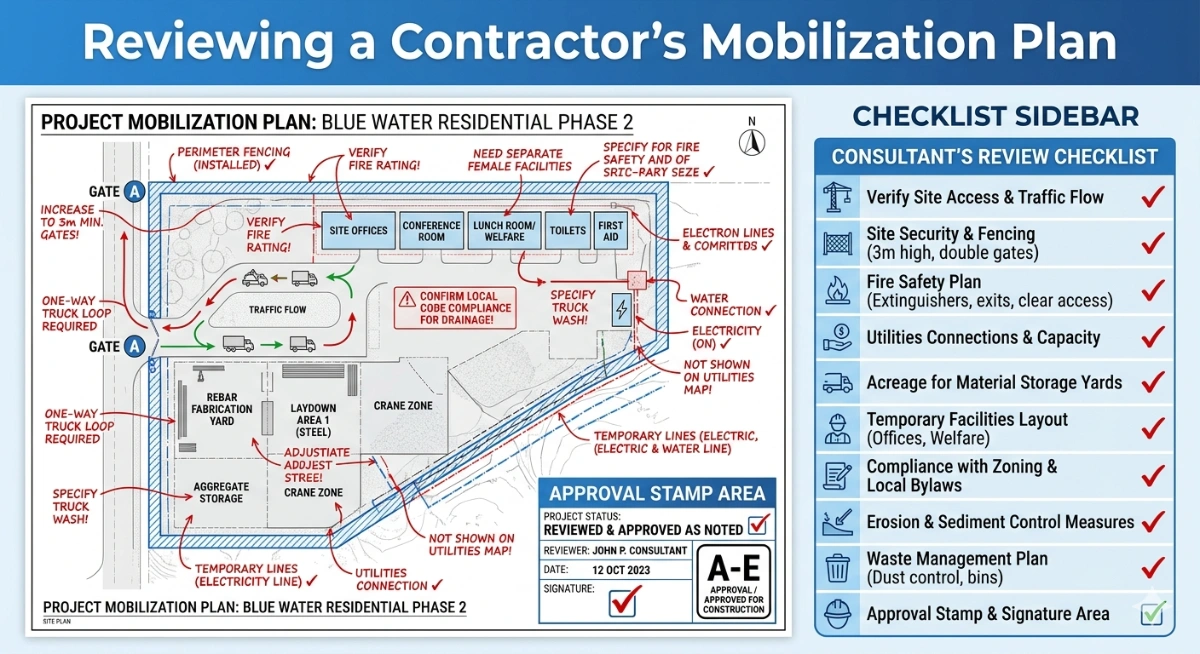
How To Review a Contractor’s Mobilization Plan

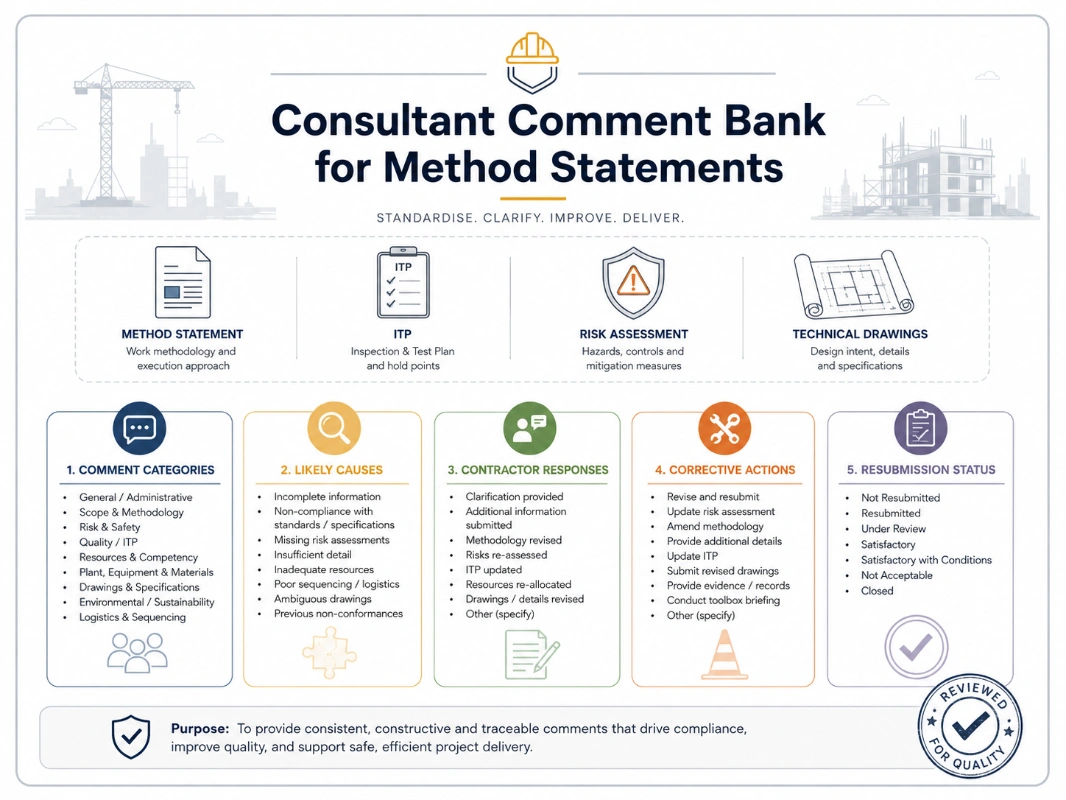
Consultant Comment Bank For Method Statements
Related Checklists
Keep the workflow moving with nearby templates chosen from similar checklist content.