Review Façade Sealant Joint Design: Movement, Adhesion, Life
Definition: Review façade sealant joint design for movement, adhesion, and service life guides façade engineers and specifiers through a structured preconstruction review to validate joint performance, durability, and documentation before procurement and installation.
- Verify movement capability, adhesion, and geometry meet calculated demands.
- Select compatible sealant, primer, and backing for each substrate.
- Document calculations, mock-ups, and approvals before procurement starts.
- Interactive, commentable checklist with export and QR code verification.
Review façade sealant joint design for movement, adhesion, and service life is a focused preconstruction process that validates joint performance before any sealant is ordered or installed. This checklist helps envelope engineers and designers confirm movement capability, adhesion and compatibility, and expected service life across typical façade joints. It concentrates on joint width and depth geometry, backer rod or bond-breaker detailing, substrate preparation requirements, and environmental exposure assumptions, while excluding installation procedures and test standards beyond approved project specifications and authority requirements. By resolving thermal, structural, and differential movement early, teams avoid adhesive failure, three-sided bonding, ponding, premature cracking, and costly reseal cycles. The outcome is a documented, defensible design basis aligned with manufacturer guidance and practical site constraints, with clear hold points for mock-ups and first-area inspections. Use this interactive page to tick items, leave comments, upload evidence, and export your review as PDF or Excel with a scannable QR for stakeholders.
- Assure the joint design’s movement envelope, geometry, and substrate compatibility before procurement, with calculations and product selections recorded. This prevents overstressed sealant beads, unintended three‑sided adhesion, and accelerated weathering, improving durability, appearance retention, and lifecycle cost while aligning decisions with manufacturer guidance and the project’s environmental exposure.
- Interactive online checklist with tick, comment, and export features secured by QR code. Use it to coordinate between façade engineers, architects, and manufacturers, attach mock-up results, and time-stamp approvals. QR authentication simplifies field verification and ensures the latest, synchronized review package is referenced across teams and devices.
- Define acceptance criteria for each joint: width-to-depth ratios, backer rod sizing, primer usage, and exposure-driven sealant chemistry. Built-in prompts request SI-unit calculations, product datasheets, and compatibility letters, reducing ambiguity and variation orders while creating a clear audit trail that supports authority submissions and internal quality assurance workflows.
- Plan for service life by linking exposure class to proven sealant chemistries, establishing maintenance intervals, and setting inspection hold points. This structured approach reduces premature failures, supports accurate budgeting, and integrates with commissioning deliverables, ensuring long-term performance of the building envelope under realistic thermal and structural movements.
Design Criteria Verification
Movement Analysis and Calculations
Joint Geometry and Detailing
Substrate and Material Compatibility
Durability and Service Life
Documentation and Quality Assurance
Designing for Movement: Calculations That Drive Joint Geometry
Sealant performance is governed by the movement envelope created by thermal cycles, wind-induced deflection, interstorey drift, and differential behavior between dissimilar materials. Begin with realistic temperature ranges for each elevation and compute thermal elongation per metre using substrate coefficients. Combine structural deflection and drift values from the façade engineer to define total expected joint movement. Translate these numbers into practical joint widths such that the anticipated change remains within the sealant’s rated capability, ideally with an extra safety margin to accommodate construction tolerances. Keep width-to-depth ratios near 2:1 and avoid depths under 6 mm, as thin sections fatigue sooner and over-deep beads restrict movement. Where backer rods are impractical, specify bond-breaker tape to eliminate three-sided adhesion. Drainage matters: introduce slopes and drips to prevent ponding that accelerates degradation. Document calculations on marked-up drawings so the intent is clear during procurement and shop drawing reviews.
- Use SI units and record ΔL per metre for each substrate.
- Size joints so movement stays within rated capability plus margin.
- Maintain 2:1 width-to-depth ratio; minimum depth 6 mm.
- Detail bond-breakers to eliminate three-sided adhesion.
- Include drainage slopes and drips to prevent ponding.
Adhesion, Compatibility, and Field Validation
Adhesion relies on compatible chemistries and clean, stable substrates. List every contact surface—anodized aluminium, coated steel, stone, GRC, and concrete—and obtain written compatibility from the sealant manufacturer. Identify primer needs by substrate and specify application rate, cure time, and surface preparation steps (abrasion grade, solvent type, and dwell). Adjacent coatings and waterproofing can inhibit cure or stain porous materials; lock down approvals before committing. Validate design intent with mock-ups that replicate joint geometry and substrates, then perform field adhesion checks under recorded ambient conditions. Accept cohesive failure within the sealant and no adhesive loss at the interface. Capture product batch numbers, photos, and results in the common data environment so the same configuration flows into production. This disciplined front-end validation reduces rework, supports warranty terms, and ensures predictable performance on the first installed metre.
- Secure manufacturer compatibility letters for each substrate.
- State primer type, rate, and cure time on drawings.
- Define substrate preparation steps and safe-use notes.
- Mock-up and field adhesion testing before production.
- Record batches, photos, and ambient conditions.
Service Life Planning and Quality Assurance
Service life depends on the right chemistry for exposure, robust detailing, and a maintenance plan. Assign exposure classes by elevation using UV index, temperature cycles, and rainfall. Select sealants with documented weathering history and confirm movement capability retention over time. Prevent early deterioration by removing ponding risks and avoiding thin or over-deep beads. Establish inspection hold points—mock-up sign-off, first-area verification, and periodic audits—so deviations are corrected early. Prepare an O&M plan that sets inspection frequency, cleaning guidance, and reseal triggers such as adhesion loss or hardening. Centralize approvals, datasheets, and calculations in a controlled CDE to maintain traceability throughout design and handover. By linking design assumptions to quality checkpoints, teams deliver durable, maintainable joints that meet performance targets per approved project specifications and authority requirements.
- Assign exposure classes and select proven chemistries.
- Eliminate ponding and brittle thin sections.
- Set hold points for mock-ups and first-area checks.
- Create an O&M plan with inspection intervals.
- Control documents in a revisioned CDE.
How to Use This Interactive Checklist
- Preparation: Gather facade drawings, movement calculations, substrate lists, sealant and primer datasheets, backer rod samples, and manufacturer contacts. Ensure access to the project CDE and equip a field kit for mock-ups.
- Set site conditions: Confirm environmental assumptions (temperature range, UV, rainfall) and structural inputs (deflection and drift) with the facade and structural engineers.
- Start interactive mode: Tick each item, add comments with location references, and upload evidence such as annotated drawings, photos, and calculation sheets.
- Coordinate: Tag responsible parties (designer, manufacturer, contractor) in comments, request clarifications, and attach manufacturer approvals for compatibility and movement capability.
- Review and reconcile: Resolve open comments, record decisions, and lock approved joint geometries and materials to prevent uncontrolled changes.
- Export: Generate a commentable record and export as PDF/Excel with embedded QR code for field verification and submittals.
- Sign-Off: Capture digital signatures from stakeholders, distribute to the project team, and archive the final, QR-authenticated pack in the CDE.
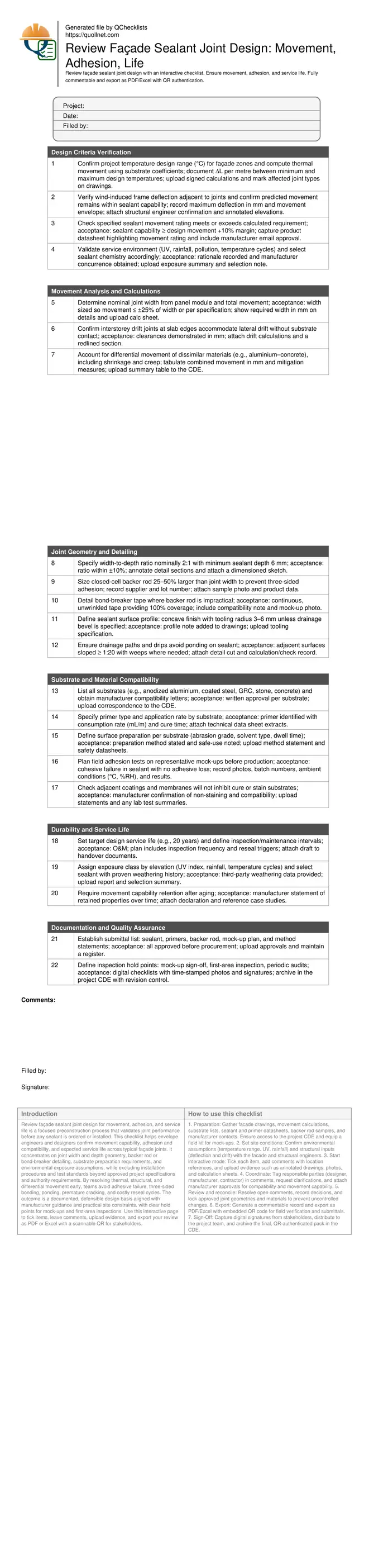
Call to Action
- Start Checklist Tick off tasks, leave comments on items or the whole form, and export your completed report to PDF or Excel—with a built-in QR code for authenticity.
- Download Excel - Façade Sealant Joint Design Review
- Download PDF - Façade Sealant Joint Design Review
- View Image - Façade Sealant Joint Design Review
Cite & Embed
“Façade Sealant Joint Design Review by Quollnet”
with a link to
this source page.
FAQ
Question: How do I determine the correct joint width for expected movement?
Question: Which sealant chemistry best suits high UV and wet exposures?
Question: What evidence should I capture during design review and mock-ups?
Question: How can I plan for long service life and reduce reseal frequency?
Related Articles
Broader reading and guidance connected to this checklist topic.


Improve Your Project Handover Process With Snag List Tracking App

Is It Important To Customize Your Qr Code And How To Do It?
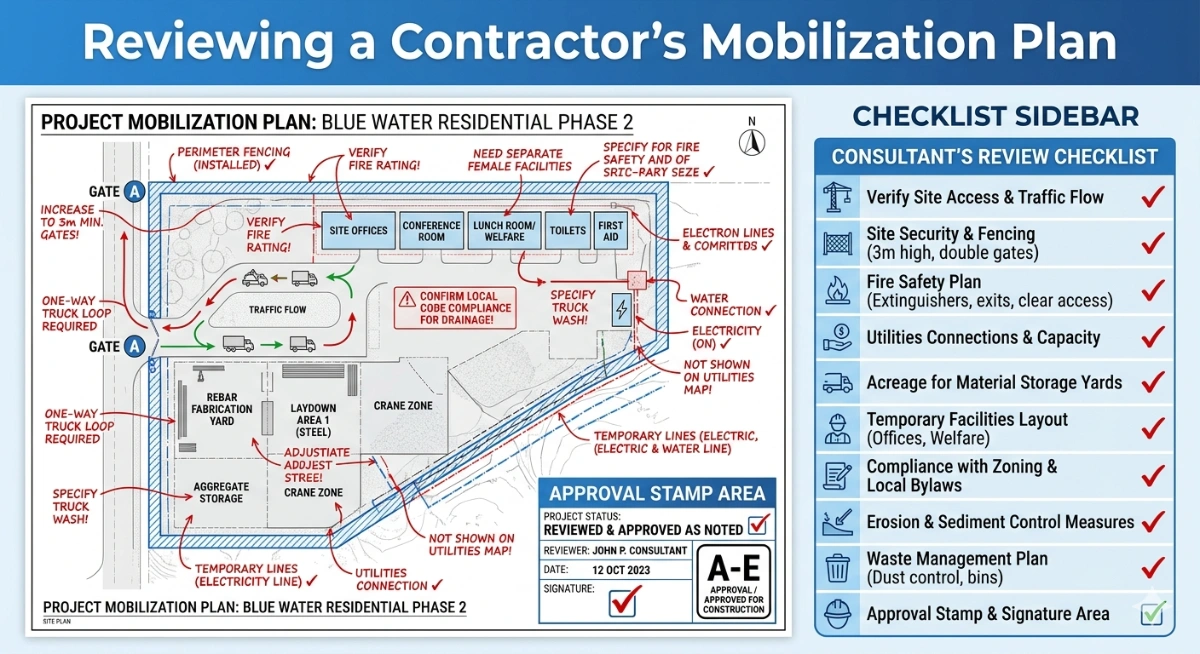
How To Review a Contractor’s Mobilization Plan

Related Checklists
Keep the workflow moving with nearby templates chosen from similar checklist content.