G
Guest

建設におけるリテンション:算定式、保証、会計ガイド

建設リテンションの仕組みを、明確な算定式、保証の種類、会計仕訳、事例とともに解説。資金繰りと品質を確保します。

建設におけるリテンション:算定式、保証、会計ガイド
Japanese version

建設におけるリテンション:算定式、保証、会計ガイド

建設におけるリテンションとは?

建設契約におけるリテンションとは、請負業者への支払額の一部を発注者が留保する契約上の金銭的仕組みです。これにより、請負業者が欠陥是正や最終引渡しを含む義務を履行することが担保されます。本ガイドでは、建設リテンションの種類、算定式、会計実務を解説し、実例も紹介します。

建設リテンションの種類と算定式

1. 固定リテンション率

    各中間支払額から一定割合を留保します。

算定式:
     Retention Amount = Interim Payment × Retention Percentage  
例: 請負業者への支払額が100,000ドルで、留保率が10%の場合、留保額は10,000ドルです。


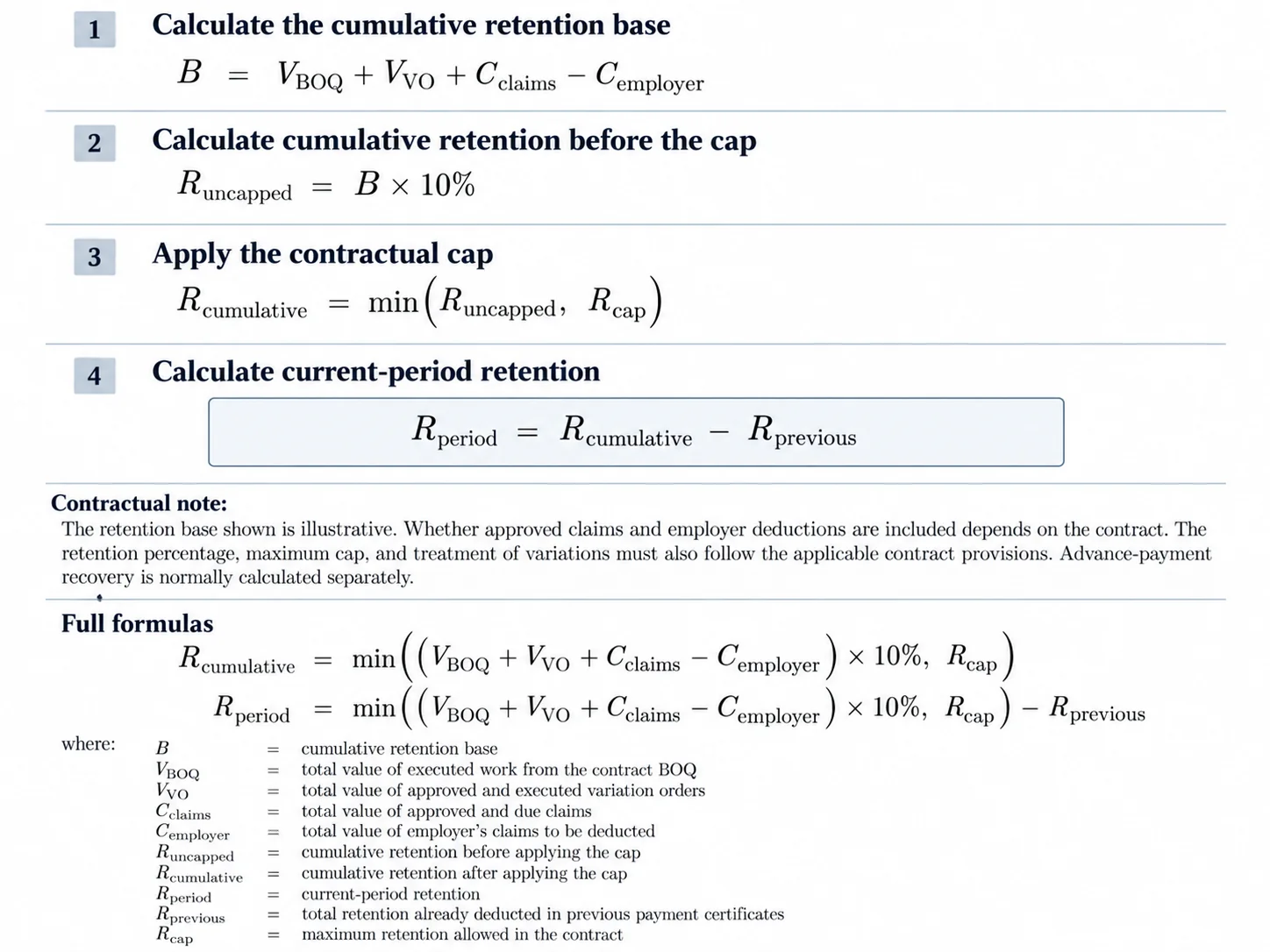
2. 上限付きリテンション

留保額があらかじめ定めた上限に達すると、控除は停止します。

算定式:

     Retention Amount = min(Interim Payment × Retention %, Retention Cap)  

    例: 上限が50,000ドルで留保率が10%の場合、50,000ドルが留保された時点で控除は停止します。


3. 二段階解除リテンション

リテンションは、実務完成時と瑕疵担保期間(DLP)終了後の2段階で解除されます。

算定式:

     Retention at Practical Completion = Total Retention × 0.5 Retention After DLP = Total Retention − Retention at Practical Completion  

    例: リテンションが20,000ドルの場合、完成時に10,000ドル、DLP後に10,000ドルが支払われます。


4. 逓減方式リテンション

プロジェクトの進捗に応じて、リテンション率が低下します。

算定式:

     Retention Amount = Interim Payment × Applicable Retention % (based on project stage)  

    例: プロジェクト前半50%は10%、次の30%は5%、残り20%は0%とします。


5. リテンションボンド

現金留保の代わりに金融商品を用います。

算定式:

     Retention Bond Value = Retention Cap or Total Retention  

    例: 上限が50,000ドルの場合、現金を留保する代わりに保証が発行されます。


リテンションが請負業者の資金繰りに与える影響

1. キャッシュフローの制約

    即時に使える資金が減少し、仕入先や作業員への支払いに影響します。

2. 運転資金への圧力

    リテンションにより、請負業者は資金調達や追加運転資金の投入を迫られることがよくあります。

3. 品質向上への動機付け

    請負業者はDLP終了まで関与を維持し、欠陥是正を確実に行います。

4. 緊張関係の可能性

    リテンションの支払い遅延や過大な留保は、請負業者と発注者の関係を損なう可能性があります。


建設でリテンションが使われる理由

    • 品質保証: 完了後の是正対応を確実にします。

    • リスク低減: 請負業者が契約不履行となった場合に発注者を保護します。

    • 履行責任: 完全かつ適切な完成を促します。


実務での活用例

    住宅プロジェクト

    引渡し後の配管や配線の不具合など、是正対応を確実にします。

    インフラプロジェクト

    上限付きリテンションにより、大規模請負業者への影響を抑えつつ発注者の利益を確保します。

    商業開発

    逓減方式リテンションは、履行マイルストーンと整合します。

    高リスク案件

    空港のような複雑な工事では、留保現金の代わりにリテンションボンドが使われます。

    公共部門契約

    多くの場合、固定の留保率を用いた二段階解除方式が採用されます。


建設におけるリテンションの会計処理

    発注者側

    初回留保時:

     Debit: Construction Expense Credit: Retention Payable  

    リテンション解除時:

     Debit: Retention Payable Credit: Bank/Cash  

    請負業者側

    Retention Receivable:

     Debit: Retention Receivable Credit: Revenue  

    入金時:

     Debit: Bank/Cash Credit: Retention Receivable  

    定期的な確認

    双方はリテンション残高を定期的に照合すべきです。


無料の建設リテンション計算ツール(Excel)をダウンロード

プロジェクト情報(出来高、留保率、上限額など)を入力すると、計算ツールがすべての計算を行います。

✅ 固定率と上限付きリテンションに対応

✅ リテンション解除額と最終純留保額を計算

✅ 強調表示されたセクションで入力しやすいレイアウト

建設リテンション計算ツールの無料ダウンロードはこちら

建設リテンション計算ツール quollnet


参考文献

    • Gould, N., & Joyce, R. (2017). Construction Law: Retention and Payment Security.

    • RICS (2020). Retention in Construction Contracts: Current Practices and Impacts.

    • CIOB (2021). Retention Policies in the Construction Industry.

    • FIDIC (2017). Conditions of Contract for Construction.

    • Quollnet.com (2024).瑕疵担保期間.


Andrei Ivanov's photo
Andrei Ivanov
@MechMindAndrei
Aug 21, 2026
0
2
81
58

建設におけるリテンション:算定式、保証、会計ガイド

Frequently Asked Questions


FAQ

Q: 建設契約におけるリテンションとは何ですか?

A: リテンションとは、契約上の仕組みとして、請負業者への支払額の一部を発注者が留保し、工事完了および瑕疵担保期間の経過まで支払わない制度です。請負業者が欠陥を是正し、義務を履行することを担保します。この慣行は法的に認められており、多くの国で建設関連法に基づいて一般的に運用されています。

FAQ

Q: 建設プロジェクトでリテンションはどのように計算されますか?

A: リテンションは通常、各中間支払額に対して一定割合で計算されます。たとえば、留保率が10%、中間支払額が100,000ドルの場合、留保額は10,000ドルです。契約条件に応じて、上限付き、二段階解除、逓減方式の算定式も用いられます。

FAQ

Q: 建設における一般的なリテンション率はどのくらいですか?

A: 建設契約で最も一般的なリテンション率は、中間支払額の5%から10%です。正確な値は、プロジェクトの種類、国の規制、交渉された契約条件によって異なります。

FAQ

Q: プロジェクトで認められるリテンションの上限額はどのくらいですか?

A: リテンションの上限は、総契約額の5%に設定されることが多いですが、これは案件によって異なります。契約によっては、契約金額に対する割合ではなく、固定の金額上限を採用する場合もあります。

FAQ

Q: リテンション金はいつ請負業者に支払われますか?

A: リテンションは通常、2段階で解除されます。すなわち、実務完成時に50%、残りの50%は瑕疵担保期間が終了し、すべての問題が解決した後に支払われます。これは二段階解除リテンションと呼ばれます。

FAQ

Q: リテンションボンドとは何で、どのように機能しますか?

A: リテンションボンドは、銀行または保険会社が提供する金融保証で、現金留保の代わりとなるものです。発注者に安全性を提供しつつ、請負業者の資金繰りを維持できます。

FAQ

Q: リテンションは請負業者の資金繰りにどのような影響を与えますか?

A: リテンションは工事実施中の運転資金を減少させ、仕入先、下請業者、労務費の支払い能力に影響することがあります。その結果、資金調達が必要になったり、工事遅延につながったりする場合があります。

FAQ

Q: リテンションは会計上どのように記録すべきですか?

A: 発注者はリテンションを「Retention Payable」として負債に計上し、請負業者は「Retention Receivable」として資産に計上します。留保時と解除時の両方で仕訳が必要です。

FAQ

Q: リテンションはすべての種類の建設プロジェクトに適用されますか?

A: はい、ただし構成は異なります。リテンションは住宅、商業、インフラ、公共部門のプロジェクトで一般的です。高リスクまたは高額案件では、現金控除の代わりにリテンションボンドが使われることがあります。

FAQ

Q: 瑕疵担保期間はリテンションとどのような関係がありますか?

A: 瑕疵担保期間は、実務完成後に発注者が欠陥を確認し、是正を求めるための期間です。この期間中に留保されたリテンションは、請負業者の責任を維持する役割を果たします。

Related Checklists


Staged Excavation Under Retention – Interactive Checklist
✅ 20 items
Staged Excavation Under Retention is the controlled, sequenced removal of soil behind a temporary works system while maintaining stability. This checklist supports retained excavation operations, including props, walers, struts, and anchors, focusing on excavation staging, monitoring updates, and formal hold points. It excludes mass grading and broad earthworks. By confirming the sequence and installing intermediate supports at defined depths, teams maintain performance of the retention system, limit wall movement, and reduce risks such as collapse, base heave, and service strikes. The checklist aligns supervision, survey, and monitoring teams on trigger levels, preload requirements, tolerances, and documentary evidence. Acceptance cues—such as RLs within tolerance, preload within ±5%, and verified clearances—provide objective go/no‑go criteria before work advances. Use this tool to coordinate daily briefings, inspection test plans, and sign-offs with the engineer, keeping records organized and traceable. Start in interactive mode to tick items, add comments, and export PDF/Excel with a QR-secured audit trail.
Place Retaining Wall Footing Concrete (Horizontal) Checklist
✅ 26 items
Place retaining wall footing concrete (horizontal) demands disciplined control of sequence, consolidation, finishing, and curing to deliver a stable, durable base. This field-ready guide focuses on the footing pour as a horizontal concrete placement, covering practical steps that prevent cold joints, segregation, honeycombing, curling, and premature cracking. It deliberately excludes reinforcement checks, keeping scope tight around formwork readiness, delivery verification, controlled placement, internal vibration, surface finishing, and curing protection for the retaining wall base. You will find clear acceptance cues, tools, and evidence requirements that help crews act decisively while documenting compliance per approved project specifications and authority requirements. Use it to plan the pour path, set lift thickness, standardize vibrator technique, validate finish elevation, and lock in moisture retention early. Go interactive on-site: tick items in sequence, add comments with photos and readings, and export your record as PDF/Excel with a secure QR link for traceable approvals.
Inspect punched window glazing and bead engagement checklist
✅ 30 items
Inspect punched window glazing installation and bead engagement is a focused, field-ready process that confirms secure glass bite, correct gasket seating, and reliable snap-in bead retention. This checklist targets single punched window openings, covering glazing placement, setting blocks, bite verification, perimeter sealant, drainage, and final tolerances. By emphasizing bead engagement and gasket compression, it reduces risks such as glass edge contact, bead disengagement, water intrusion, and sightline inconsistency. The scope excludes curtain walls, storefronts, and structural glazing; acceptance follows approved project specifications and authority requirements. Practical cues include measurable tolerances in millimetres, retention pull checks in newtons, and water drainage timing in seconds. Outcomes are predictable installation quality, traceable documentation, and fewer callbacks. Use this interactive format to tick requirements, add punch-list comments, attach photos and readings, and export the signed record. Start now: tick items, comment on issues, and export PDF/Excel with a QR-secured audit trail.
Place and Cure Basement Wall Concrete (Vertical) Checklist
✅ 24 items
Place and cure basement wall concrete (vertical) is a critical operation where pour rate control, proper vibration, well-managed joints, and disciplined curing determine long-term durability. This checklist guides vertical wall concrete placement in basements, covering concrete rise rate, consolidation, cold joint prevention, curing methods, and environmental protection. It intentionally excludes reinforcement inspection, focusing solely on formwork readiness, delivery checks, controlled lifts, vibration techniques, bonding at interfaces, and early-age protection. By following these steps, you reduce risks such as formwork pressure blowouts, segregation, honeycombing, cold joints, and thermal cracking. The result is straighter walls, tighter waterstops, improved surface finish, and predictable strength gain verified by documented field readings. Use the interactive features to tick items in real time, attach photos and measurements, add comments for decisions, and export your record as PDF or Excel with a secure QR link.
Substructure Lessons Learned Checklist: Retention & GW
✅ 22 items
Substructure Lessons Learned Checklist provides a structured way to capture retention performance, groundwater behavior, and practical improvement suggestions without blame analysis. This post-construction review tool supports foundation substructure teams working with earth-retention systems, deep excavations, and dewatering performance. It focuses on facts: instrument readings, photos, dates, locations, and outcomes versus expectations. The scope includes retaining walls and support-of-excavation systems, groundwater head and inflow observations, adjacent movement effects, and the conversion of observations into clear, owner-assigned actions. It excludes personnel attribution, contractual liability narratives, and fault-finding. By emphasizing calibrated instrumentation, consistent units (SI), and verifiable evidence, the checklist helps avoid recurring issues such as excessive wall deflection, unexpected inflows, turbidity exceedances, and settlement near property lines. The outcome is a repeatable knowledge record that improves design criteria, sequencing, monitoring plans, and contingency measures on the next job. Start in interactive mode to tick items, add comments, and export as PDF/Excel via secure QR authentication.

Related Articles


Construction Project Retention
⏳ 3 min read
Retention In Construction: Formulas, Bonds & Accounting Guide
Learn how construction retention works with clear formulas, bond types, accounting entries, and examples. Ensure cash flow and quality in your projects.
Backcharge Deduction Subcontractor Ipc
⏳ 8 min read
How To Deduct a Backcharge From a Subcontractor Ipc
Learn how to show, dedu a Subcontractor IPC, with a worked payment example, balance calculation, document checklist, and practical controls.
Defect Liability Period Dlp
⏳ 2 min read
What Is Construction Defect Liability Period - Dlp
This article explores the defects liability period in FIDIC contracts, comparing it to statutory periods in civil law countries. It discusses the contractor's obligations, retention money, and the potential for latent defects.
How To Create a Project Cash Flow For Contractors
⏳ 6 min read
Learn How To Create a Comprehensive Cash Flow For Construction Projects. Introducing Cashflowpot
Learn how to create a comprehensive cash flow for construction projects, including key contract conditions, subcontractor retention, work in excess of billing (WIEB), advance payments, and indirect costs. This step-by-step guide helps contractors manage project cash flows efficiently.
Construction Cashflow Prediction
⏳ 7 min read
Construction Project Cash Flow Prediction
Learn how to accurately predict construction project cash flows using mathematical models such as polynomial and exponential curves. Discover essential adjustments, including advance payments, retention deductions, payment delays, and work-in-progress billing, to align predicted work with real cash outflows.