Review dynamic façade maintenance strategy for motors, actuators, and sensors
Definition: Review dynamic façade maintenance strategy for motors, actuators, and sensors equips facility managers to evaluate preventive and condition-based plans, documentation, access, spares, KPIs, and risks across automated shading and louver systems.
- Align service intervals, lubrication, calibration, and replacements with actual duty.
- Reduce failures, energy waste, façade jams, wind-risk incidents, and complaints.
- Apply evidence-based intervals using BMS data and vendor-approved methods.
- Interactive, commentable checklist; export PDF/Excel; secured by QR code.
Review dynamic façade maintenance strategy for motors, actuators, and sensors is a focused framework for facility teams to evaluate preventive maintenance, condition-based monitoring, and lifecycle planning across automated shading, blinds, and louver systems. The scope centers on electro-mechanical drives, linear and rotary actuators, and environment-sensing devices tied to BMS control, excluding structural glazing and aesthetic cleaning. By reviewing service intervals, access and lockout procedures, lubrication methods, calibration tolerances, and spares strategy, you reduce jamming, overheating, nuisance alarms, and energy waste. You also improve uptime, wind safety response, daylight performance, and occupant comfort. This checklist emphasizes clear acceptance criteria, evidence capture, and traceable approvals per approved project specifications and authority requirements. Use it to align vendors, technicians, and asset managers on one practical plan that withstands seasonal loads and real duty cycles. Start in interactive mode: tick items, add comments, attach photos, and export results to PDF/Excel with a secured QR code for easy re-verification.
- Align vendor manuals, duty-cycle data, and real operating conditions into a single, evidence-backed plan that schedules inspections, lubrication, calibration, and replacements at the right time, minimizing shutdowns and costly emergency access while improving daylighting, wind safety response, and comfort.
- Interactive online checklist with tick, comment, and export features secured by QR code. Attach photos, readings, and certificates, link QR-tagged assets, and generate audit-ready PDF/Excel reports so stakeholders can verify decisions, track changes, and sign off quickly with transparent, time-stamped accountability.
- Establish measurable performance indicators—MTBF, jam rates, alarm-to-action time, energy impact—and use BMS logs, thermal images, torque readings, and calibration certificates as proof, enabling faster approvals, budget clarity, and targeted interventions before minor issues escalate into façade outages.
- Standardize access and lockout procedures for every elevation, confirm critical spares and service levels, and create seasonal test windows. This reduces weather-related failures, speeds vendor response, and keeps audit trails ready for client reviews and authority requirements.
Strategy Governance & Documentation Review
Motors Maintenance Strategy
Actuators & Mechanisms Strategy
Sensors & Calibration Strategy
Controls & Monitoring Strategy
Access, Safety & Spares Strategy
Governance that turns manuals into an actionable, auditable plan
A robust review starts by converting disparate vendor manuals and field knowledge into one governed maintenance strategy. Build a complete asset register with QR-tagged motors, actuators, and sensors mapped to elevations and zones. Define preventive and condition-based intervals from actual duty cycles, not generic calendars. Reference vendor instructions and per approved project specifications for lubrication, torque checks, and calibration, ensuring revisions are controlled. Capture risks in a living FMEA so failure modes like jammed louvers, overcurrent trips, or sensor drift have defined mitigations and triggers. Require evidence for every decision—photos, readings, part numbers, and signatures—so audits and budget reviews are answered with facts, not opinions. By aligning documentation, risks, and acceptance criteria, you reduce ambiguity, standardize handoffs between vendors and in-house teams, and make seasonal updates straightforward when weather or usage patterns shift.
- Keep one owner for asset register.
- Reference approved project specifications consistently.
- Require before/after evidence for changes.
- Tie actions to quantified risks.
Motors and actuators: intervals, tolerances, and failure triggers
Electro-mechanical reliability depends on specifying what to measure and when action is required. For motors, require periodic current checks with a clamp meter, temperature rise by IR camera, insulation resistance with a 500 V megohmmeter, and targeted lubrication where serviceable. Define vibration limits so rising RMS velocity prompts corrective work before bearings fail. For actuators, baseline stroke times at commissioning and set an acceptable variance window; verify end-stop switches close crisply; record torque margins and mechanical backlash to flag wear. Tie each reading to a clear acceptance threshold and a defined response—continue, adjust, or replace—so technicians don’t guess. On site, this avoids common issues like louvers stalling on cold mornings due to stiff grease or mis-set limits that lead to repeated overcurrent trips. Evidence (photos, meters, and certificates) keeps the plan defensible and repeatable.
- Trend motor current and temperature.
- Verify actuator stroke time variance.
- Record torque margins and backlash.
- Use vendor-approved lubricants only.
- Document failure triggers and responses.
Sensors, controls, and data-driven continuous improvement
Sensor health underpins safe and comfortable operation. Calibrate light, wind, and temperature sensors to traceable standards and verify placement avoids reflections and obstructions. In controls, map alarms to maintenance actions and ensure a fast alarm-to-ticket workflow. Schedule live seasonal tests (equinox/solstice) to prove real-world behavior under changing sun and wind. Log critical variables—movement cycles, current draw, wind speed, and lux—at actionable intervals, then trend for drift and early warnings. Define KPIs such as MTBF, jam rate per 1000 cycles, alarm-to-action time, and energy impact from shading positions. Share monthly dashboards and close the loop by updating intervals or methods when data shows benefit. This creates a cycle of continuous improvement rather than a static calendar task list.
- Calibrate sensors to traceable standards.
- Test seasonal control scripts live.
- Automate alarm-to-ticket workflows.
- Publish KPIs monthly with trends.
How to Use This Maintenance Strategy Review Checklist
- Preparation: Gather vendor manuals, approved project specifications, asset register, BMS access, CMMS login, IR camera, clamp meter, megohmmeter (500 V DC), lux meter, anemometer, calibrated thermometer, and site access permits, PPE, and LOTO equipment.
- Open interactive mode: Select building, elevation, and zone. Scan asset QR tags to auto-fill records. Tick items as you proceed, and add comments where the current strategy lacks clarity.
- Work through sections: Governance, Motors, Actuators, Sensors, Controls, and Access. Apply acceptance criteria, record measurements where sampled, and link supporting photos, certificates, and method statements.
- Attach documentation: Upload vendor pages cited, calibration certificates, risk assessments, and training records. Reference drawing numbers and asset IDs for traceability.
- Export and share: Generate a versioned PDF/Excel report with embedded QR code for re-verification. Circulate to facility, vendor, and client representatives for review.
- Sign-Off: Capture digital signatures from maintenance lead, vendor, and client. Archive the report in the CMMS, schedule follow-up actions, and lock controlled documents.
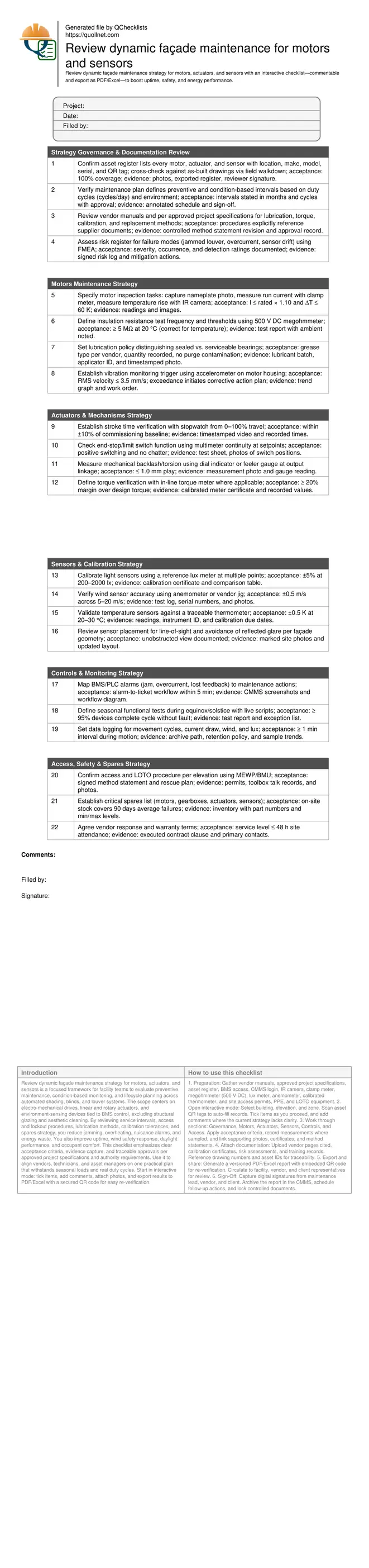
Call to Action
- Start Checklist Tick off tasks, leave comments on items or the whole form, and export your completed report to PDF or Excel—with a built-in QR code for authenticity.
- Download Excel - Dynamic Façade Maintenance Strategy Review
- Download PDF - Dynamic Façade Maintenance Strategy Review
- View Image - Dynamic Façade Maintenance Strategy Review
Cite & Embed
“Dynamic Façade Maintenance Strategy Review by Quollnet”
with a link to
this source page.
FAQ
Question: How often should we review the dynamic façade maintenance strategy?
Question: Which KPIs best indicate whether the strategy is working?
Question: Who should participate in the strategy review and sign-off?
Question: How do we handle seasonal and wind-related behavior changes?
Question: What records must be retained for audits and client reviews?
Related Articles
Broader reading and guidance connected to this checklist topic.


Master Construction Project Cashflow With Cashflowpot

Related Checklists
Keep the workflow moving with nearby templates chosen from similar checklist content.