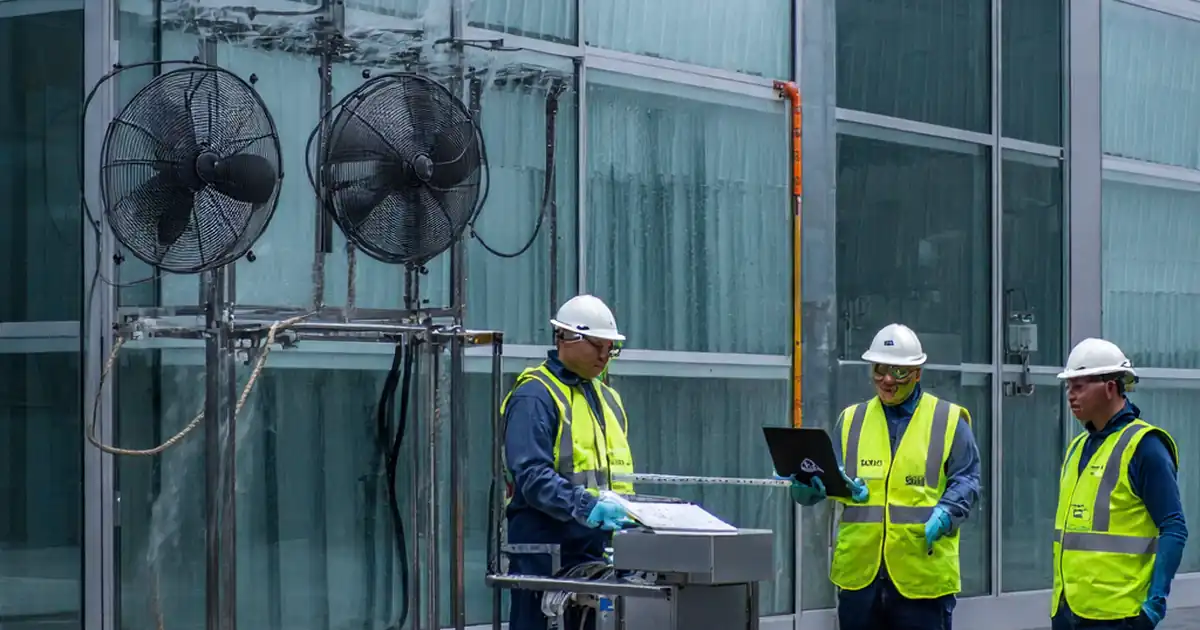
Review Dynamic Façade Fail-Safe Positions Under Weather or Outage
Definition: Review dynamic façade fail-safe positions under wind, rain, or power loss is a commissioning checklist for façade engineers and site managers, defining verification steps, acceptance criteria, and required evidence.
- Verify sensors, setpoints, actuators, and passive returns meet specifications.
- Prove safe positions under wind, rain, and outage within defined times.
- Capture photos, logs, and signatures for traceable, auditable closeout records.
- Interactive, commentable, export, QR code for authenticated sharing and sign-off.
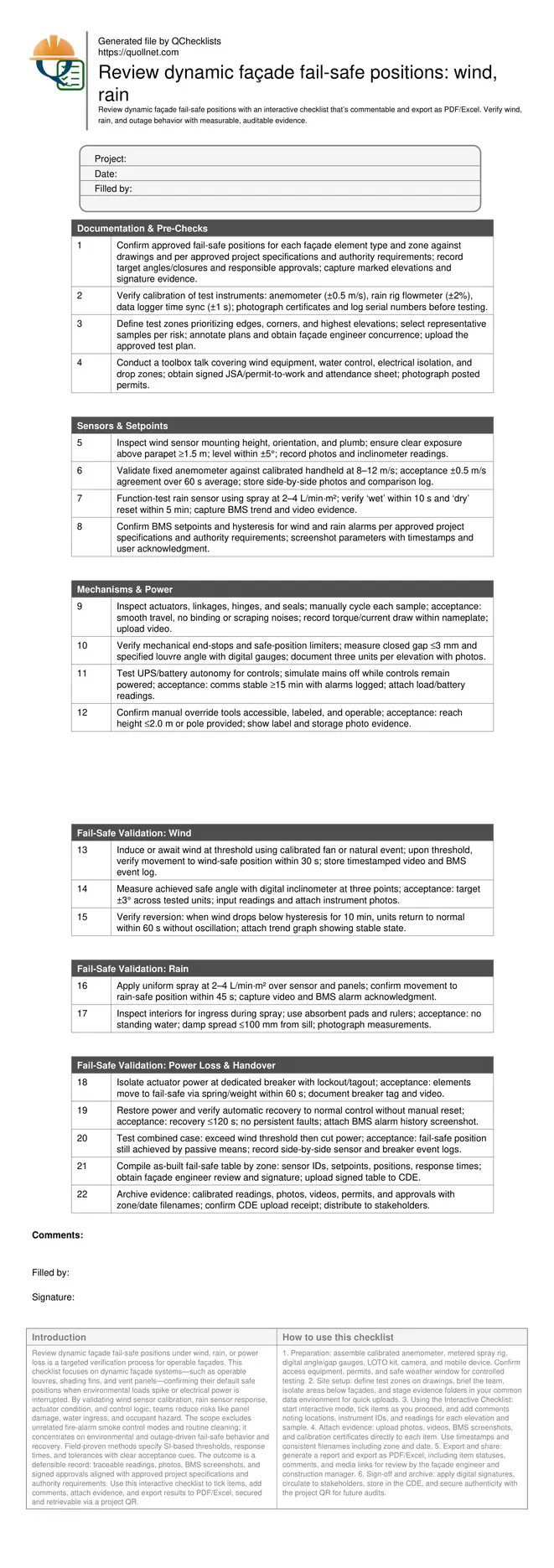
Review dynamic façade fail-safe positions under wind, rain, or power loss is a targeted verification process for operable façades. This checklist focuses on dynamic façade systems—such as operable louvres, shading fins, and vent panels—confirming their default safe positions when environmental loads spike or electrical power is interrupted. By validating wind sensor calibration, rain sensor response, actuator condition, and control logic, teams reduce risks like panel damage, water ingress, and occupant hazard. The scope excludes unrelated fire-alarm smoke control modes and routine cleaning; it concentrates on environmental and outage-driven fail-safe behavior and recovery. Field-proven methods specify SI-based thresholds, response times, and tolerances with clear acceptance cues. The outcome is a defensible record: traceable readings, photos, BMS screenshots, and signed approvals aligned with approved project specifications and authority requirements. Use this interactive checklist to tick items, add comments, attach evidence, and export results to PDF/Excel, secured and retrievable via a project QR.
- This checklist standardizes verification of wind and rain setpoints, actuator returns, and recovery logic, ensuring each operable façade element reaches its defined safe position within measured time limits and tolerances, backed by calibrated instruments and timestamped evidence.
- Field methods balance realism and control: portable anemometers validate site sensors, spray rigs simulate rainfall intensity, and breaker tests confirm passive returns during outages. Results are captured as data logs, photos, and signed tables for repeatable, auditable commissioning across elevations and zones.
- Acceptance focuses on measurable outcomes: angle within ±3°, gaps ≤3 mm, rain response within 45 seconds, wind response within 30 seconds, and recovery without hunting. Documented deviations trigger corrective actions, retests, and engineer approvals to protect the envelope and occupants under adverse conditions.
- Interactive online checklist with tick, comment, and export features secured by QR code.
Documentation & Pre-Checks
Sensors & Setpoints
Mechanisms & Power
Fail-Safe Validation: Wind
Fail-Safe Validation: Rain
Fail-Safe Validation: Power Loss & Handover
Why fail-safe positions matter for dynamic façades
Operable façades add comfort and performance, but their benefits depend on predictable behavior during environmental upsets. Fail-safe positions prevent damage, water ingress, and injury when wind accelerates or rain begins. Typical strategies include louvres feathering to a near-closed angle, vent panels shutting, or fins aligning to minimize loads. Acceptance hinges on objective measures: angle tolerances, gap limits, and timed responses backed by calibrated instruments. A practical jobsite approach captures before-and-after states, BMS events, and physical measurements for each tested elevation. When a unit deviates—slow movement, overshoot, inconsistent gaps—you can pinpoint root causes such as sensor bias, linkage friction, or mis-set hysteresis. By anchoring tests to approved project specifications and authority requirements, teams avoid disputes and accelerate handover, while maintaining a defensible record for warranty and operations.
- Define safe angles and closures for each element type.
- Measure responses with calibrated, timestamped instruments.
- Prioritize high-risk edges, corners, and top floors.
- Record deviations and trigger corrective actions.
- Capture photos, logs, and signatures per zone.
Proving performance under wind and rain
Wind and rain events require different test techniques but the same rigor. For wind, compare rooftop or mast anemometers to a handheld unit, then use a calibrated fan or opportunistic gusts to cross the alarm threshold. Confirm motion initiates promptly and stops on setpoint, then verify reversion after hysteresis holds. For rain, use a controlled spray at defined intensity to activate wet sensors and observe panels moving to the rain-safe state. Inspect interior sills and joints for leakage using pads and rulers. Throughout, trend BMS points—sensor values, commands, positions—and keep video synced to time logs. Acceptance focuses on predictable, repeatable behavior with measurable tolerances, not subjective impressions.
- Correlate fixed and handheld anemometer readings.
- Simulate rainfall with controlled, metered spray rigs.
- Trend alarms, commands, and positions together.
- Verify reversion logic and hysteresis stability.
- Inspect interiors for leakage with measurements.
Outage behavior, passive returns, and recovery
Power interruptions reveal whether passive mechanisms genuinely protect the façade. Spring returns and weighted balances should drive panels to safe positions within a defined time after power loss, independent of controls. Controls continuity via UPS preserves alarming and logging, but actuators must still fail safely if feeds are cut upstream. Confirm automatic recovery: when power returns, elements should resume normal logic without manual intervention or hunting. Combined testing—wind setpoint exceeded, then power removed—demonstrates resilience under layered stress. Document lockout/tagout, breaker IDs, and sequence times to keep the electrical safety record intact. Finally, consolidate the as-built fail-safe table and distribute it to stakeholders for operations readiness.
- Verify passive returns achieve safe state within limits.
- Maintain controls logging via UPS during tests.
- Confirm automatic recovery without manual resets.
- Combine wind threshold and outage scenarios.
- Document lockout/tagout and breaker identifiers.
How to Use the Interactive Fail‑Safe Review Checklist
- Preparation: assemble calibrated anemometer, metered spray rig, digital angle/gap gauges, LOTO kit, camera, and mobile device. Confirm access equipment, permits, and safe weather window for controlled testing.
- Site setup: define test zones on drawings, brief the team, isolate areas below façades, and stage evidence folders in your common data environment for quick uploads.
- Using the Interactive Checklist: start interactive mode, tick items as you proceed, and add comments noting locations, instrument IDs, and readings for each elevation and sample.
- Attach evidence: upload photos, videos, BMS screenshots, and calibration certificates directly to each item. Use timestamps and consistent filenames including zone and date.
- Export and share: generate a report and export as PDF/Excel, including item statuses, comments, and media links for review by the façade engineer and construction manager.
- Sign-off and archive: apply digital signatures, circulate to stakeholders, store in the CDE, and secure authenticity with the project QR for future audits.
Call to Action
- Start Checklist Tick off tasks, leave comments on items or the whole form, and export your completed report to PDF or Excel—with a built-in QR code for authenticity.
- Download Excel - Dynamic Façade Fail-Safe Position Review
- Download PDF - Dynamic Façade Fail-Safe Position Review
- View Image - Dynamic Façade Fail-Safe Position Review
Cite & Embed
“Dynamic Façade Fail-Safe Position Review by Quollnet”
with a link to
this source page.

FAQ
Question: What defines a “fail-safe” position for dynamic façades?
Question: How do I validate wind thresholds without strong natural wind?
Question: What evidence should be collected for rain fail-safe testing?
Question: How do I test power loss safely without damaging equipment?
Related Articles
Broader reading and guidance connected to this checklist topic.



Related Checklists
Keep the workflow moving with nearby templates chosen from similar checklist content.