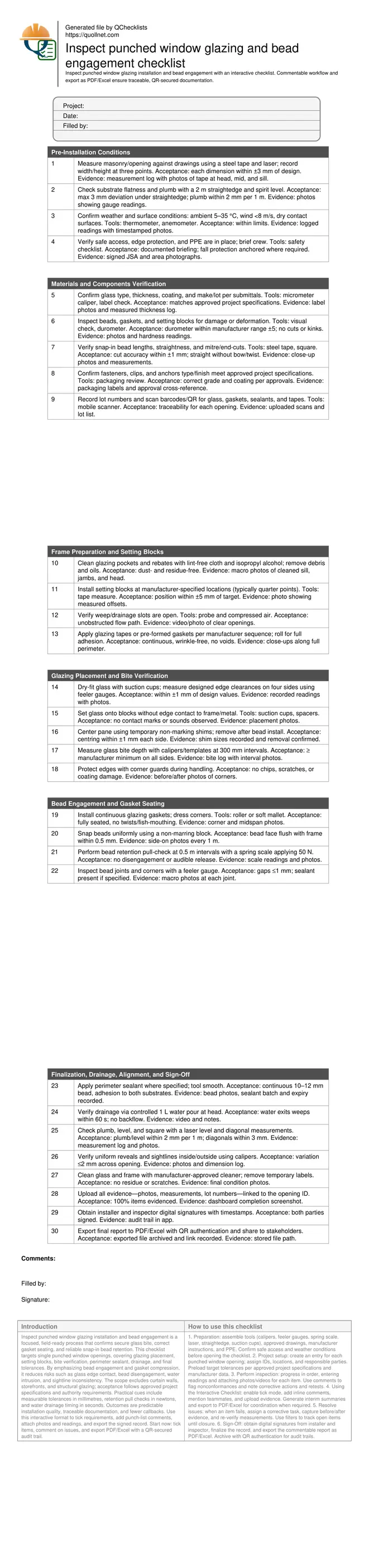
Inspect punched window glazing and bead engagement checklist
Definition: Inspect punched window glazing installation and bead engagement for site inspectors and installers, defining checks, tolerances, and evidence to verify correct glass bite, gasket seating, bead retention, drainage, and final alignment.
- Verify openings, materials, and glass bite against drawings and manufacturer data.
- Ensure snap-in beads fully engage and gaskets seat without twists or gaps.
- Document measurements, photos, and lot numbers for traceable quality assurance.
- Interactive, commentable checklist with export and QR code verification.
Inspect punched window glazing installation and bead engagement is a focused, field-ready process that confirms secure glass bite, correct gasket seating, and reliable snap-in bead retention. This checklist targets single punched window openings, covering glazing placement, setting blocks, bite verification, perimeter sealant, drainage, and final tolerances. By emphasizing bead engagement and gasket compression, it reduces risks such as glass edge contact, bead disengagement, water intrusion, and sightline inconsistency. The scope excludes curtain walls, storefronts, and structural glazing; acceptance follows approved project specifications and authority requirements. Practical cues include measurable tolerances in millimetres, retention pull checks in newtons, and water drainage timing in seconds. Outcomes are predictable installation quality, traceable documentation, and fewer callbacks. Use this interactive format to tick requirements, add punch-list comments, attach photos and readings, and export the signed record. Start now: tick items, comment on issues, and export PDF/Excel with a QR-secured audit trail.
- Validate punched window glazing with measurable criteria: glass bite, edge clearances, gasket seating, snap-in bead engagement, drainage performance, and final alignment. Capture photo evidence, lot numbers, and readings at defined intervals for full traceability.
- Reduce leak, rattle, and disengagement risks by confirming material compatibility, pocket cleanliness, precise setting block locations, continuous seals, and verified bead retention. Use objective tools—calipers, gauges, spring scale, laser level—for acceptance decisions on site.
- Interactive online checklist with tick, comment, and export features secured by QR code.
- Deliver a signed, shareable report by logging approvals, timestamps, and corrective actions. Export as PDF/Excel for submittals and archive with QR authentication to streamline closeout and simplify future maintenance or warranty reviews.
Pre-Installation Conditions
Materials and Components Verification
Frame Preparation and Setting Blocks
Glazing Placement and Bite Verification
Bead Engagement and Gasket Seating
Finalization, Drainage, Alignment, and Sign-Off
Focused scope: punched windows, measurable glazing controls
Punched windows demand precise, repeatable checks because small misalignments drive leaks, rattles, and callbacks. This checklist concentrates on single openings, validating opening prep, materials, glazing placement, bead engagement, and final drainage—without drifting into curtain walls or storefront systems. Using simple, objective tools—calipers, feeler gauges, spring scales, and laser levels—you will verify glass bite, uniform edge clearances, and snap-in bead retention with defined tolerances. Evidence capture (photos, lot numbers, readings) creates a defensible quality record aligned with approved project specifications and authority requirements. A typical jobsite example: a bead that feels “in” still fails a 50 N pull-check; the fix is reseating the gasket and re-snapping the bead until flush within 0.5 mm. This process removes ambiguity and speeds sign-off.
- Keep within punched window scope; avoid system mixing.
- Prefer gauges and scales over appearance-only checks.
- Record evidence at defined, repeatable intervals.
- Confirm tolerances before sealant or cleaning.
- Resolve defects immediately, then re-measure.
Getting bite, blocks, and clearances right the first time
Reliable performance starts with clean pockets and correctly placed setting blocks, typically at quarter points to distribute load. Dry-fitting allows early detection of edge clearance issues, which you measure on all four sides with feeler gauges. Once centred using temporary shims, confirm glass bite with templates or calipers at 300 mm intervals, ensuring it meets or exceeds the manufacturer minimum. This prevents edge contact and accommodates movement while maintaining warranted engagement beneath the bead line. Protect glass edges during all handling with corner guards, and document conditions before and after final seating. If any bite reading falls below the minimum or clearances vary beyond ±1 mm, pause installation, adjust blocks or shims, and recheck until readings align. Only proceed to bead installation when bite, centring, and support meet targets.
- Clean pockets to avoid gasket bridging.
- Place blocks within ±5 mm of targets.
- Measure bite at 300 mm intervals.
- Centre glass within ±1 mm per side.
- Stop work if bite is undersized.
Bead engagement, gasket seating, and drainage assurance
Snap-in beads and gaskets do more than finish the sightline—they lock in bite and seal against air and water. Seat gaskets continuously, pressing corners flat to prevent fish-mouthing. Engage beads using a non-marring block until they sit flush within 0.5 mm. Prove retention objectively with a 50 N pull-check every 0.5 m. Corner and splice joints must close to ≤1 mm and be sealed where specified. After engagement, perform a controlled 1 L water pour at the head; water should exit weeps within 60 s without backflow. Only then apply perimeter sealant if required, tool smooth, and verify adhesion. Finish with laser checks for plumb/level/square and uniform reveals. Capture photos of each verification step and log sealant batch data to secure warranties and streamline closeout.
- Roll gaskets; avoid twisted sections.
- Confirm beads flush within 0.5 mm.
- Retention check at 0.5 m intervals.
- Drainage must clear within 60 s.
- Record sealant batch and expiry.
How to Use This Interactive Checklist
- Preparation: assemble tools (calipers, feeler gauges, spring scale, laser, straightedge, suction cups), approved drawings, manufacturer instructions, and PPE. Confirm safe access and weather conditions before opening the checklist.
- Project setup: create an entry for each punched window opening; assign IDs, locations, and responsible parties. Preload target tolerances per approved project specifications and manufacturer data.
- Perform inspection: progress in order, entering readings and attaching photos/videos for each item. Use comments to flag nonconformances and note corrective actions and retests.
- Using the Interactive Checklist: enable tick mode, add inline comments, mention teammates, and upload evidence. Generate interim summaries and export to PDF/Excel for coordination when required.
- Resolve issues: when an item fails, assign a corrective task, capture before/after evidence, and re-verify measurements. Use filters to track open items until closure.
- Sign-Off: obtain digital signatures from installer and inspector, finalize the record, and export the commentable report as PDF/Excel. Archive with QR authentication for audit trails.
Call to Action
- Start Checklist Tick off tasks, leave comments on items or the whole form, and export your completed report to PDF or Excel—with a built-in QR code for authenticity.
- Download Excel - Punched Window Glazing & Bead Engagement Inspection
- Download PDF - Punched Window Glazing & Bead Engagement Inspection
- View Image - Punched Window Glazing & Bead Engagement Inspection
Cite & Embed
“Punched Window Glazing & Bead Engagement Inspection by Quollnet”
with a link to
this source page.
FAQ
Question: What is an acceptable glass bite for punched window glazing?
Question: How do I verify snap-in bead engagement reliably on site?
Question: When should perimeter sealant be applied in relation to bead engagement?
Question: How can I prevent water intrusion in punched window installations?
Related Articles
Broader reading and guidance connected to this checklist topic.


Major Construction Defects That Needs Immediate Attention

Retention In Construction: Formulas, Bonds & Accounting Guide

Master Construction Project Cashflow With Cashflowpot
Related Checklists
Keep the workflow moving with nearby templates chosen from similar checklist content.