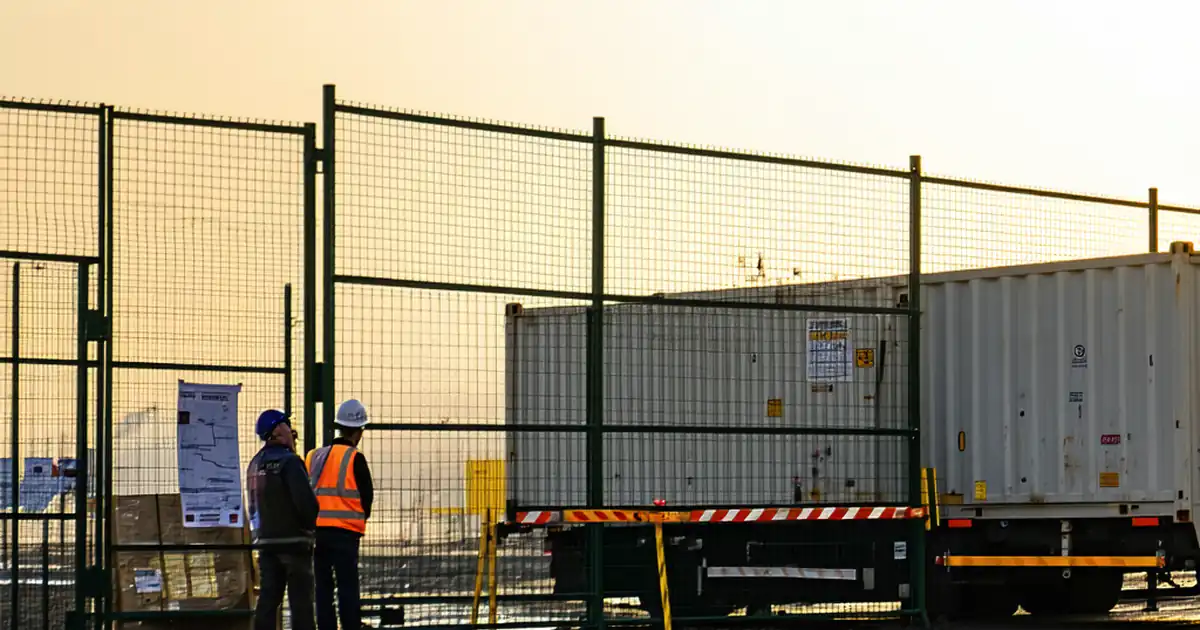
Mobilization Plan Starter Checklist for Contractors
Definition: Mobilization Plan Starter Checklist for contractors preparing preconstruction mobilization, confirming contract requirements, site setup, temporary works, utilities, staffing, security, and documentation readiness before major works commence on any construction project.
- Confirms contract preliminaries, permits, and authority approvals are in place.
- Validates site access, boundaries, utilities, and temporary facilities readiness.
- Coordinates plant, deliveries, laydown, welfare, safety and supervision plans.
- Interactive, commentable, export options with QR code verification included.
Mobilization Plan Starter Checklist helps contractors, project managers, and site engineers finalize a practical, contract-aware preconstruction mobilization plan. It aligns your contractor startup plan with employer/engineer requirements and confirms a safe, efficient site setup before works begin. Within scope: site access and boundaries, temporary site layout, welfare and first aid, temporary power and services, plant and delivery logistics, security and emergency arrangements, permits and approvals, labor onboarding, and document control. This pre-start mobilization checklist also validates engineer/employer facilities required by contract and anticipates future demobilization or relocation. By addressing risks like delayed utilities, unsafe yards, unsecured perimeters, and missing permits, you improve schedule certainty, reduce rework, and pass readiness reviews. Use this tool to assign actions, attach evidence, and create an auditable trail per approved project specifications and authority requirements. Start interactive mode to tick items, add comments, and export PDF/Excel with a QR code.
- Ensure contract preliminaries, permits, and authority requirements are confirmed before mobilizing. This checklist clarifies employer/engineer obligations, submission sequences, and acceptance criteria, helping you avoid rejections, stop-work notices, or late start penalties by validating documents, dates, responsibilities, and required approval statuses with solid evidence.
- Establish a safe, efficient temporary site layout with defined access, fencing, signage, welfare, first aid, lighting, power, drainage, and communications. Acceptance cues include measured clearances, load capacity, lux levels, flow/pressure readings, and signed inspections to remove uncertainty before labour and equipment arrive on site.
- Streamline plant and material movements with scheduled deliveries, laydown zoning, lifting plans, and supervision coverage. The checklist helps you deconflict cranes, utilities, and storage, safeguard quality via weather protection and tracking, and reduce congestion by assigning time windows and evidence requirements to each logistics task.
- Interactive online checklist with tick, comment, and export features secured by QR code.
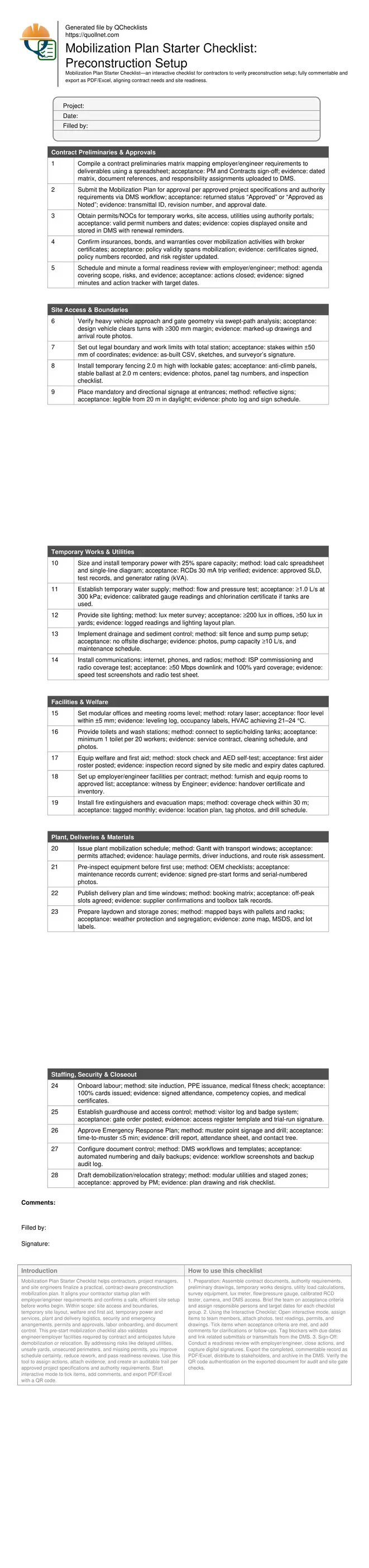
Contract Preliminaries & Approvals
Site Access & Boundaries
Temporary Works & Utilities
Facilities & Welfare
Plant, Deliveries & Materials
Staffing, Security & Closeout
Why mobilization planning matters before site works start
Mobilization converts contracts and intent into a safe, workable site. The best plans translate employer and engineer requirements into practical actions, evidence, and acceptance cues you can measure. Start by mapping obligations to submittals and permits, then time approvals to avoid idle plant and labour. Validate access geometry with swept-path checks and set boundaries with survey-grade control so deliveries and laydown do not clash with public roads or utilities. Commit to objective thresholds: clearance margins, lux levels, flow and pressure, and RCD trip values. These cues let supervisors sign confidently and keep audits quick. Build a readiness review with the employer’s representative to close actions before resources arrive. Capture every decision and reading in your DMS so the site can prove diligence at any time. This approach reduces change friction, keeps authorities satisfied, and protects the programme from the cost of late or unsafe starts.
- Tie requirements to measurable acceptance cues and evidence.
- Sequence permits to land before critical deliveries.
- Prove access safety using swept-path and survey data.
- Hold a readiness review with action closure.
Designing an efficient temporary site layout
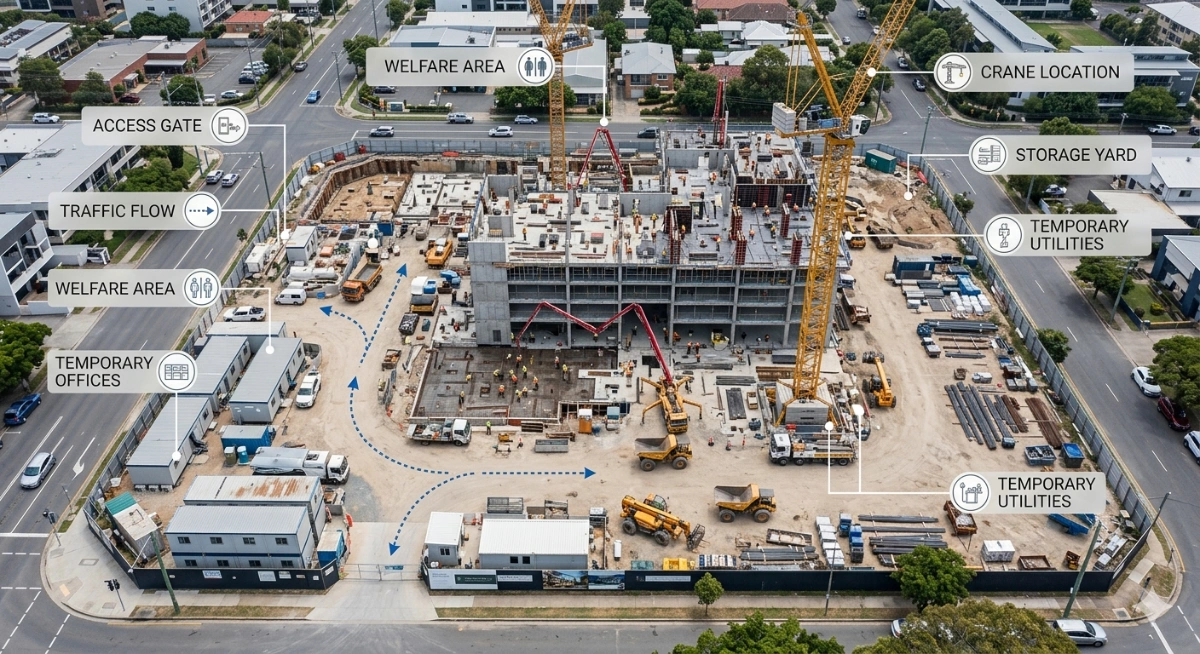
A clear temporary layout speeds work and minimizes incidents. Place offices, stores, workshops, welfare, and first aid to separate pedestrians from plant, using marked walkways and barriers. Light work areas to at least 50 lux and offices to 200 lux, verified by a calibrated meter. Provide drainage with silt control to prevent offsite discharge, and route temporary power with RCDs and lockable boards to avoid nuisance trips and shock risk. Zone laydown areas by material type, weight, and weather sensitivity; fit racks, pallets, and tarpaulins with tie-downs rated for local wind. Fix directional and mandatory signage where lines-of-sight are clear. Test radios across the yard and confirm internet bandwidth to support meetings, DMS, and remote approvals. Keep escape routes clear, post muster points, and check extinguishers cover all cabins within a 30 m reach.
- Separate pedestrians and plant with defined walkways.
- Verify lux levels using a calibrated meter.
- Install RCD-protected, lockable power distribution.
- Control silt and maintain clear drainage routes.
- Zone and protect materials by risk profile.
Controlling approvals, utilities, and safety baselines
Authority approvals and baseline tests should be complete before major deliveries. Submit the mobilization plan and temporary works designs through your DMS, track revisions, and only proceed on returned approvals per approved project specifications and authority requirements. Commission utilities with documented measurements: water flow and pressure, generator spare capacity, RCD trips, and earthing continuity where applicable. Record actuals on calibrated instruments and photo-log installations. Train guards, supervisors, and first aiders; issue radios and confirm the call tree. Conduct an emergency drill and record time-to-muster against target. Configure document control with auto-numbering and daily backups so permits, minutes, and evidence cannot be lost. Finally, prepare a demobilization approach that keeps offices and services modular to relocate or remove without disrupting ongoing work as site phases change.
- Only mobilize on returned approvals and permits.
- Record utility tests with calibrated instruments.
- Drill and document emergency response timing.
- Back up evidence daily in the DMS.
How to Use This Mobilization Plan Starter Checklist
- Preparation: Assemble contract documents, authority requirements, preliminary drawings, temporary works designs, utility load calculations, survey equipment, lux meter, flow/pressure gauge, calibrated RCD tester, camera, and DMS access. Brief the team on acceptance criteria and assign responsible persons and target dates for each checklist group.
- Using the Interactive Checklist: Open interactive mode, assign items to team members, attach photos, test readings, permits, and drawings. Tick items when acceptance criteria are met, and add comments for clarifications or follow-ups. Tag blockers with due dates and link related submittals or transmittals from the DMS.
- Sign-Off: Conduct a readiness review with employer/engineer, close actions, and capture digital signatures. Export the completed, commentable record as PDF/Excel, distribute to stakeholders, and archive in the DMS. Verify the QR code authentication on the exported document for audit and site gate checks.
Call to Action
- Start Checklist Tick off tasks, leave comments on items or the whole form, and export your completed report to PDF or Excel—with a built-in QR code for authenticity.
- Download Excel - Mobilization Plan Starter Checklist
- Download PDF - Mobilization Plan Starter Checklist
- View Image - Mobilization Plan Starter Checklist
Cite & Embed
“Mobilization Plan Starter Checklist by Quollnet”
with a link to
this source page.
FAQ
Question: When should I complete the Mobilization Plan Starter Checklist?
Question: What evidence should I capture for approvals and utilities?
Question: How do I adapt this checklist for small projects?
Question: What if an authority approval is delayed?
Related Articles
Broader reading and guidance connected to this checklist topic.

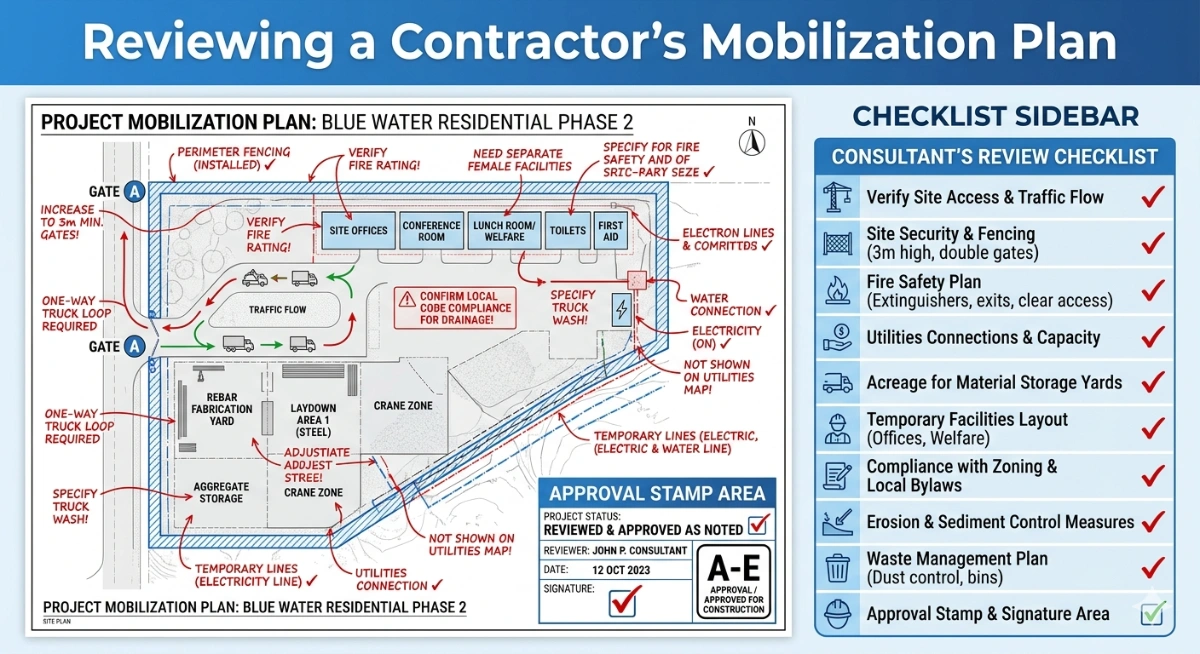
How To Review a Contractor’s Mobilization Plan

Eot Claim Checklist | Free Extension Of Time Submission Guide
Related Checklists
Keep the workflow moving with nearby templates chosen from similar checklist content.