First 30 Days Site Startup Checklist
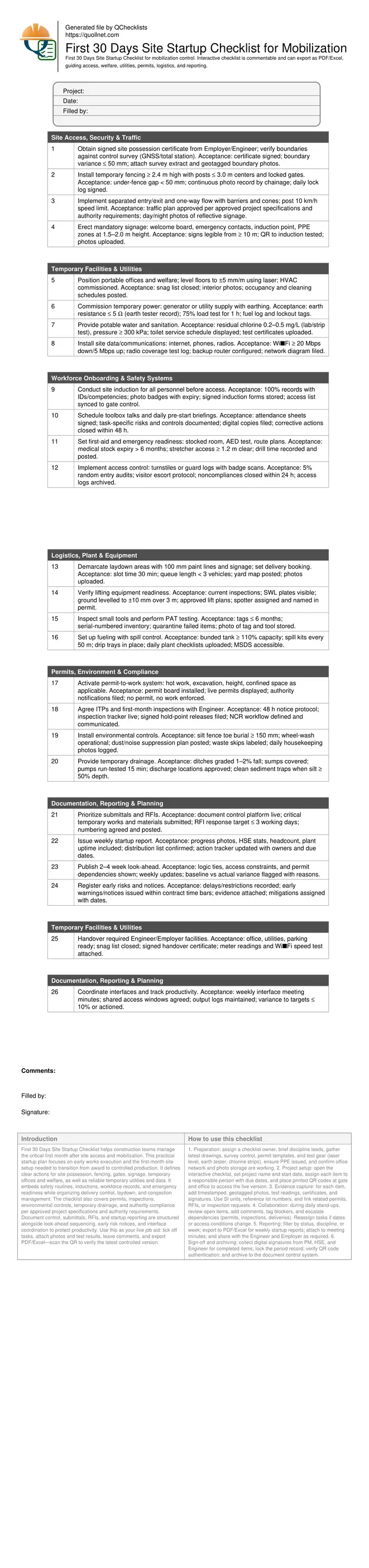
Definition: First 30 Days Site Startup Checklist guides site managers and supervisors through the first month after access, turning mobilization into organized early execution across safety, logistics, utilities, documentation, and compliance.
- Confirm access, secure perimeters, and control traffic from day one.
- Mobilize welfare, utilities, and data to support reliable early works.
- Lock in inductions, permits, and inspections to avoid stoppages.
- Interactive, commentable, export-enabled checklist with QR code verification.
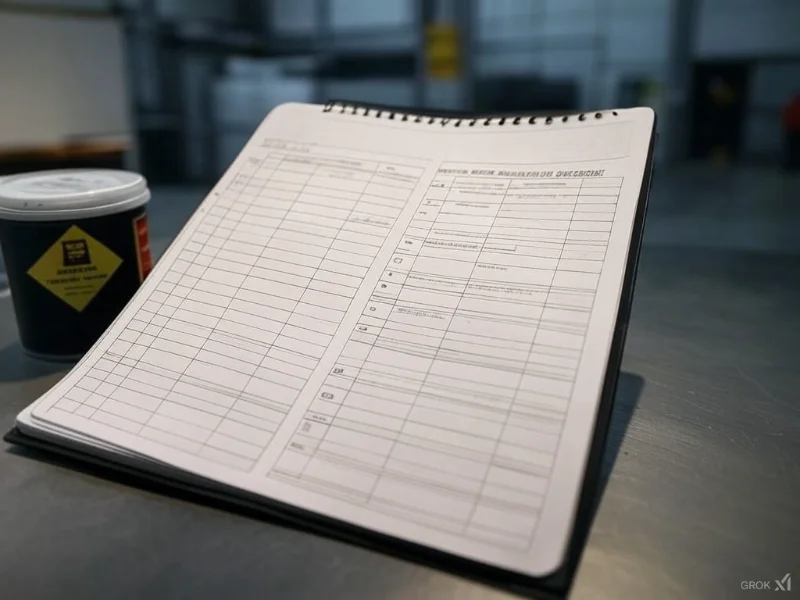
First 30 Days Site Startup Checklist helps construction teams manage the critical first month after site access and mobilization. This practical startup plan focuses on early works execution and the first-month site setup needed to transition from award to controlled production. It defines clear actions for site possession, fencing, gates, signage, temporary offices and welfare, as well as reliable temporary utilities and data. It embeds safety routines, inductions, workforce records, and emergency readiness while organizing delivery control, laydown, and congestion management. The checklist also covers permits, inspections, environmental controls, temporary drainage, and authority compliance per approved project specifications and authority requirements. Document control, submittals, RFIs, and startup reporting are structured alongside look-ahead sequencing, early risk notices, and interface coordination to protect productivity. Use this as your live job aid: tick off tasks, attach photos and test results, leave comments, and export PDF/Excel—scan the QR to verify the latest controlled version.
- Establishes a secure, compliant, and functional site within the first month by sequencing access, fencing, signage, and traffic controls alongside offices, welfare, and utilities. Evidence-based steps reduce ambiguity and create a defensible project record from day one.
- Builds reliable routines for inductions, supervision, emergency readiness, and plant availability so the workforce can operate safely and consistently. Acceptance criteria, test readings, and photos create objective proof that systems work under real jobsite conditions.
- Accelerates approvals with prioritized submittals, live RFI tracking, and defined inspections and hold points. Integrated environmental controls, temporary drainage, housekeeping, and waste segregation prevent stoppages and complaints while protecting adjacent stakeholders.
- Interactive online checklist with tick, comment, and export features secured by QR code.
Site Access, Security & Traffic
Temporary Facilities & Utilities
Workforce Onboarding & Safety Systems
Logistics, Plant & Equipment
Permits, Environment & Compliance
Documentation, Reporting & Planning
Temporary Facilities & Utilities
Documentation, Reporting & Planning
Secure Possession, Control Access, and Make Traffic Safe
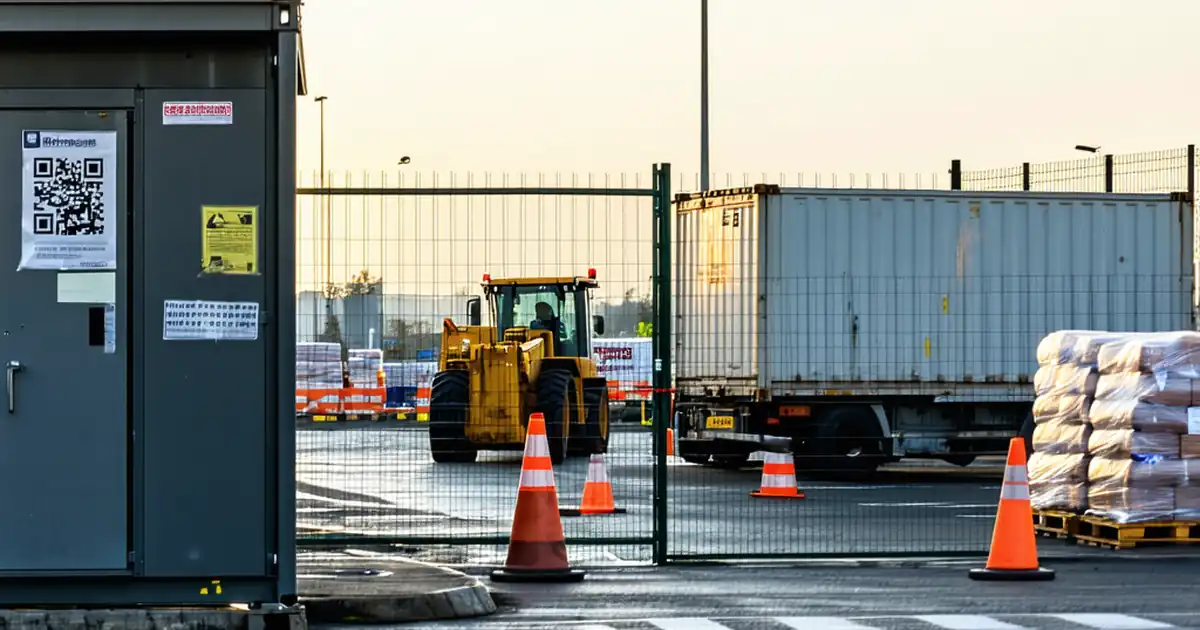
Early certainty begins with lawful site possession and clear physical control. Obtain the signed possession certificate and align boundaries to your survey control to avoid later disputes. Build a continuous, tamper-resistant fence with locked gates, then design traffic to separate pedestrians, deliveries, and plant. Post low speed limits and reflective signage per approved project specifications and authority requirements, and capture day/night photos to prove visibility. Create designated entry/exit points and one-way systems that support turning radii of large vehicles without reversing where possible. Publish emergency contacts, induction points, and PPE requirements at eye level. Use QR codes to drive workers to digital inductions and the live checklist. A simple booking system stabilizes deliveries and prevents gate congestion. Record every decision with photos, logs, and signatures so you can defend access, safety, and right-of-way at progress meetings.
- Signed possession plus survey variance within 50 mm.
- Fence height at least 2.4 m, gaps under 50 mm.
- One-way traffic, 10 km/h, reflective signs proven at night.
- Entry logs auditable; visitor protocol enforced.
Make Temporary Facilities and Utilities Reliable
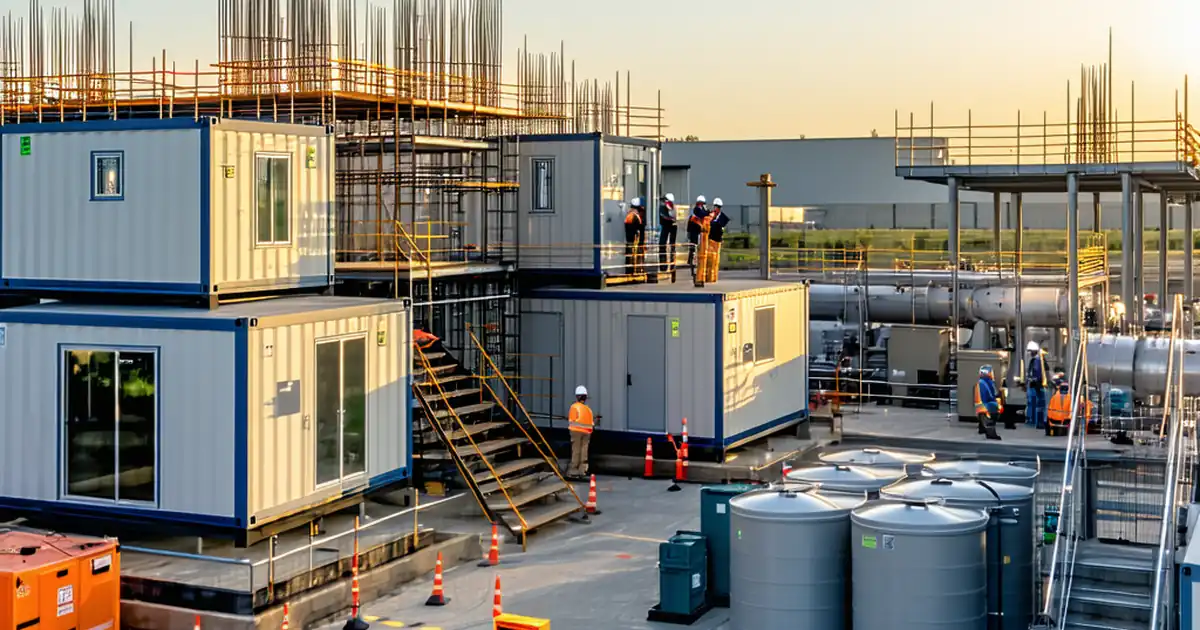
Portable offices and welfare must work from day one. Level cabins to tight tolerances to avoid door binding and water ponding. Commission HVAC, lighting, and power with a verified earth resistance and a documented load test so first meetings do not fail. Deliver potable water with tested residual chlorine and adequate pressure, and set predictable servicing for toilets and wash stations. Provide internet with measured throughput and radio coverage for field teams. Establish a secure fueling area with secondary containment and spill response. First-aid facilities, AEDs, extinguishers, and clear evacuation routes must be ready before work ramps up. These steps create dependable shelter, communications, and hygiene, enabling safe supervision and productive starts despite changing weather and delivery spikes.
- Earth resistance at or below 5 Ω.
- Wi‑Fi throughput meets or exceeds 20/5 Mbps.
- Residual chlorine 0.2–0.5 mg/L verified.
- Bunded fuel storage at 110% capacity.
- First-aid stocks within date range.
Lock in Controls: Permits, Environment, Documentation, and Look-Aheads
Administrative readiness prevents stoppages. Stand up a permit-to-work system that ties into your look-ahead so excavation, lifting, and hot work are never waiting on paperwork. Agree inspection test plans and hold points with the Engineer, and use a tracker with 48-hour notifications. Install environmental protections early: silt fences, wheel-wash, dust suppression, waste segregation, and temporary drainage with adequate falls. Stand up document control for priority submittals and live RFI registers; communicate numbering rules to every subcontractor. Issue a weekly startup report with photos and HSE data, and maintain a 2–4 week look-ahead that reflects access constraints, approvals, and interfaces. Finally, log early risks, restricted access, and potential delays; issue timely notices within contract time bars, and assign mitigation owners.
- Permits aligned with look-ahead windows.
- 48-hour inspection notice protocol live.
- Silt fence toe burial at least 150 mm.
- Submittals prioritized; RFI target ≤ 3 days.
- Risk register with actionable owners.
How to Use This Interactive Startup Checklist
- Preparation: assign a checklist owner, brief discipline leads, gather latest drawings, survey control, permit templates, and test gear (laser level, earth tester, chlorine strips), ensure PPE issued, and confirm office network and photo storage are working.
- Project setup: open the interactive checklist, set project name and start date, assign each item to a responsible person with due dates, and place printed QR codes at gate and office to access the live version.
- Evidence capture: for each item, add timestamped, geotagged photos, test readings, certificates, and signatures. Use SI units, reference lot numbers, and link related permits, RFIs, or inspection requests.
- Collaboration: during daily stand-ups, review open items, add comments, tag blockers, and escalate dependencies (permits, inspections, deliveries). Reassign tasks if dates or access conditions change.
- Reporting: filter by status, discipline, or week; export to PDF/Excel for weekly startup reports; attach to meeting minutes; and share with the Engineer and Employer as required.
- Sign-off and archiving: collect digital signatures from PM, HSE, and Engineer for completed items; lock the period record; verify QR code authentication; and archive to the document control system.
Call to Action
- Start Checklist Tick off tasks, leave comments on items or the whole form, and export your completed report to PDF or Excel—with a built-in QR code for authenticity.
- Download Excel - First 30 Days Site Startup Checklist
- Download PDF - First 30 Days Site Startup Checklist
- View Image - First 30 Days Site Startup Checklist
Cite & Embed
“First 30 Days Site Startup Checklist by Quollnet”
with a link to
this source page.
FAQ
Question: How do I scale this checklist for a small site without overloading the team?
Question: What minimum utilities must be operational before starting early works?
Question: How should we handle permits and inspections to avoid early delays?
Question: What’s the best way to track subcontractor compliance during mobilization?
Related Articles
Broader reading and guidance connected to this checklist topic.

Related Checklists
Keep the workflow moving with nearby templates chosen from similar checklist content.