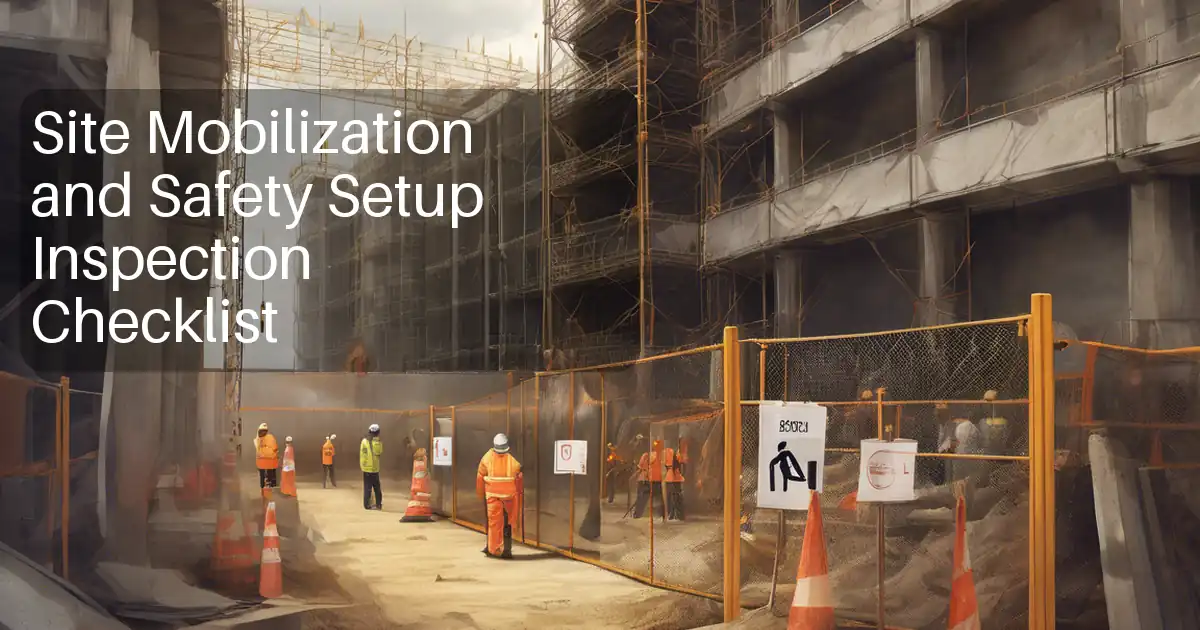
Contractor Mobilization Plan Review Checklist for Consultants
Definition: Contractor Mobilization Plan Review Checklist equips consultant/supervision teams to forensically audit contractor mobilization submittals, eliminate phasing conflicts, and verify logistics, heavy lifts, temporary utilities, and access before site start.
- Catch phase-blocking layouts early with overlays and 4D phasing.
- Demand quantified evidence, tolerances, and approvals before mobilization starts.
- Control cranes, routes, and utilities to avoid unsafe, costly rework.
- Interactive, commentable, export, QR code for traceable site sign-offs.
Contractor Mobilization Plan Review Checklist helps consultant and supervision teams scrutinize contractor mobilization submittals before site start. This mobilization review focuses on a construction mobilization plan’s logistics, phasing, and temporary works so the site can activate safely and efficiently. By rigorously assessing crane locations, access routes, laydown sizing, utilities, and staffing, you prevent hidden phasing conflicts and downstream blockages—like a phase 1 crane base that obstructs phase 2 works. The checklist guides a logistics and phasing review using overlays, 4D/time–location analysis, swept-path checks, and quantified acceptance criteria. It emphasizes verifiable evidence, approvals, and signatures per approved project specifications and authority requirements. Outcomes include safer lifts, clearer access, right-sized laydown, compliant permits, and a mobilization that supports—not hinders—the programme. Use this interactive tool to collaborate with contractors, assign actions, and track close-out. Start interactive mode to tick items, add comments, and export PDF/Excel with a secure QR for traceable sign-off.
- Use this consultant-focused checklist to interrogate contractor mobilization plans with overlays, 4D phasing, swept-path analysis, and quantified tolerances. Capture evidence, approvals, and signatures to avoid phase clashes, blocked access, and rework before boots hit the ground.
- Mitigate crane, utilities, and logistics risks by demanding stamped drawings, load schedules, lift studies, and geotechnical bearing checks. The process verifies capacities, clearances, buffers, and permits per approved project specifications and authority requirements.
- Interactive online checklist with tick, comment, and export features secured by QR code.
- Drive accountability with action owners, deadlines, and traceable records. Field teams attach photos, mark-ups, and registers; office teams align programme, laydown readiness, and deliveries. The result is a safe, compliant, and phased mobilization that protects schedule and budget.
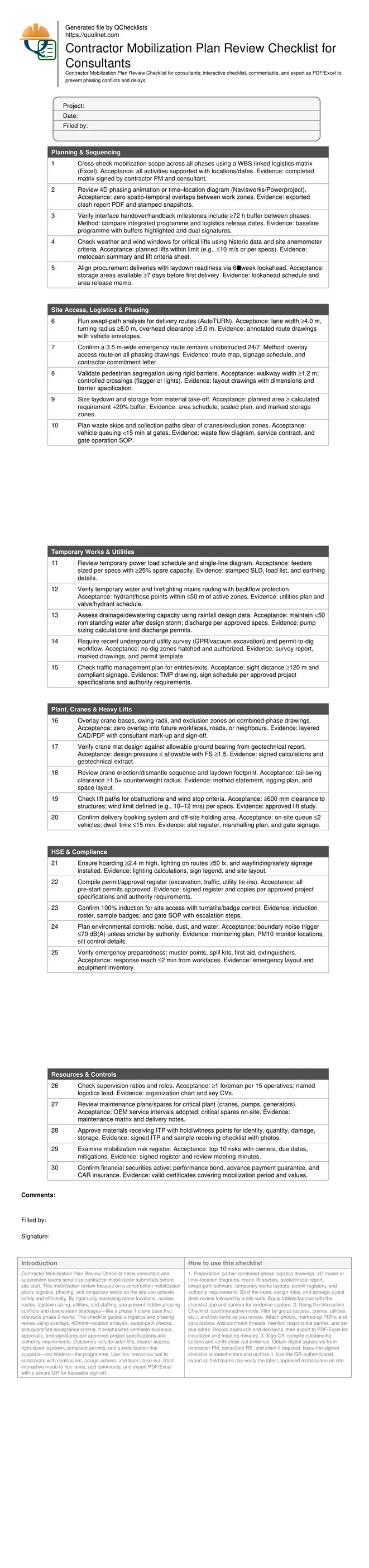
Planning & Sequencing
Site Access, Logistics & Phasing
Temporary Works & Utilities
Plant, Cranes & Heavy Lifts
HSE & Compliance
Resources & Controls
Why a rigorous mobilization review prevents phase conflicts
Mobilization activates the site’s physical backbone—access, laydown, cranes, power, and controls. If these are placed for today but ignore tomorrow, later phases stall. A consultant-led review interrogates the submittal for spatial and temporal conflicts that typical narratives miss. Overlay crane radii on all phases, confirm access corridors remain open during handbacks, and right-size storage to avoid choke points. Examine how temporary utilities are routed so connections and isolations do not cut off active workfaces. Require evidence, not intentions: stamped drawings, capacity calculations, and interface buffers. This disciplined approach blocks common pitfalls like a phase 1 crane pad stranded in a phase 2 foundation or cabins sitting on future utility trenches. Early detection protects safety, schedule, and cost by removing conflicts before resources mobilize, while still cheap to change.
- Overlay logistics across all phases, not just phase one.
- Demand quantified capacities, clearances, and buffers.
- Keep emergency and public access open at all times.
- Require signatures on drawings and registers.
Evidence-based methods and acceptance cues for consultants
Use tools that produce verifiable outputs. 4D phasing or time–location diagrams demonstrate when two crews try to share the same space. Swept-path analysis shows whether delivery vehicles can safely negotiate gates and internal turns. Load schedules and single-line diagrams validate power capacity and spare headroom. Geotechnical data justifies crane mat design and bearing pressures. Lift studies define clearances and wind limits. Each method has acceptance cues: minimum widths and radii, buffers between phases, spare capacity percentages, and documented stop criteria. Enforce a consistent rule: if it is not drawn, calculated, scheduled, or signed, it is not approved. Close gaps by marking up combined-phase drawings, attaching calculations, and referencing permit registers. This makes decisions auditable and resistance-proof during execution.
- Prefer overlays and models to verbal assurances.
- Tie every item to drawings, calcs, or registers.
- Define pass/fail thresholds early and visibly.
- Record comments and decisions with dates.
Common tricks and robust countermeasures
Contractors may position a crane perfectly for early lifts but block later works, propose laydown where future foundations sit, or route temporary power across upcoming excavations. Counter these by demanding combined-phase overlays and dismantle logistics, not just initial setups. Require delivery booking with off-site holding to prevent road congestion. Insist on recent underground surveys before fencing or cabins go in. Validate environmental controls with measurable triggers and monitoring locations. Confirm supervision ratios and named logistics leads so responsibilities are clear. Finally, lock in approvals: permit registers, insurance certificates, and stamped drawings. When everything is evidenced and signed, tactics that rely on ambiguity lose power—and the project stays buildable through every phase.
- Look for perfect-now, impossible-later equipment positions.
- Check utility routes against future excavations.
- Demand dismantle and back-out plans, not only setups.
- Use booking and monitoring to control variability.
How to Use This Interactive Mobilization Plan Review Checklist
- Preparation: gather combined-phase logistics drawings, 4D model or time–location diagrams, crane lift studies, geotechnical report, swept-path software, temporary works layouts, permit registers, and authority requirements. Brief the team, assign roles, and arrange a joint desk review followed by a site walk. Equip tablets/laptops with the checklist app and camera for evidence capture.
- Using the Interactive Checklist: start interactive mode, filter by group (access, cranes, utilities, etc.), and tick items as you review. Attach photos, marked-up PDFs, and calculations. Add comment threads, mention responsible parties, and set due dates. Record approvals and decisions, then export to PDF/Excel for circulation and meeting minutes.
- Sign-Off: compile outstanding actions and verify close-out evidence. Obtain digital signatures from contractor PM, consultant RE, and client if required. Issue the signed checklist to stakeholders and archive it. Use the QR-authenticated export so field teams can verify the latest approved mobilization on site.
Call to Action
- Start Checklist Tick off tasks, leave comments on items or the whole form, and export your completed report to PDF or Excel—with a built-in QR code for authenticity.
- Download Excel - Contractor Mobilization Plan Review
- Download PDF - Contractor Mobilization Plan Review
- View Image - Contractor Mobilization Plan Review
Cite & Embed
“Contractor Mobilization Plan Review by Quollnet”
with a link to
this source page.
FAQ
Question: What should a contractor mobilization plan review include?
Question: When should the mobilization plan be reviewed and revalidated?
Question: How can we detect a crane location that will block later phases?
Question: What evidence must we require before approving mobilization?
Related Articles
Broader reading and guidance connected to this checklist topic.
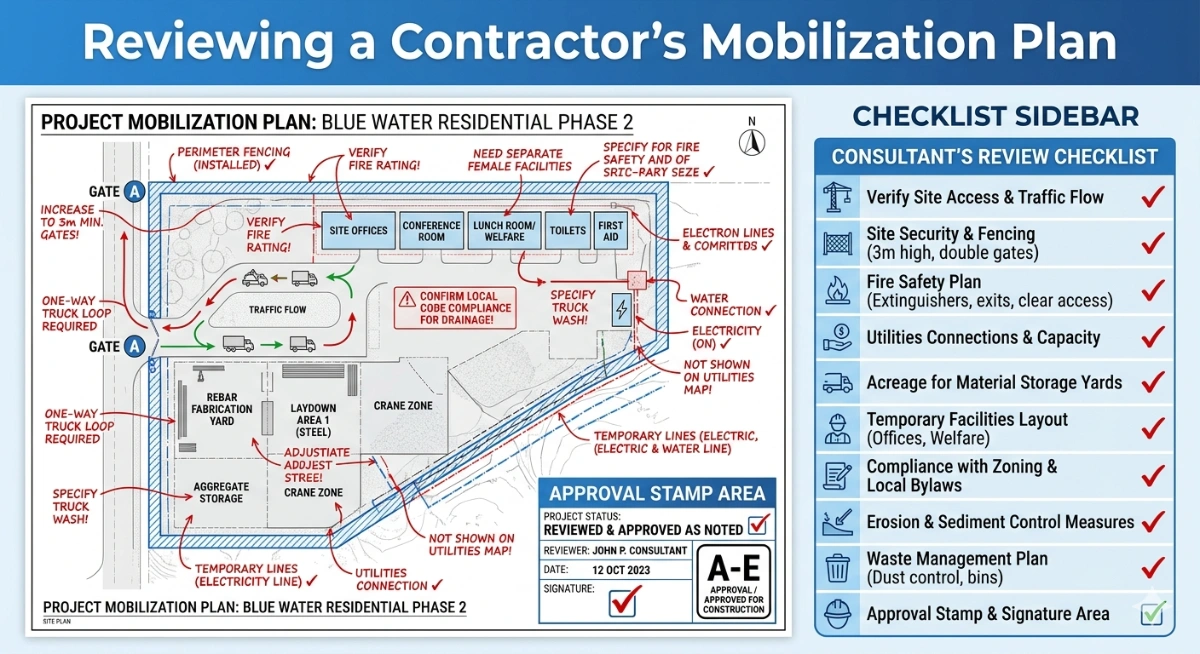
How To Review a Contractor’s Mobilization Plan


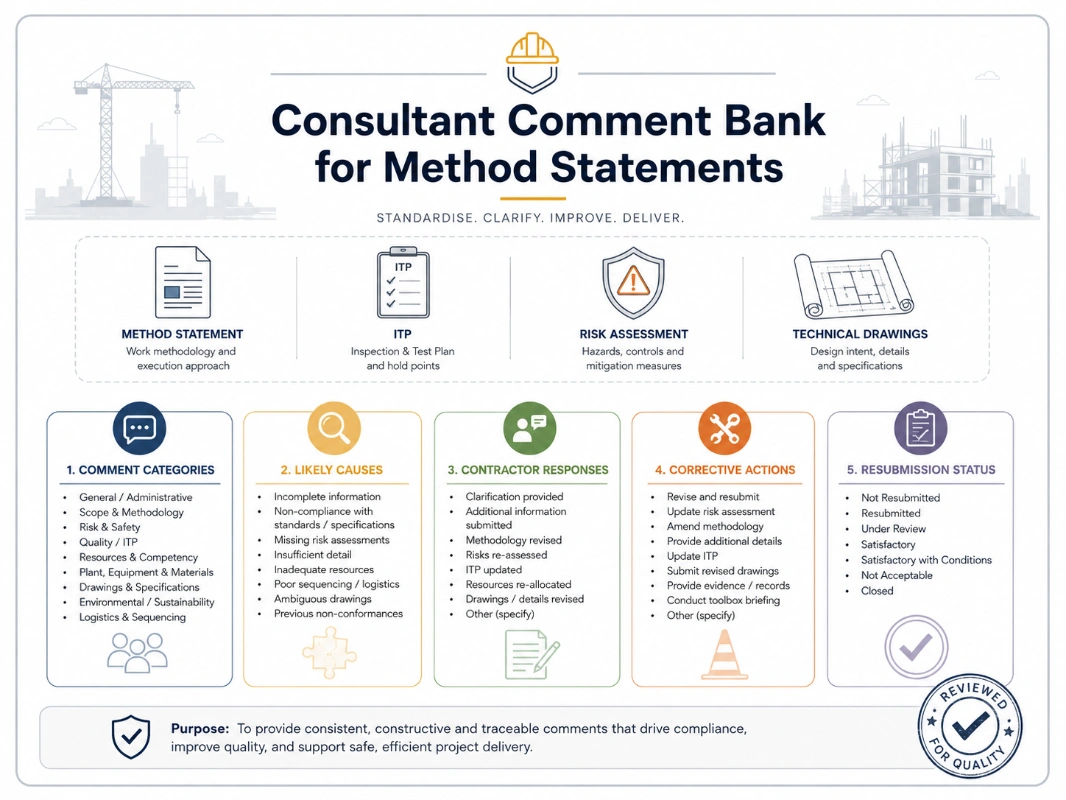
Consultant Comment Bank For Method Statements
Related Checklists
Keep the workflow moving with nearby templates chosen from similar checklist content.