G
Guest

As-Planned vs. As-Built Analysis | Construction Delay Method

Learn how As-Planned vs. As-Built analysis is used to evaluate construction delays. Understand the steps, advantages, challenges, and when to apply it for EOT claims or dispute resolution.

As-Planned vs. As-Built Analysis | Construction Delay Method
English version

As-Planned vs. As-Built Analysis in Construction Projects

Introduction

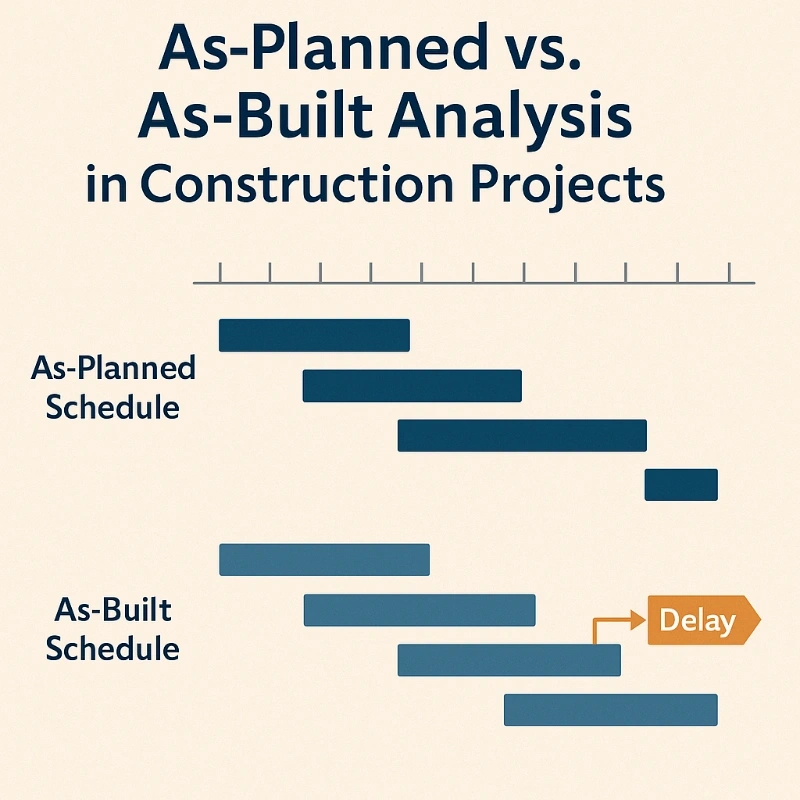
As-Planned vs. As-Built analysis is one of the most commonly used retrospective methods for assessing construction delays. It compares what was originally scheduled (the as-planned program) to what actually happened (the as-built timeline) to determine the extent and cause of delays. It is widely accepted in post-project delay claims and disputes.


1. What Is As-Planned vs. As-Built?

This method involves overlaying the original construction schedule with actual progress records. Delays are identified by analyzing variances between planned and actual task start and finish dates. This approach helps determine whether delays were:

  • Caused by the contractor

  • Due to client-side issues

  • Unforeseen external factors

Itโ€™s best used after project completion or when sufficient actual data is available.
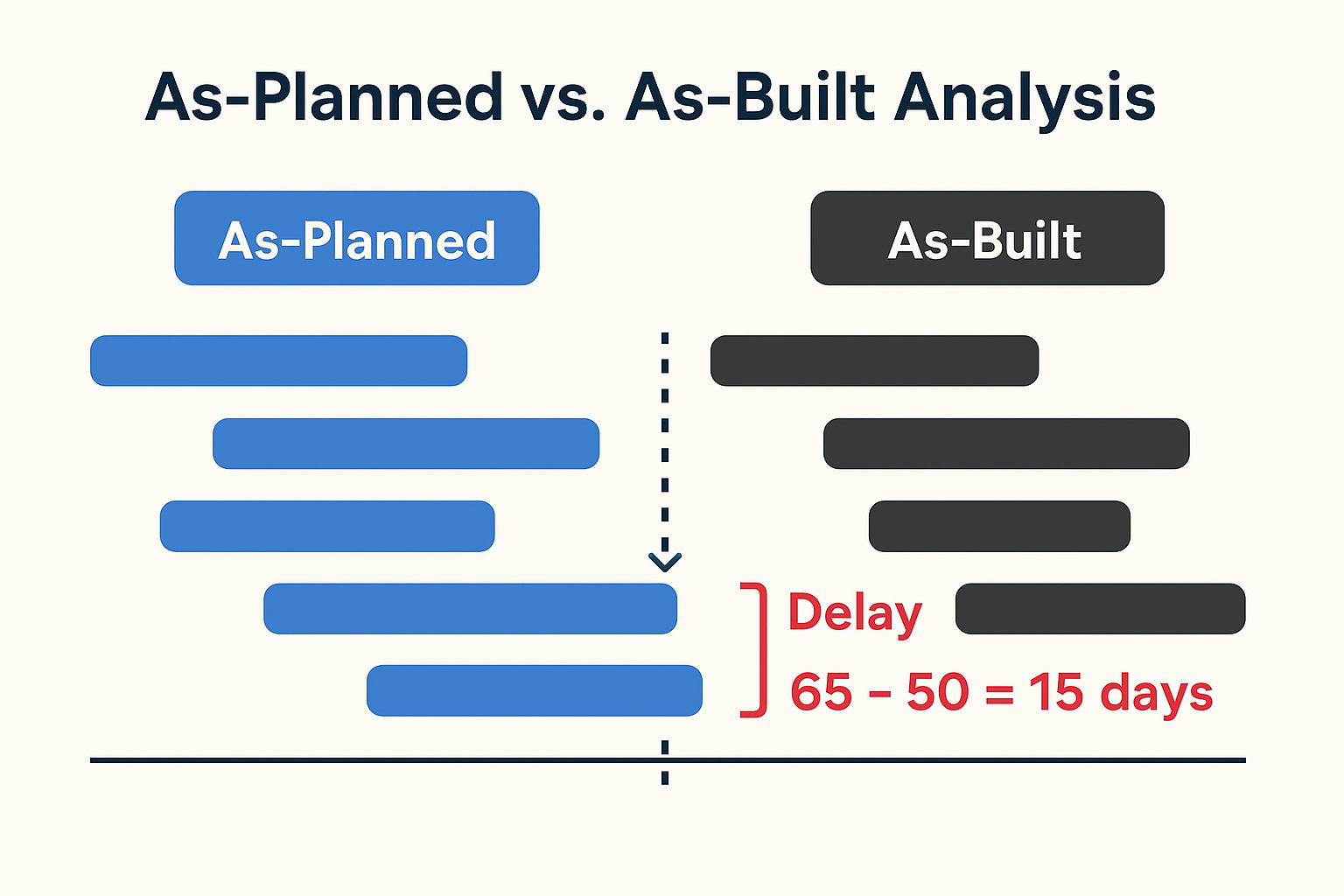
as planned vs as built analysis compare


2. How the Analysis Works

  • Step 1: Collect the baseline (as-planned) schedule and progress updates.

  • Step 2: Build or extract the as-built schedule using site records, daily reports, and updates.

  • Step 3: Compare activity-by-activity to highlight deviations.

  • Step 4: Identify impacts on the projectโ€™s critical path and completion date.


3. Example Application

If the as-planned schedule shows โ€œSteel Deliveryโ€ on Day 45 but the as-built record shows it occurred on Day 70, the delay is 25 days. By checking if this task was on the critical path, the analyst can determine whether this delay impacted the overall project delivery.

as Planned vs As Built method real example


4. Contractual Relevance

Contracts such as FIDIC, NEC, and JCT accept this method for evaluating claims after delays have occurred, especially when prospective methods like TIA are no longer suitable.

However, its reliability depends on:

  • A valid baseline schedule

  • Accurate and detailed as-built records


5. Pros and Cons

Aspect Pros Cons
Timing Good for completed or nearly-complete projects Not useful for live project forecasting
Simplicity Clear comparison of scheduled vs. actual May oversimplify complex concurrent delays
Acceptance Common in arbitration Can be challenged if records are inconsistent

6. Common Challenges

  • Inconsistent or missing progress updates

  • Manipulation of as-built data to influence outcome

  • Overlooking logical sequencing and float consumption

  • Not accounting for weather or force majeure impacts


7. Best Practices

  • Maintain detailed daily logs, schedules, and updates throughout the project.

  • Use software like Primavera P6 or MS Project with audit trails.

  • Pair this method with delay event logs and change order records for better accuracy.


8. Tools to Support Your Delay Analysis

Accurate As-Planned vs. As-Built analysis starts with structured documentation and clarity. To streamline your delay evaluation and EOT claims, download these free, ready-to-use tools:


Conclusion

As-Planned vs. As-Built is a foundational technique for understanding construction delays after the fact. When supported by reliable data and used with critical path analysis, it provides a clear view of what went wrong, when, and whyโ€”making it valuable in both claims preparation and forensic delay analysis.

Elie Saad's photo
Elie Saad
Apr 19, 2025
9
108
1.34k+
5.63k+

As-Planned vs. As-Built Analysis | Construction Delay Method

Frequently Asked Questions


FAQ

Q: What is As-Planned vs. As-Built analysis in construction?

A: Itโ€™s a retrospective method comparing the original project schedule with the actual sequence of work. For example, if an activity was planned to finish on Day 50 but actually finished on Day 65, the delay = 65 - 50 = 15 days. This variance helps pinpoint responsibility and impact.

FAQ

Q: When is As-Planned vs. As-Built analysis used?

A: It's typically used post-project, especially when submitting Extension of Time (EOT) claims. For instance, if your as-built timeline shows cumulative delays of 30+ days on the critical path, this analysis helps justify time entitlement.

FAQ

Q: Is As-Planned vs. As-Built accepted in arbitration or court?

A: Yes. Industry data shows that over 60% of retrospective delay claims presented in formal dispute settings use this method or a variation of it. Its success depends on maintaining daily reports, approved baseline schedules, and consistent progress updates.

FAQ

Q: What are the main limitations of this method?

A: It does not account for logic-driven float consumption or concurrency unless combined with Critical Path Method (CPM) analysis. A delay on a non-critical activity might show a variance but not affect the projectโ€™s finish date, so not all delays equal entitlement.

FAQ

Q: How does it compare to Time Impact Analysis (TIA)?

A: As-Planned vs. As-Built looks backward, TIA looks forward. If TIA inserts a 10-day fragnet into an ongoing schedule, As-Planned vs. As-Built would reveal a 10-day overrun only after the event occurred. Both can be used together for more robust delay justification.

Related Checklists


Verify substructure as-built survey: acceptance checklist
โœ… 29 items
Verify substructure as-built survey is a focused quality-assurance process to confirm constructed dimensions and elevations match the issued design. This checklist guides surveyors and site engineers through as-built verification, including control checks, foundation survey procedures, substructure geometry validation, and elevation checks. It sets practical tolerances, clarifies evidence requirements, and details how to update records and secure acceptance without drifting into closeout documentation. By following a consistent methodโ€”control, measure, compare, reportโ€”you reduce rework, avoid clashes with superstructure elements, and prevent costly schedule impacts. Outcomes include defensible survey records, redlined drawings, updated CAD/BIM models, and traceable approvals aligned to the projectโ€™s coordinate system and vertical datum. Use this interactive page to tick tasks, add comments where deviations occur, attach photos and files, and export as PDF/Excel with a secure QR that links stakeholders to the approved record set.
Nominated Subcontractor Proposal/Instruction Review Checklist
โœ… 24 items
Nominated Subcontractor Proposal/Instruction Review Checklist provides a structured, internal form for contractors to assess a proposed or instructed nomination before acceptance, conditional acceptance, or objection. This practical nomination review consolidates scope definition, programme and sequencing, commercial exposure, technical capability, and contractual protection in one place. Within the first pass, you will surface interface gaps, builderโ€™s work in connection, temporary works responsibilities, lead times, authority approvals, and back-to-back obligations per approved project specifications and authority requirements. The checklist avoids common risks such as misaligned LD caps, inadequate insurance limits, weak pass-through of delay damages, unclear warranty terms, and unfunded advance payments. Outcomes are decision-ready, evidence-backed, and immediately distributable to project controls, procurement, and commercial leads. Use the interactive mode to tick items, add comments, attach proofs, and export to PDF/Excel with a QR-secured audit trail.
As-Built Surveys and Dimensional Checks Inspection Checklist
โœ… 15 items
As-built surveys and dimensional checks are critical processes in the construction industry, ensuring that the completed work aligns with the original design specifications. This inspection involves comparing the as-built conditions of a construction project with the planned drawings to identify any discrepancies. By conducting thorough dimensional checks, contractors can ensure quality control, compliance with standards, and avoid costly rework. This checklist is designed to facilitate a structured inspection process, allowing users to tick off items, leave comments, and export the completed report as a PDF or Excel file, secured with a QR code for authenticity.
Elevator Pit and Machine Room Inspection Checklist
โœ… 10 items
This checklist is designed for professionals tasked with inspecting elevator pits and machine rooms prior to equipment installation. It ensures that all necessary preparations, safety checks, and compliance measures are thoroughly addressed. By following this comprehensive guide, inspectors can identify potential issues that could delay installation or pose safety risks. Regular use of this checklist helps maintain high standards of safety, operational efficiency, and regulatory compliance.
Verify Sheet Pile Toe Level and Driving Criteria Guide
โœ… 24 items
Verify sheet pile toe level and driving criteria with this focused, field-ready checklist. It guides you through sheet pile driving verification, including penetration criteria, blow counts per 250 mm, refusal confirmation, obstruction handling, and accurate as-built documentation. The scope covers steel sheet pile installation only, emphasizing toe elevation checks, driving logs, hammer energy control, and survey validation. By staying within this scope, you reduce the risk of false refusal, bent sheets, damaged interlocks, inadequate embedment, and incomplete records that can delay approvals or compromise wall performance. You will capture evidence for each sheet: set per blow, verticality observations, toe level survey shots, groundwater context, and obstruction treatmentsโ€”ready for engineer review. The outcome is a defensible record proving design penetration and refusal were achieved per approved project specifications and authority requirements. Use the interactive features to tick items, add comments for variances, and export your as-built package to PDF/Excel with a project QR code.

Related Articles


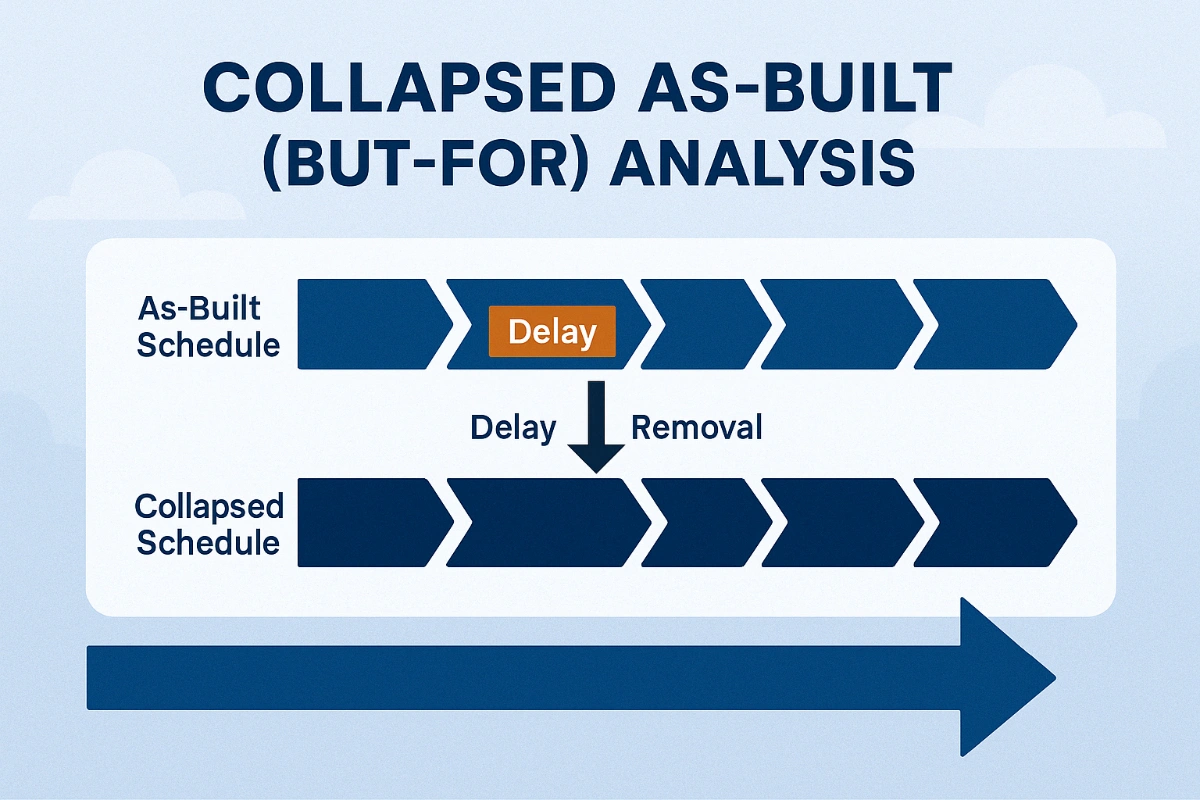
Collapsed As Built
โณ 3 min read
Collapsed As-built (but-for) Analysis | Construction Delay Method
Discover how Collapsed As-Built (But-For) analysis helps evaluate delays in completed construction projects. Learn when to use it, how it works, and how it supports forensic delay claims.
Time Impact Analysis
โณ 2 min read
Time Impact Analysis (tia) | Construction Delay Method
Master Time Impact Analysis (TIA), the leading prospective method for assessing construction delays. Understand its use, contract requirements, and best practices.
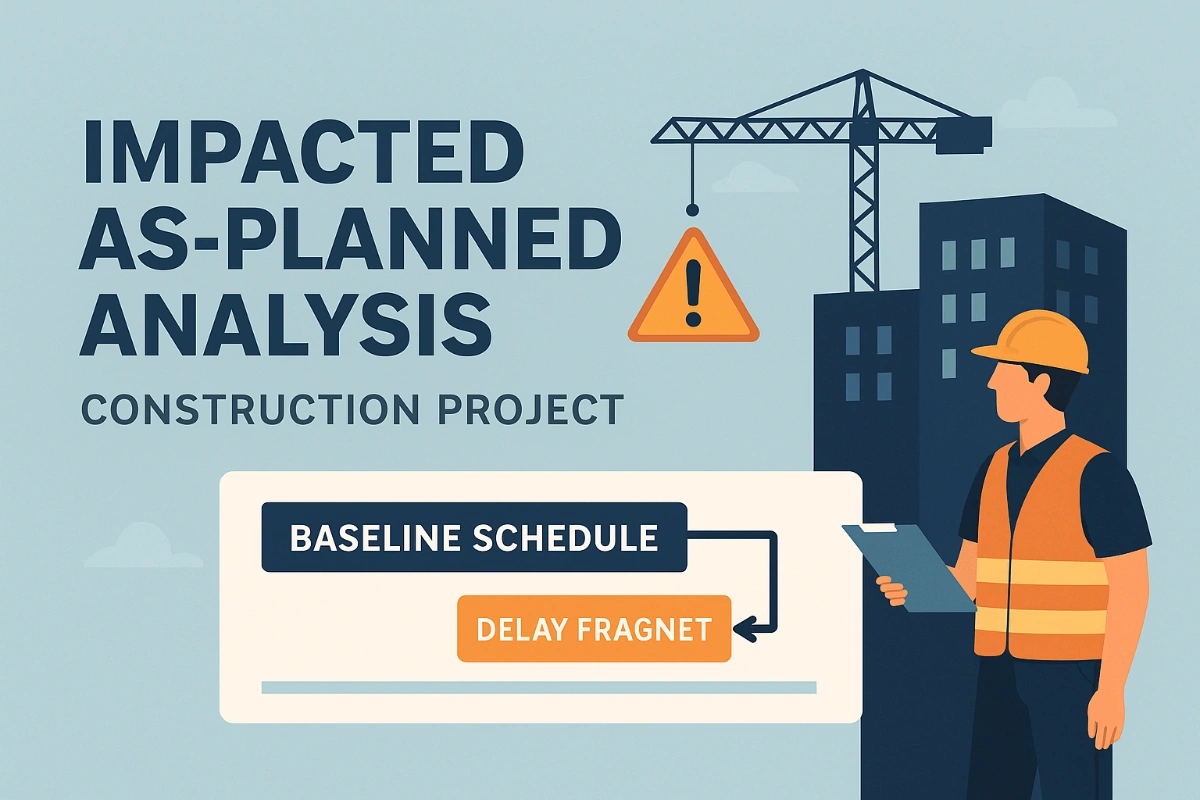
Impacted As Planned
โณ 3 min read
Impacted As-planned Analysis | Construction Delay Method
Understand how Impacted As-Planned (IAP) analysis is used to model construction delays based on baseline schedules. Learn how to perform IAP, when to use it, and how it compares to TIA and other delay methods.
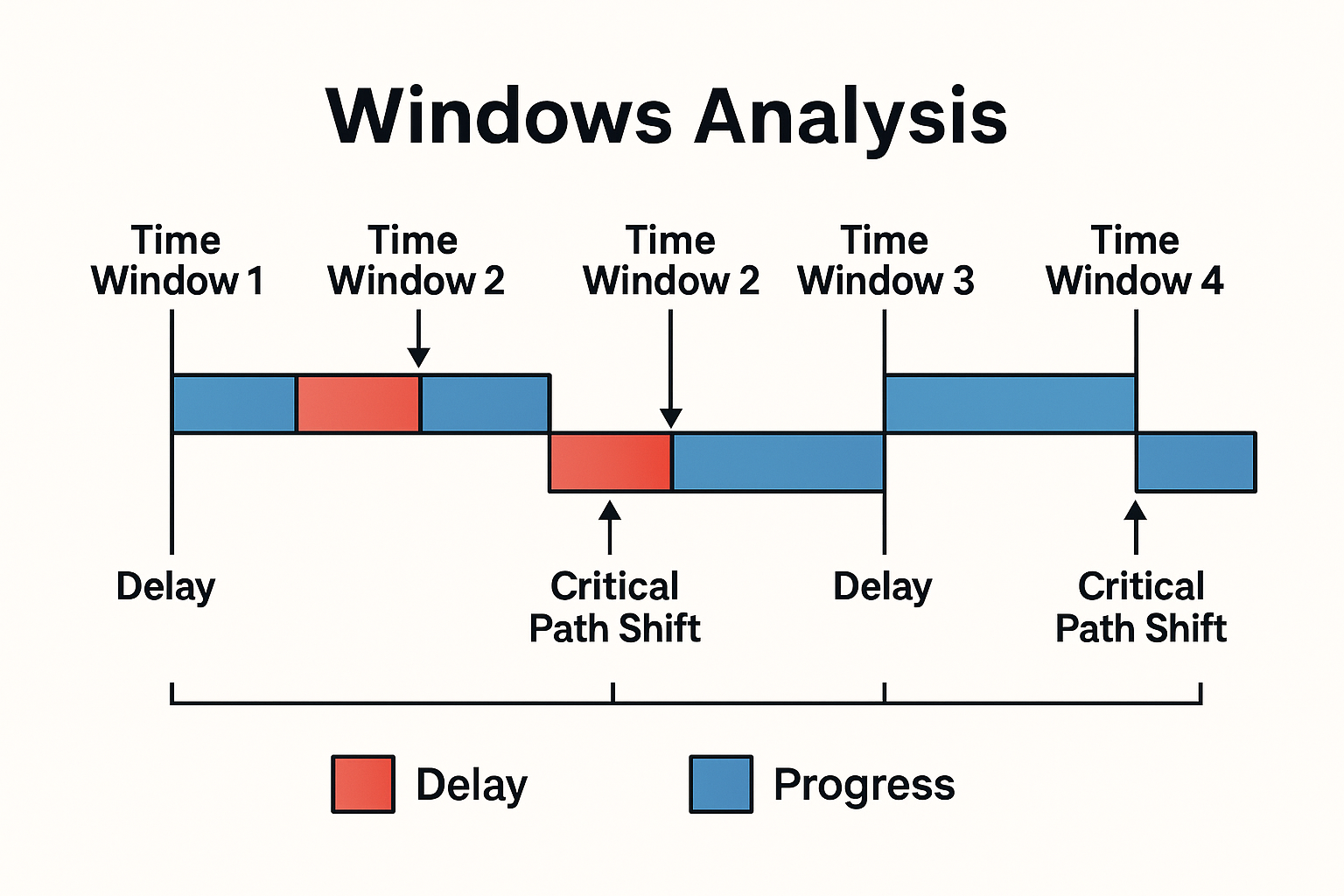
Windows Analysis
โณ 3 min read
Windows Analysis | Construction Delay Evaluation Method
Learn how Windows Analysis blends prospective and retrospective methods to accurately evaluate construction delays. Explore window selection, critical path shifts, and legal considerations.
Delay Analysis Construction
โณ 4 min read
Delay Analysis In Construction | Methods, Legal Claims, Eot Tools, And Ai Assistant
Learn about top delay analysis methods in construction, legal strategies for EOT claims, and access free tools including the free DelayClaims AI Assistant, method selector excel and others.