Test façade handover records, certificates, and test reports for completeness so QA managers confirm every mandatory document is present, accurate, signed, traceable, and organized before client acceptance and defects liability commencement.
- Cover contract deliverables matrix, as-built data, O&M, warranties, and approvals.
- Verify dates, signatures, calibration, and traceability against project specifications.
- Cross-check test outcomes with acceptance criteria; log deviations, actions, and re-tests.
- Interactive, commentable checklist with export and QR code verification.
The checklist
Document Control & Indexing
- Validate the master deliverables index against the approved contract deliverables matrix; method: side-by-side comparison; acceptance: 100% required façade documents listed; evidence: signed index and gap log.
- Enforce approved naming, numbering, and version control in the DMS; method: batch audit; acceptance: zero orphan or duplicate files; evidence: audit report screenshot.
- Confirm file formats per approved project specifications (PDF/A for records, searchable text, native CAD with Xrefs); method: file properties check; acceptance: all compliant; evidence: export of format report.
- Verify revision history shows preparer, reviewer, and approver with dates; method: stamp/signature check; acceptance: complete approval chain present; evidence: photos/PDFs of stamped pages.
- Check transmittals reference correct packages and issue dates fall within the agreed handover window; method: transmittal register review; acceptance: no missing transmittals; evidence: signed transmittal sheets.
Contract & Specification Alignment
- Cross-check each document’s content against approved project specifications and authority requirements; method: 10% spot-check per category; acceptance: zero major deviations; evidence: annotated checklist with references.
- Verify supplier/subcontractor approvals for façade systems and key components; method: approval letters review; acceptance: approvals issued before installation; evidence: compiled approval pack.
- Ensure as-built drawings reflect final installed details and interfaces; method: overlay redlines with site photos; acceptance: discrepancies resolved; evidence: signed marked-up overlays.
- Confirm all deviations/NCRs related to façade materials and methods are closed; method: NCR register check; acceptance: zero open NCRs; evidence: closure certificates and updated register.
Product Certificates & Traceability
- Match product certificates (panels, glass, frames, anchors, sealants) to batch/lot numbers; method: cross-reference labels; acceptance: one-to-one match; evidence: photos of labels and certificate references.
- Check fire-related declarations for relevant façade materials; method: scope verification vs product and assembly; acceptance: valid, signed, and aligned to installed configuration; evidence: declarations with dates.
- Verify protective coating/anodizing warranties state thickness and durability requirements; method: warranty review; acceptance: duration covers defects liability plus agreed buffer; evidence: warranty letters with terms.
- Confirm glazing certificates list glass make-up, edge treatment, and heat-soak (if applicable); method: certificate vs shop drawing check; acceptance: details align; evidence: initialed certificate copies.
- Validate façade access/maintenance equipment certificates and load ratings; method: certificate review; acceptance: current and suitable for installed systems; evidence: certificates with equipment IDs.
Testing & Inspection Reports
- Review water penetration and air leakage test reports; method: compare pressures/results to acceptance criteria; acceptance: pass or documented remedial actions; evidence: signed summary sheet.
- Check structural tests (proof load, pull-out, bracket deflection) include instrument calibration; method: verify calibration within 12 months of test; acceptance: valid certificates; evidence: attached calibration certs.
- Verify sealant adhesion/compatibility tests match installed substrates and sealant lots; method: cross-check product IDs; acceptance: pass; evidence: lab reports with test photos.
- Confirm thermal performance calculations reflect as-built configuration and coatings; method: parameter comparison; acceptance: U-value and SHGC within specified limits; evidence: calculation sheets signed.
- Ensure site inspection records cover every elevation and typical/atypical details; method: sampling plan review; acceptance: 100% locations signed off; evidence: inspection maps with signatures.
- Validate leak investigations and remedial works are closed with re-test passes; method: compare before/after records; acceptance: no outstanding leaks; evidence: re-test certificates attached.
Handover Sign-offs & Warranty
- Assemble O&M manuals covering cleaning, maintenance cycles, access, and replacement parts; method: content checklist; acceptance: complete and legible; evidence: signed table of contents.
- Collect training records for building operators on façade access/maintenance; method: attendance logs; acceptance: names, dates, and topics recorded; evidence: signed attendance sheets.
- Confirm main contractor, specialist subcontractor, and client sign-offs; method: digital signatures; acceptance: all parties sign; evidence: e-signed completion certificates with timestamps.
Digital Archive & Security
- Generate an immutable archive of all façade documents; method: export to PDF/A and hash; acceptance: checksum log stored; evidence: hash report with timestamps.
- Enable a QR code linking to the verified archive index; method: QR generator; acceptance: scans open correct index; evidence: test screenshots of scan results.
- Set role-based permissions and daily off-site backups; method: admin configuration; acceptance: backup logs show last 24 h; evidence: exported admin report.
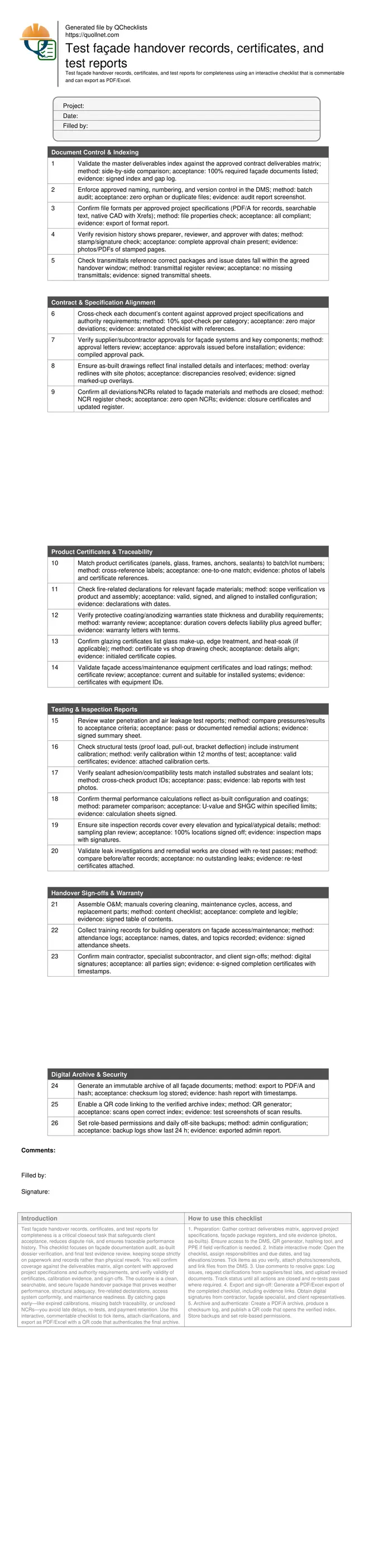
Preview the printable checklist
Preview page one below. Open the image or download the PDF for all pages.
At a glance
- This checklist delivers a reliable method for validating the completeness of façade handover records, certificates, and test reports. It aligns documentation with the deliverables matrix, checks signatures and dates, and confirms content accuracy against approved project specifications and authority requirements.
- It emphasizes traceability: linking product batch numbers to certificates, matching test parameters to acceptance criteria, and ensuring calibration certificates are current. The result is a defensible audit trail that withstands client, insurer, and third-party review at closeout and throughout the defects liability period.
- Interactive online checklist with tick, comment, and export features secured by QR code.
- Practical acceptance cues—such as 100% coverage of elevations, valid instrument calibration within 12 months of testing, and zero open NCRs—guide teams to quick decisions. Evidence capture (photos, screenshots, signed sheets, hash logs) ensures each requirement is verifiable and sharable across stakeholders.
How to Use This Checklist
- Preparation: Gather contract deliverables matrix, approved project specifications, façade package registers, and site evidence (photos, as-builts). Ensure access to the DMS, QR generator, hashing tool, and PPE if field verification is needed.
- Initiate interactive mode: Open the checklist, assign responsibilities and due dates, and tag elevations/zones. Tick items as you verify, attach photos/screenshots, and link files from the DMS.
- Use comments to resolve gaps: Log issues, request clarifications from suppliers/test labs, and upload revised documents. Track status until all actions are closed and re-tests pass where required.
- Export and sign-off: Generate a PDF/Excel export of the completed checklist, including evidence links. Obtain digital signatures from contractor, façade specialist, and client representatives.
- Archive and authenticate: Create a PDF/A archive, produce a checksum log, and publish a QR code that opens the verified index. Store backups and set role-based permissions.
Build a reliable façade dossier that stands up to review
A rigorous façade handover dossier proves what was installed, how it performs, and who approved it. Start with an agreed deliverables matrix and use it to drive a master index that captures drawings, as-built changes, test evidence, warranties, O&M content, approvals, and close-out certificates. Apply strict naming and version control so every file is uniquely identifiable and retrievable. Confirm that each document is legible, searchable (for PDFs), and linked to the correct elevation, zone, and package. When gaps appear—like missing batch references, unsigned test summaries, or unclear acceptance notes—log them immediately and assign actions with due dates. Close coordination between the façade specialist, main contractor, and client representative accelerates issue resolution and eliminates late surprises. Finish by exporting an immutable archive with a checksum log and an index that maps documents to systems and locations, enabling fast audits months or years later.
- Drive content from an agreed deliverables matrix.
- Enforce naming, numbering, and version control.
- Link documents to elevation, zone, and package.
- Log gaps with owners and due dates.
- Export an immutable, indexed archive.
Verify tests, instruments, and outcomes with clear acceptance cues
Testing validates façade performance; documentation proves it. For water, air, and structural testing, ensure test parameters match approved project specifications and authority requirements, and confirm the tested specimen or area reflects the as-built configuration. Calibration certificates for gauges, load cells, and data loggers must be valid on the test date; expired instruments undermine results. Check that reports include raw data, photos, plots, and a clear pass/fail statement tied to acceptance criteria. For sealant and material compatibility, confirm the tested substrates and product lots match what was actually installed. If remedials occurred, require re-test evidence showing closure of issues. Create a summary sheet mapping each report to elevations and details, making it easy for reviewers to verify coverage at a glance.
- Match parameters to approved acceptance criteria.
- Use instruments with current calibration.
- Tie results to elevations and details.
- Require re-tests for remedial works.
- Keep raw data with signed summaries.
Close deviations and ensure full traceability to product batches
Traceability connects product certificates and test outcomes to physical items on the façade. Capture batch, lot, or serial numbers from labels or delivery records and link them to declarations, warranties, and test reports. Where substitutions or deviations occurred, keep signed approvals with a clear rationale and risk assessment. For as-built drawings, confirm that interface details and penetration treatments match installed reality; unresolved mismatches cause maintenance and warranty disputes. Maintain a live NCR register through closeout, and only issue final completion when all items are closed and documented. Centralize evidence—photos of labels, signed approvals, and updated drawings—so reviewers can confirm traceability in minutes instead of hours.
- Record batch and lot numbers from labels.
- Link numbers to certificates and tests.
- Attach approvals for any substitutions.
- Update as-builts to match reality.
- Close all NCRs before completion.