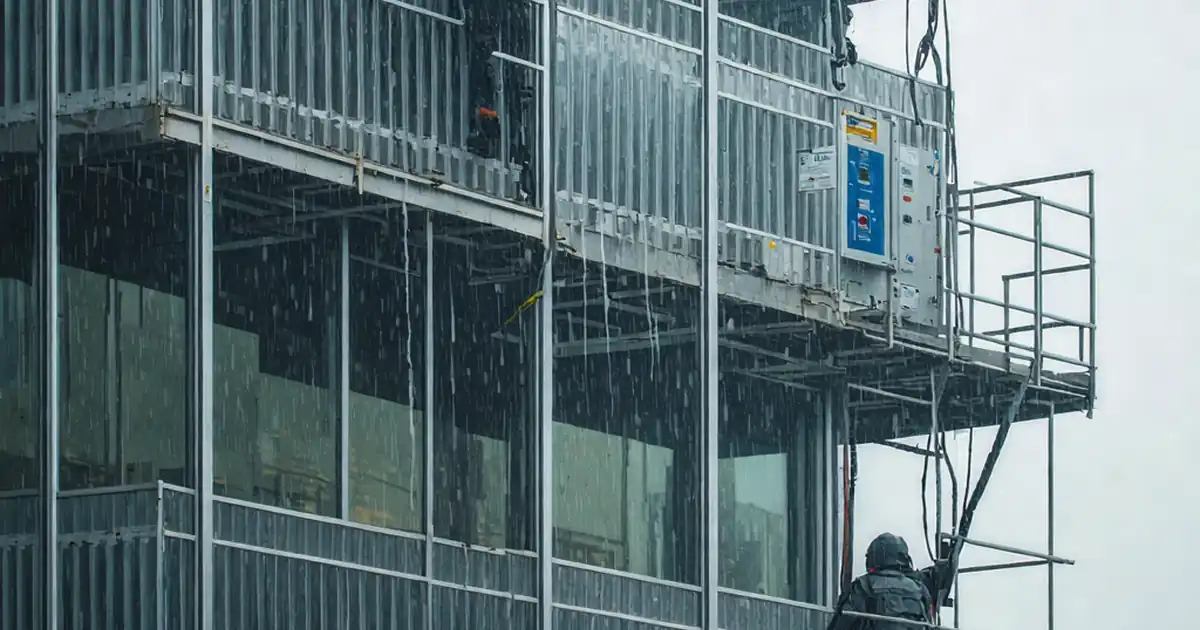
Test dynamic façade response to rain sensors and protective closure for commissioning teams validating automated weather protection, closure timing, and fail-safe behavior under controlled wetting, ensuring safe, documented operation before handover.
- Confirms sensors detect rainfall and command protective closed position reliably
- Validates closure timing, hysteresis, and safe default during sensor faults
- Captures photos, logs, and signatures for traceable commissioning records
- Interactive, commentable checklist with export and QR code verification
The checklist
Pre-Test Setup
- Verify latest approved drawings list all dynamic façade zones and operable elements; mark test sequence on drawings and upload annotated PDFs as evidence.
- Confirm dedicated power supply to façade actuators and controllers is available and stable using a multimeter; acceptance: within manufacturer voltage tolerance, record readings and photos.
- Check controller time sync (BMS/NTP) for accurate logs; acceptance: clock offset ≤ 2 s. Capture screenshot of time server settings and current time.
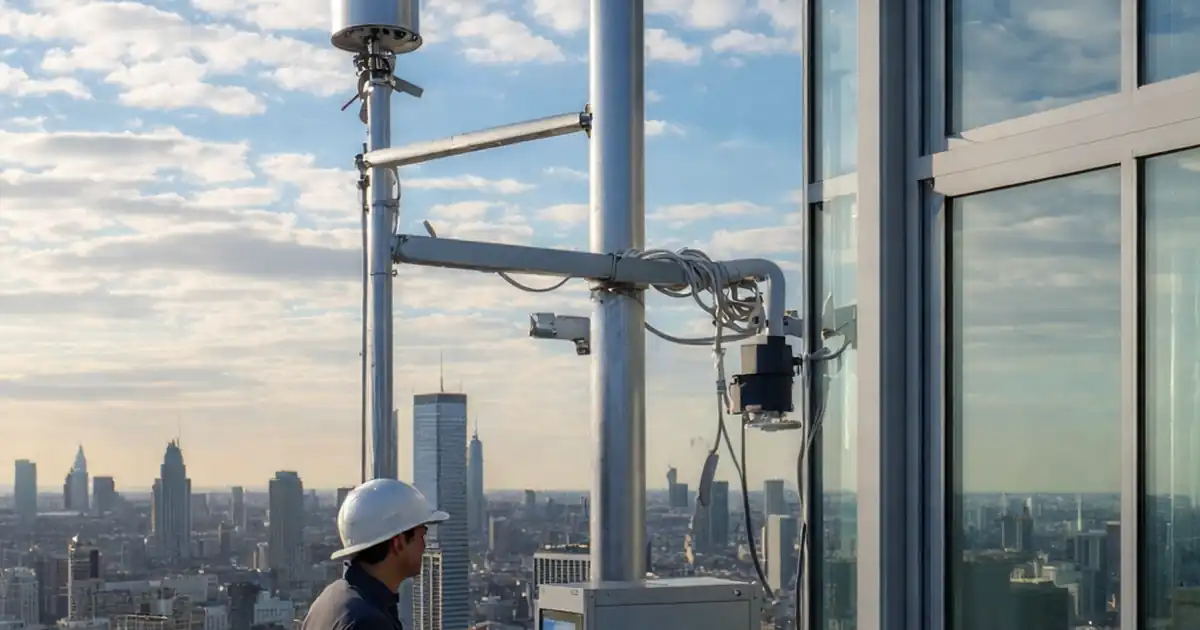
- Inspect rain sensor mounting location, orientation, and shielding; acceptance: unobstructed exposure, downward tilt 15–45° per datasheet. Photograph installation and label ID/tag.
Sensor Calibration & Verification
- Clean rain sensor surface with lint-free cloth and deionized water; acceptance: no debris/film. Upload before/after photos.
- Verify sensor output type (dry contact/analog) and wiring continuity using a multimeter; acceptance: continuity per schematic, insulation resistance ≥ 1 MΩ. Attach test readings.
- Check trigger threshold setting against specification; acceptance: factory default or project-set threshold documented. Capture controller parameter screenshot.
- Trend sensor input on BMS for 2 minutes in dry state; acceptance: stable ‘dry’ without chatter. Export CSV and attach.
Dry Run & Baseline
- Command all operable elements to normal (non-rain) position via BMS; acceptance: position feedback confirms within ±2° or ±5 mm. Photograph three representative locations.
- Test manual override at one controller; acceptance: override blocks auto commands and reverts on release. Record video and note duration to revert ≤ 10 s.
- Verify local weather interlocks disabled except rain for this test; acceptance: wind/smoke inputs logically isolated or simulated safe. Upload logic snapshot.
Simulated Rain Response
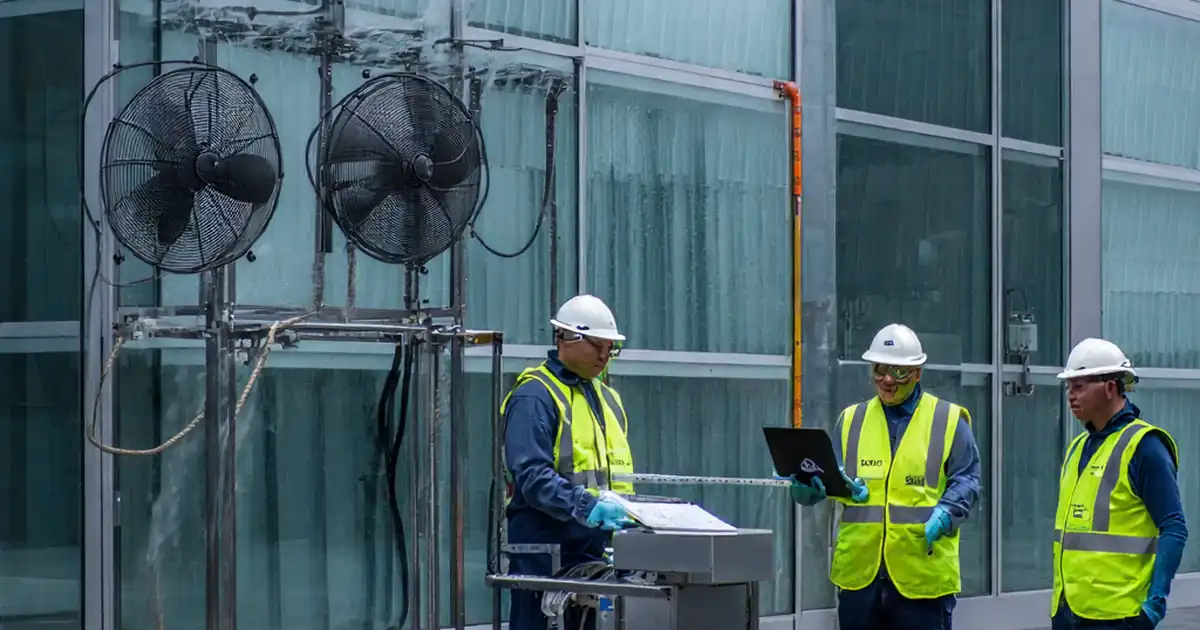
- Set up calibrated spray rig to deliver uniform rainfall 2–5 mm/min over sensor; verify rate with graduated rain gauge over 5 minutes. Upload measurements.
- Start wetting and time to sensor ‘rain’ state; acceptance: input changes within 10 s of continuous wetting. Record video with on-screen timer.
- Measure command issuance to façade actuators after rain detection; acceptance: close command within 5 s of input change. Attach BMS trend showing timestamps.
- Verify all operable elements reach protective closed position; acceptance: full closure within 60 s without stalls. Capture photos of 10% sample per zone and note any exceptions.
- Inspect gaskets and drip edges for effective sealing under spray; acceptance: no visible ingress at interior line for 3 minutes. Upload interior photos.
- Check BMS annunciation: rain active, zone closed, and any faults; acceptance: correct alarm text and priority. Screenshot alarm list and acknowledge times.
- Stop wetting and time hysteresis/dry delay; acceptance: system remains closed for programmed delay (e.g., 5–15 min) before auto-reopen. Provide trend export evidencing delay.
Fail-safe, Overrides & Recovery
- Simulate sensor open-circuit fault; acceptance: system defaults to protective closed state and alarms within 30 s. Attach fault injection method and logs.
- Simulate sensor short-circuit fault; acceptance: same safe closed response and clear alarm description. Provide trend and controller diagnostics screenshots.
- Test occupant local override during active rain; acceptance: override cannot force open against rain command, with logged attempt. Record video and BMS note.
Integration, Logging & Handover
- Verify event logging: sensor change, command issued, motion start/stop, alarm, and restore; acceptance: all events time-stamped and stored ≥ 30 days. Export and attach logs.
- Update asset registry with sensor IDs, locations, firmware, and calibration date; acceptance: complete entries with photos and tag numbers. Upload registry export.
- Capture final sign-off with responsible parties; acceptance: digital signatures, punch-list closures documented per approved project specifications and authority requirements. Attach signed certificate.
Preview the printable checklist
Preview page one below. Open the image or download the PDF for all pages.
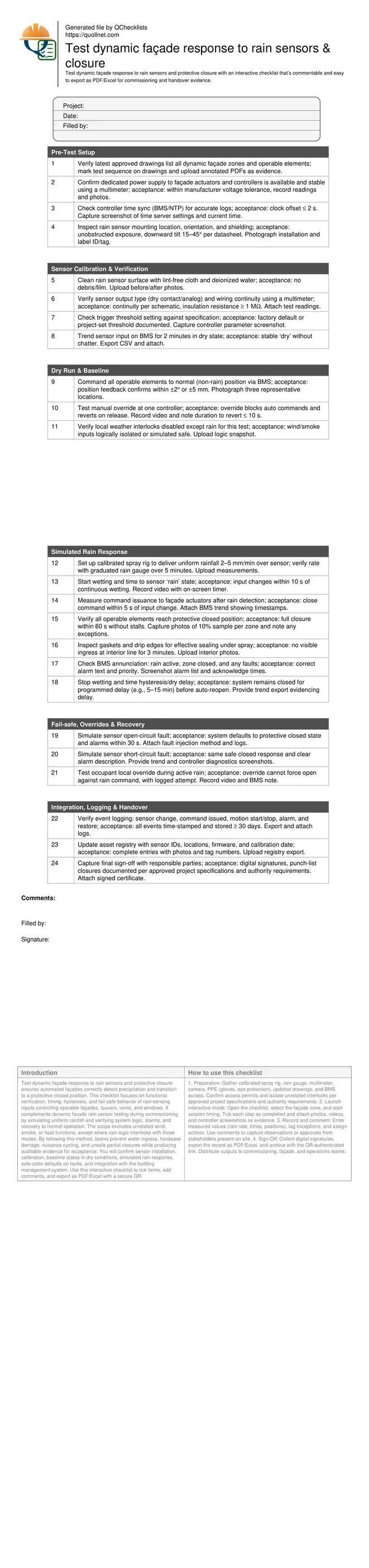
At a glance
- This procedure validates that rain sensors correctly detect wetting and drive every operable element to the protective closed position within specified timing. It reduces water ingress risk, prevents damage to motors and finishes, and builds evidence for acceptance per approved project specifications and authority requirements.
- The test uses controlled simulated rainfall at measured rates to verify trigger thresholds, hysteresis delays, and recovery to normal. It checks manual override priorities, fail-safe defaults on sensor faults, and integrations with BMS alarms. Evidences include time-stamped photos, videos, and exported trend logs for each tested zone.
- Interactive online checklist with tick, comment, and export features secured by QR code. Field teams capture as-found conditions, readings, and closures, while stakeholders review comments remotely. Final sign-off includes digital signatures, asset references, and attachments, ensuring a clear, auditable record for operation and maintenance phases.
How to Use This Interactive Rain Response Test Checklist
- Preparation: Gather calibrated spray rig, rain gauge, multimeter, camera, PPE (gloves, eye protection), updated drawings, and BMS access. Confirm access permits and isolate unrelated interlocks per approved project specifications and authority requirements.
- Launch interactive mode: Open the checklist, select the façade zone, and start session timing. Tick each step as completed and attach photos, videos, and controller screenshots as evidence.
- Record and comment: Enter measured values (rain rate, times, positions), tag exceptions, and assign actions. Use comments to capture observations or approvals from stakeholders present on site.
- Sign-Off: Collect digital signatures, export the record as PDF/Excel, and archive with the QR-authenticated link. Distribute outputs to commissioning, façade, and operations teams.
Establish Controlled Rain Conditions and Reliable Triggers
Dynamic façades must recognize rain consistently to prevent water ingress. Use a calibrated spray rig to produce uniform wetting across the rain sensor, targeting 2–5 mm/min rainfall equivalent and verifying with a graduated gauge at 1-minute intervals. The aim is to prove the trigger occurs quickly without spurious chatter. Confirm the input type and threshold in the controller and observe a steady dry baseline before wetting. During the test, capture the time from initial wetting to input change, then to command issuance and movement start. Document closed positions with photos and position feedback when available. Finally, verify annunciation text and priorities in the BMS so operators receive meaningful, actionable alarms during actual weather events.
- Verify rainfall rate with a physical gauge reading
- Target sensor change within 10 seconds of wetting
- Issue close command within 5 seconds of detection
- Record closed position within 60 seconds total
- Capture BMS alarm text and priorities
Prove Hysteresis, Recovery, and Nuisance Prevention
After wetting stops, the system must remain closed until the façade is safe to reopen. Hysteresis or dry delay timers prevent nuisance cycling from intermittent drizzle or splashback. Trend the sensor state and actuator commands to confirm the programmed delay, typically several minutes, then verify an orderly return to normal positions. Ensure occupant overrides cannot defeat the rain close command, while authorized personnel can restore automatic mode without power cycling. Test both open-circuit and short-circuit sensor faults to verify a safe closed default and clear fault annunciation. This reduces risk of damage to interiors and actuators, and provides operators with confidence during unpredictable weather.
- Confirm dry delay matches documented setpoint
- Prevent overrides from forcing open in rain
- Default closed on sensor fault conditions
- Trend recovery back to normal positions
- Export time-stamped evidence for review
Documentation, Acceptance Cues, and Real-World Readiness
Acceptance hinges on objective, retrievable evidence: annotated drawings, time-synchronized photos and videos, and exported trend logs. Look for clean sensor faces, correctly oriented mounts, and stable input signals. Verify that alarm texts match operator expectations and that data retention spans at least one month. Record any elements that fail to reach full closure, including exact locations and failure modes, and raise corrective actions. Update the asset registry with sensor identifiers, firmware, and calibration dates to support maintenance. Close with digital signatures from commissioning, controls, façade, and client representatives to formalize readiness for weather events.
- Synchronize clocks before evidence capture
- Photograph sensor tags and mounting angles
- Export CSV trends for each tested zone
- List exceptions with precise locations
- Obtain multi-party digital sign-off