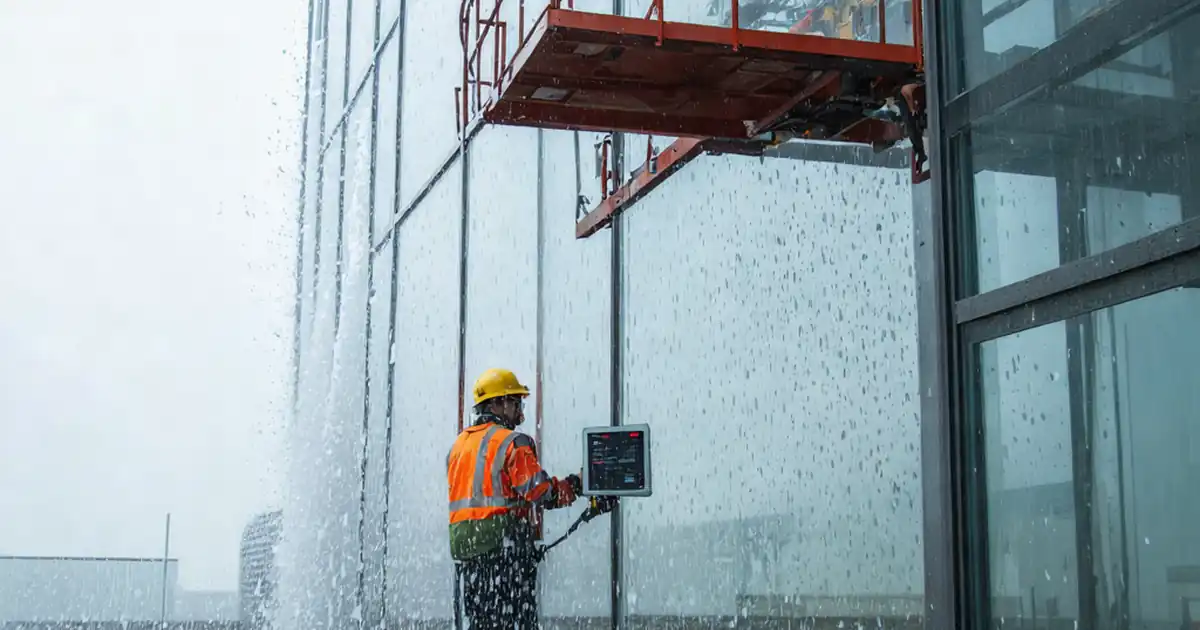
Test façade mock-up for water penetration under dynamic pressure
Definition: Test façade mock-up for water penetration under dynamic pressure provides construction QA teams a structured, evidence-based process to plan, execute, and report wind-driven rain testing with calibrated instruments, safety controls, and defensible results.
- Verify mock-up fidelity, materials, and drainage before testing begins
- Calibrate pressure, wind, and spray to specified dynamic conditions
- Capture leaks with grid references, photos, video, and data logs
- Interactive, commentable checklist with export and QR code verification
Test façade mock-up for water penetration under dynamic pressure is a critical building envelope quality assurance procedure. Also called dynamic water penetration testing or wind-driven rain testing of façade mock-ups, it validates that assembled systems, joints, and interfaces resist rain under airflow-induced pressure differentials. This checklist focuses on a representative exterior mock-up only, using a spray rack and wind generator with calibrated pressure measurement. It excludes structural, thermal, or acoustic testing and avoids mixing static pressure protocols. By following these steps, teams reduce false failures from miscalibration, prevent unsafe setups, document findings with time-synced data, and produce clear pass/fail evidence for stakeholders. Outcomes include confident performance verification, targeted remediation when needed, and a complete audit trail aligned with approved project specifications and authority requirements. Use this interactive page to tick items, add comments, attach photos and logs, and export as PDF/Excel secured with a QR link for authentication.
- Establishes a controlled, repeatable method for dynamic water penetration testing on a representative façade mock-up, ensuring geometry, drainage, and materials match approved drawings and manufacturer requirements before any wetting or pressure is applied.
- Reduces disputes by calibrating differential pressure, wind speed, and spray rate with traceable instruments, documenting uniformity and stability, and time-synchronizing all sensors to create a defensible data record across test stages.
- Interactive online checklist with tick, comment, and export features secured by QR code. Field teams attach photos, videos, and CSV logs, while reviewers track sign-offs, corrective actions, and retesting status from any device.
- Improves decision-making with clear acceptance cues, grid-referenced leak mapping, and immediate stop/safe procedures for uncontrolled ingress, followed by concise reporting, stakeholder sign-offs, and QR-authenticated deliverables for permanent records.
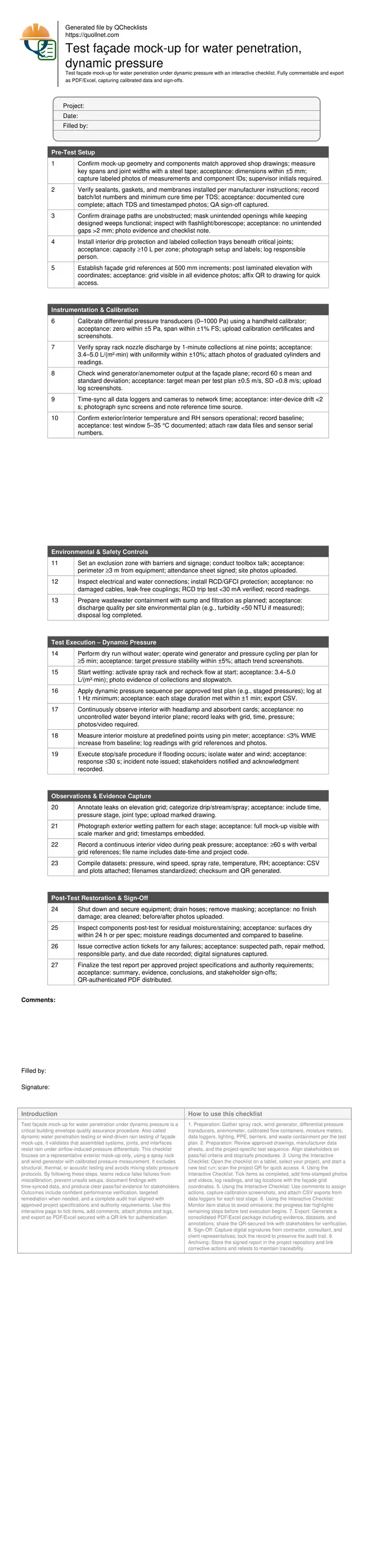
Pre-Test Setup
Instrumentation & Calibration
Environmental & Safety Controls
Test Execution – Dynamic Pressure
Observations & Evidence Capture
Post-Test Restoration & Sign-Off
Planning the Mock-Up and Avoiding False Starts
A credible dynamic water test begins with a faithful façade mock-up. Ensure the assembly mirrors field conditions: joint types, sealant geometries, drainage, interfaces, and tolerances. Record batch numbers and confirm cure windows per manufacturer data; premature testing often creates false failures. Create an interior leak-observation environment with lighting, absorbent cards, and labeled trays under critical joints. Establish a visible coordinate grid so all photos, videos, and notes reference precise locations. Before wetting, verify paths for intentional drainage remain open while unintended gaps are masked. Many failures trace back to missing gaskets, reversed membranes, or clogged weeps—issues best caught pre-test. Finally, align stakeholders on pass/fail criteria, stop/safe protocols, and documentation formats. When the setup is right, the test validates performance rather than workmanship errors unrelated to design intent.
- Match mock-up to drawings, materials, and joint geometries
- Document cure times and capture product batch numbers
- Keep designed drainage open; mask unintended gaps
- Create a clear grid for repeatable leak references
Controlling Dynamic Loads with Calibrated Instruments
Dynamic water penetration depends on three controls: spray rate, wind speed, and pressure differential. Calibrate each with traceable instruments and record the uncertainty. Validate spray uniformity using timed collections across the wetted area. Measure wind speed at the façade plane and stabilize it before starting a stage. Use differential pressure transducers to confirm that the target sequence is achieved and held long enough to matter. Time-synchronize sensors and cameras to avoid mismatched evidence. On real jobs, drifting loggers and clogged nozzles have produced misleading failures; routine checks and screenshots eliminate doubt. Record temperature and relative humidity, too, because environmental shifts can alter readings and dry-out rates. By maintaining these controls, you separate system performance from test noise and deliver repeatable, defensible results.
- Calibrate pressure, wind, and spray with traceable tools
- Verify spray uniformity within ±10% across the area
- Stabilize wind and pressure before each stage
- Time-sync devices to align data and media
Executing, Observing, and Reporting with Evidence
Begin with a dry run to confirm pressure stability and equipment behavior before introducing water. During testing, maintain continuous interior observation, using the grid to mark any leakage as a drip, stream, or spray. Capture high-resolution exterior photos each stage to show wetting coverage. Use moisture meters at predefined points to quantify interior changes from baseline. If uncontrolled ingress occurs, execute the stop/safe protocol promptly and document actions. After testing, consolidate logs, photos, and videos into a clear report that states methods, conditions, data, and conclusions. Assign corrective actions where required and plan retesting for verification. Comprehensive, time-aligned evidence transforms arguments into decisions and accelerates closeout.
- Run a dry test to stabilize controls
- Use a grid to classify and locate leaks
- Capture photos, videos, and CSV datasets
- Trigger stop/safe if flooding appears
How to Use This Interactive Dynamic Water Test Checklist
- Preparation: Gather spray rack, wind generator, differential pressure transducers, anemometer, calibrated flow containers, moisture meters, data loggers, lighting, PPE, barriers, and waste containment per the test plan.
- Preparation: Review approved drawings, manufacturer data sheets, and the project-specific test sequence. Align stakeholders on pass/fail criteria and stop/safe procedures.
- Using the Interactive Checklist: Open the checklist on a tablet, select your project, and start a new test run; scan the project QR for quick access.
- Using the Interactive Checklist: Tick items as completed, add time-stamped photos and videos, log readings, and tag locations with the façade grid coordinates.
- Using the Interactive Checklist: Use comments to assign actions, capture calibration screenshots, and attach CSV exports from data loggers for each test stage.
- Using the Interactive Checklist: Monitor item status to avoid omissions; the progress bar highlights remaining steps before test execution begins.
- Export: Generate a consolidated PDF/Excel package including evidence, datasets, and annotations; share the QR-secured link with stakeholders for verification.
- Sign-Off: Capture digital signatures from contractor, consultant, and client representatives; lock the record to preserve the audit trail.
- Archiving: Store the signed report in the project repository and link corrective actions and retests to maintain traceability.
Call to Action
- Start Checklist Tick off tasks, leave comments on items or the whole form, and export your completed report to PDF or Excel—with a built-in QR code for authenticity.
- Download Excel - Façade Mock-Up Dynamic Water Penetration Test
- Download PDF - Façade Mock-Up Dynamic Water Penetration Test
- View Image - Façade Mock-Up Dynamic Water Penetration Test
Cite & Embed
“Façade Mock-Up Dynamic Water Penetration Test by Quollnet”
with a link to
this source page.
FAQ
Question: What is dynamic water penetration testing of a façade mock-up?
Question: Which pressure levels and spray rates should I use?
Question: How large should the façade mock-up be?
Question: What constitutes a failure and what are next steps?
Related Articles
Broader reading and guidance connected to this checklist topic.



Plasticizers And Superplasticizers: How They Affect Concrete Slump

Is It Important To Customize Your Qr Code And How To Do It?

What Is a Snag List Or Punch List
Related Checklists
Keep the workflow moving with nearby templates chosen from similar checklist content.