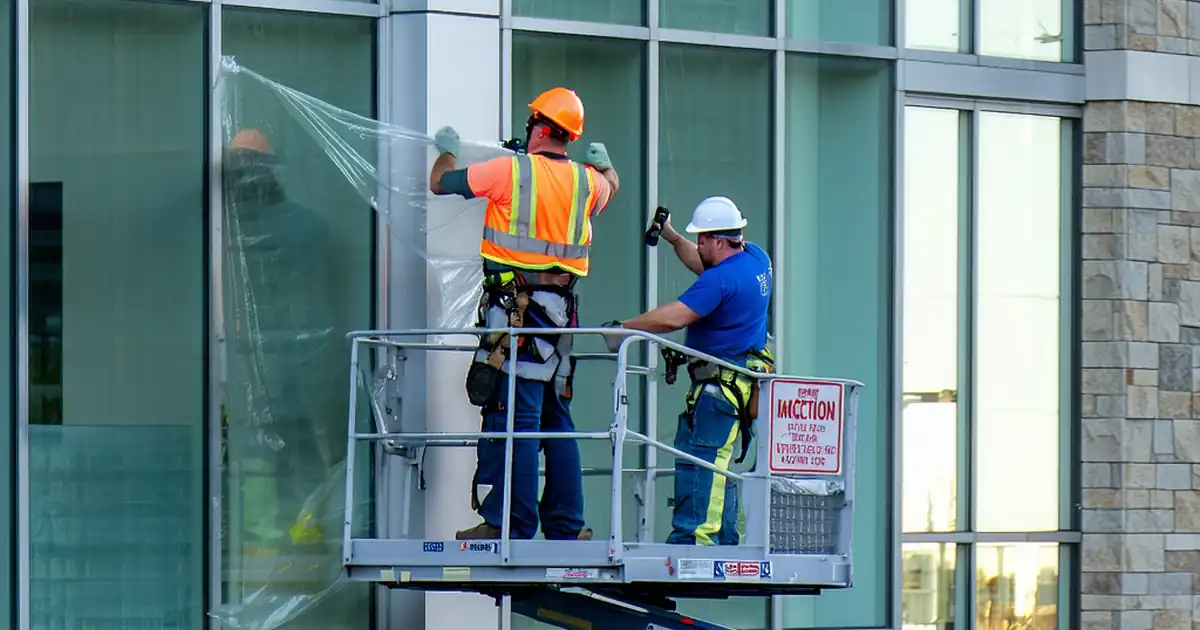
Review façade cleaning and replacement strategy for damaged units
Definition: Review façade cleaning and replacement strategy for damaged units provides a structured checklist for project managers and envelope specialists to validate methods, safety, sequencing, and documentation before site execution.
- Confirm scope, access, and sequencing to minimize disruption and rework.
- Validate cleaning chemistry, tools, and tolerances against material manufacturers.
- Plan damaged unit replacement with weatherproofing, handling, and QA evidence.
- Interactive, commentable checklist with export and QR code verification.
Review façade cleaning and replacement strategy for damaged units is the starting point for safe, efficient, and compliant building envelope work. This checklist helps teams validate the façade maintenance plan, align cladding replacement methods, and set clear acceptance criteria for curtain wall cleaning and unit swap-out. Scope covers access planning, cleaning chemistry, wastewater control, damaged unit assessment, temporary weatherproofing, installation sequencing, and evidence capture. It excludes structural re-cladding schemes, insulation retrofits, and interior remediation. By front-loading a robust strategy review, you reduce scratching, etching, water ingress, schedule conflicts, and warranty voids, while delivering a uniform appearance and durable performance. Outcomes include documented approvals, calibrated tools, protected surroundings, and traceable QA records per approved project specifications and authority requirements. Use this interactive checklist to tick tasks, add photos, log meter readings, and attach approvals. Invite comments for clarifications, resolve actions in-thread, and export as PDF/Excel with a QR code for authenticated handover.
- Establishes a unified approach for façade cleaning and damaged unit replacement by aligning access, methods, materials, and tolerances up front, minimizing clashes with logistics and adjacent trades while preserving warranties and appearance consistency.
- Verifies cleaning chemistry with controlled test patches, water quality thresholds, and pressure limits; sets wastewater containment and disposal pathways; and sequences work to avoid streaking, re-soiling, or differential loading on curtain wall frames and anchors.
- Defines a measured plan for damaged unit assessment, compatible replacements, temporary weatherproofing, torque and sealant controls, lift plans, and disposal documentation, ensuring traceability from lot numbers to installed locations across elevations.
- Interactive online checklist with tick, comment, and export features secured by QR code.
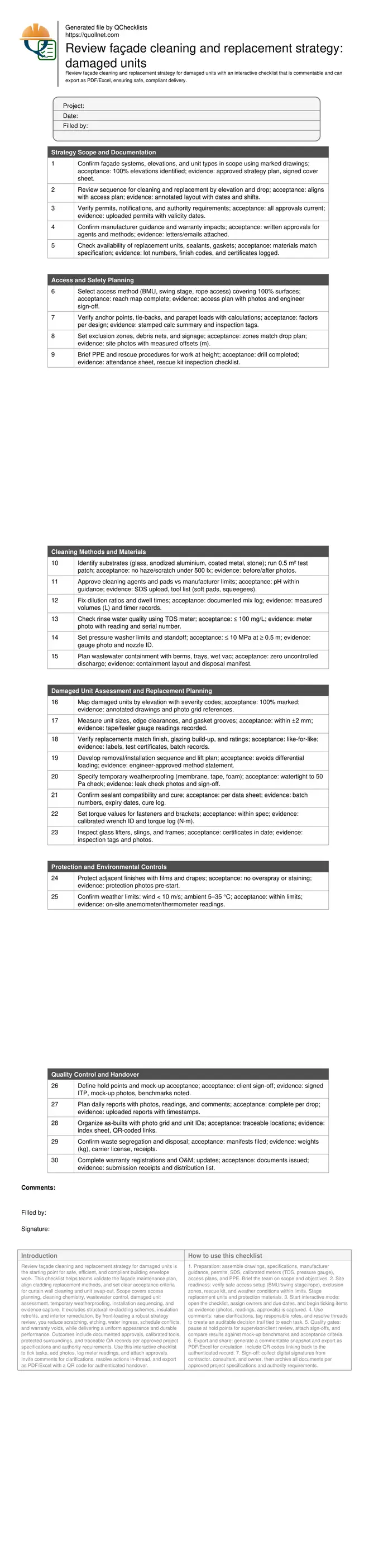
Strategy Scope and Documentation
Access and Safety Planning
Cleaning Methods and Materials
Damaged Unit Assessment and Replacement Planning
Protection and Environmental Controls
Quality Control and Handover
Align strategy early to control risk, cost, and appearance
A clear façade cleaning and replacement strategy minimizes rework, delays, and appearance inconsistencies. Begin by fixing scope, elevations, and unit types using current drawings, then align access, sequencing, and weather windows. The review should lock in acceptance criteria for cleaning outcomes and replacement tolerances so teams know exactly what “good” looks like. Confirm permits and manufacturer approvals to protect warranties, and require evidence logs for chemistry, tools, and calibrated meters. Create a reach plan to verify 100% surface access, and set exclusion zones with measured offsets to prevent hazards below. By defining hold points and a mock-up benchmark, you establish a visual standard for glazing clarity, metal sheen, and joint lines. Close gaps with a daily reporting routine capturing readings, photos, and comments. Real-world issues like streaks from poor sequencing or leaks from rushed temporary covers are prevented when the strategy is documented, approved, and evidenced before the first drop.
- Fix scope and elevations using current drawings.
- Define acceptance criteria and hold points early.
- Secure manufacturer approvals to protect warranties.
- Plan reach maps and exclusion zones thoroughly.
- Use daily reports to capture traceable evidence.
Prove cleaning methods with controlled tests and measurable limits
Cleaning must be validated by substrate. Run a small test patch per material and inspect under consistent lighting to rule out haze, etching, or pad scratches. Lock in agent pH limits, set dilution ratios, and document dwell times. Control water quality using a TDS meter so dissolved solids do not spot the surface after drying. Limit washer pressure and maintain standoff to protect seals and coatings. Sequence top-to-bottom, leeward to windward, coordinating with other trades to avoid re-soiling. Capture evidence: SDS, batch numbers, meter serials, and before/after photos. Set wastewater containment using berms, trays, and wet vacs, and pre-arrange disposal to an approved facility. These controls remove ambiguity, standardize outcomes across drops, and preserve the façade’s finish.
- Test patches for every substrate type.
- Record pH, dilution, and dwell times.
- Hold TDS ≤ 100 mg/L for rinse water.
- Limit pressure and maintain standoff.
- Contain and document wastewater disposal.
Replace damaged units without compromising weatherproofing or structure
For damaged units, measure sizes and clearances to confirm replacements fit within tight tolerances. Verify finishes, glazing build-ups, and ratings match the original to maintain performance and appearance. Develop a removal and lift plan that avoids differential loading on frames, and schedule temporary weatherproofing capable of resisting typical site winds and incidental rain. Control sealant compatibility and cure using batch logs and data sheets. Use calibrated torque tools and record values to prevent loose connections or distortions. Inspect handling equipment certificates and tag gear in date. Map each replaced unit to a photo grid, then update as-builts and warranties. This approach prevents water ingress, misalignment, and callbacks while leaving a complete, traceable record.
- Survey and record tight dimensional tolerances.
- Match finish, glazing, and rating exactly.
- Engineer the lift and removal sequence.
- Weatherproof openings during all pauses.
- Log torque, sealants, and unit IDs.
How to Use This Checklist
- Preparation: assemble drawings, specifications, manufacturer guidance, permits, SDS, calibrated meters (TDS, pressure gauge), access plans, and PPE. Brief the team on scope and objectives.
- Site readiness: verify safe access setup (BMU/swing stage/rope), exclusion zones, rescue kit, and weather conditions within limits. Stage replacement units and protection materials.
- Start interactive mode: open the checklist, assign owners and due dates, and begin ticking items as evidence (photos, readings, approvals) is captured.
- Use comments: raise clarifications, tag responsible roles, and resolve threads to create an auditable decision trail tied to each task.
- Quality gates: pause at hold points for supervisor/client review, attach sign-offs, and compare results against mock-up benchmarks and acceptance criteria.
- Export and share: generate a commentable snapshot and export as PDF/Excel for circulation. Include QR codes linking back to the authenticated record.
- Sign-off: collect digital signatures from contractor, consultant, and owner, then archive all documents per approved project specifications and authority requirements.
Call to Action
- Start Checklist Tick off tasks, leave comments on items or the whole form, and export your completed report to PDF or Excel—with a built-in QR code for authenticity.
- Download Excel - Façade Cleaning & Damaged Unit Replacement Review
- Download PDF - Façade Cleaning & Damaged Unit Replacement Review
- View Image - Façade Cleaning & Damaged Unit Replacement Review
Cite & Embed
“Façade Cleaning & Damaged Unit Replacement Review by Quollnet”
with a link to
this source page.
FAQ
Question: How do I select a cleaning method for mixed façade materials on the same elevation?
Question: When should façade cleaning or unit replacement be postponed due to weather?
Question: How can I prevent leaks when replacing damaged curtain wall or panel units?
Question: What documentation is needed to protect warranties and compliance?
Question: How do we coordinate replacement lifts without disrupting building operations?
Related Articles
Broader reading and guidance connected to this checklist topic.





Free Site Housekeeping Checklist – Download In Excel, Word, & Pdf
Related Checklists
Keep the workflow moving with nearby templates chosen from similar checklist content.