Excavators in 2026: The King of Construction Goes Electric, Connected, and Intelligent
Summary
Excavators are the most versatile and widely used machines in construction, often performing the first major task on a project: excavation and site preparation. Modern excavators can dig, lift, load, demolish, and grade using a wide range of attachments. In 2026, the excavator industry is evolving rapidly with the introduction of AI-assisted operation, GPS machine control, electric powertrains, and telematics systems that improve productivity and reduce fuel consumption. This article explains how excavators work, the main types and technologies used today, the decision between renting and buying equipment, and the future direction of the excavator market as automation and autonomous systems become more common.
2026 Snapshot: The Excavator Market Is Entering the Intelligent Machine Era
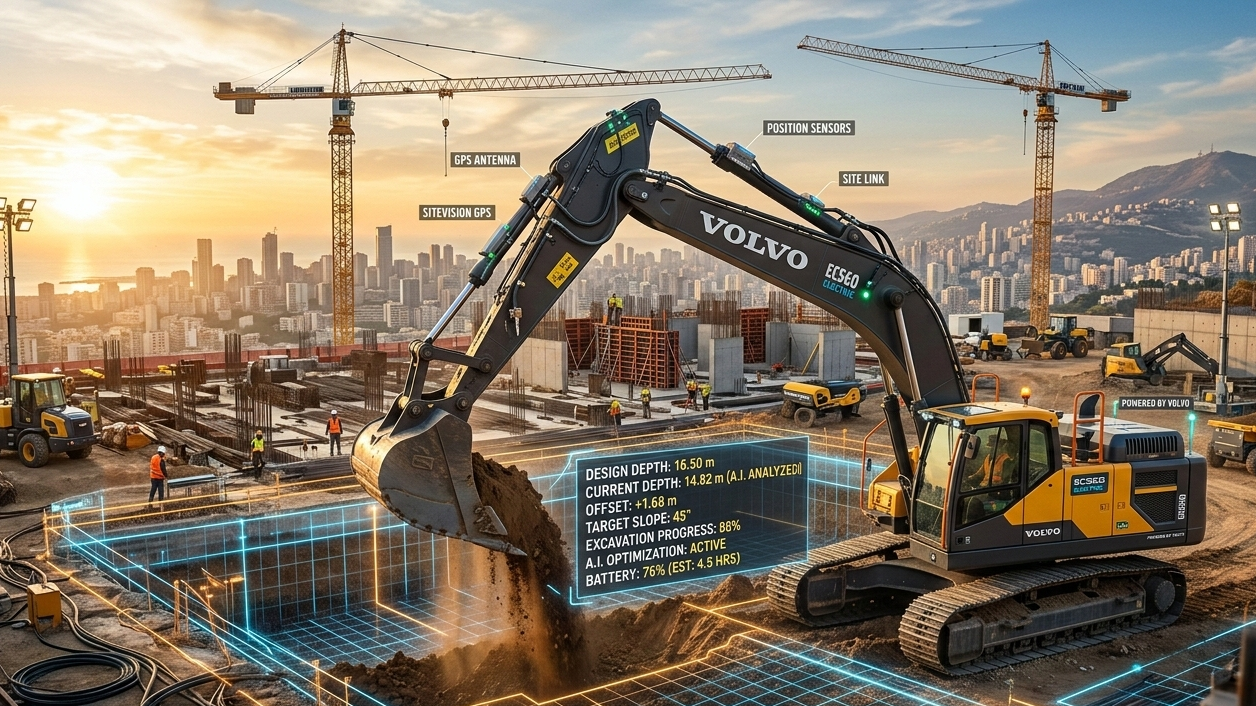
By 2026 the excavator industry is experiencing a major technological transition. Manufacturers are moving beyond basic hydraulic machines toward connected, semi-autonomous construction equipment combining AI-assisted operation, GPS machine control, telematics, and advanced sensors. Some experimental systems are exploring “embodied AI” approaches, where machines interpret visual information and jobsite instructions using advanced models similar to vision-language-action (VLA) systems. While these technologies are still emerging, they illustrate the direction the industry is moving.
At the same time, manufacturers are expanding electric and hybrid excavators, particularly for urban construction where noise, emissions, and space constraints are important. GPS and telematics systems are also evolving from simple tracking tools into predictive maintenance and fleet-optimization platforms, allowing contractors to monitor machine health, reduce downtime, and optimize equipment utilization.
Although fully autonomous excavation remains rare outside controlled environments, the combination of AI assistance, digital machine control, and connected fleet systems is already transforming how excavators operate on modern construction projects.
1. Why the Excavator Is the King of Construction
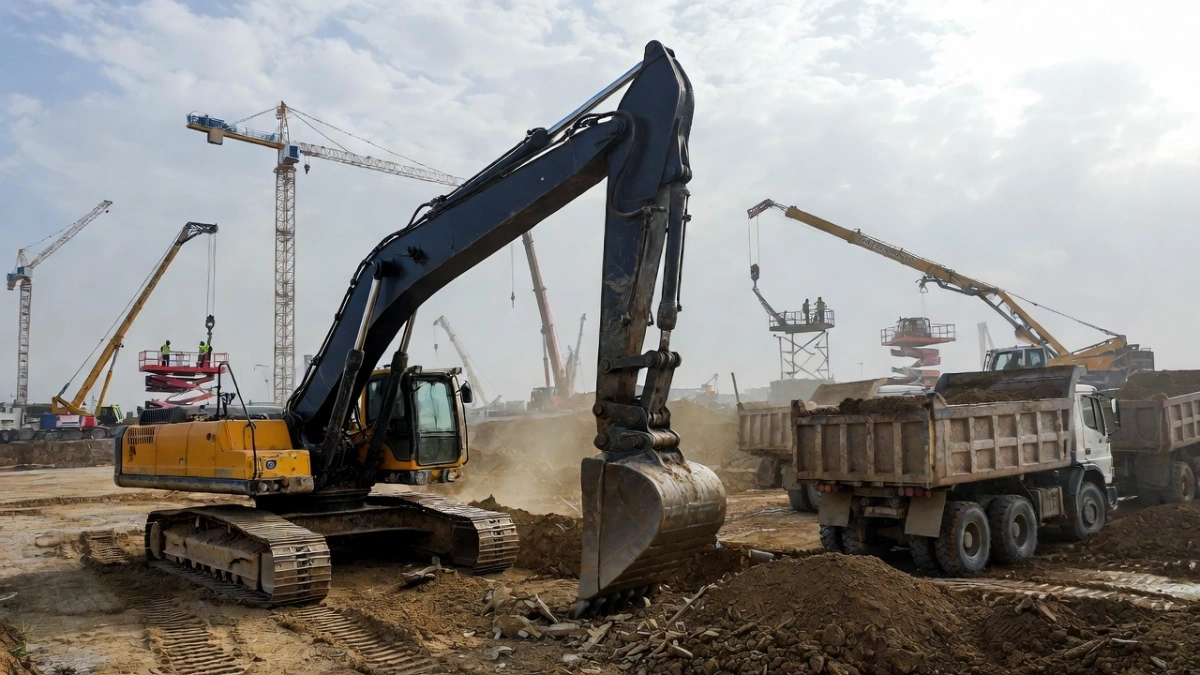
Almost every construction project begins with excavation. Before foundations are poured, utilities installed, or structures built, the ground must be cleared, shaped, and prepared. The excavator is typically the first heavy machine to arrive on site and often remains one of the most important machines throughout the project.
Excavators are sometimes called the “king of construction equipment” because of their flexibility. A single machine can perform many tasks simply by changing attachments.
Typical tasks performed by excavators include:
-
Site clearing and earthmoving
-
Foundation excavation
-
Trenching for utilities
-
Demolition of structures
-
Material handling and loading trucks
-
Landscaping and grading
With modern attachments and hydraulic systems, an excavator can replace several specialized machines.
2. Basic Components of an Excavator
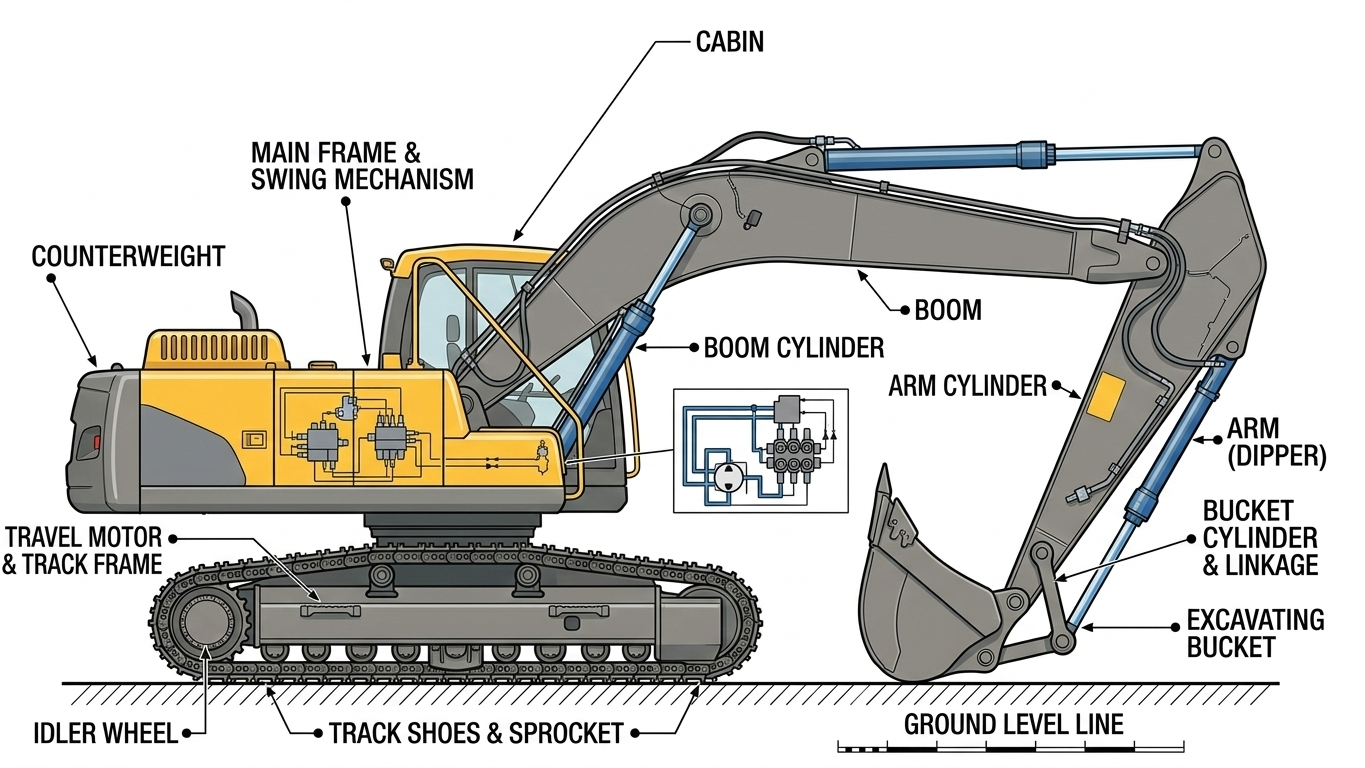
Although excavators vary widely in size, their basic architecture is similar.
Undercarriage
The undercarriage supports the machine and allows it to move across the construction site.
Two main types exist:
Tracked (crawler) excavators
-
Best stability
-
Suitable for soft or uneven terrain
-
Common in heavy construction
Wheeled excavators
-
Faster movement between locations
-
Better suited to urban environments and road work
The undercarriage contains the tracks or wheels, rollers, drive motors, and travel system.
Upper Structure (House)
The upper structure rotates 360° and contains the main operating systems:
-
Engine or electric power unit
-
Hydraulic pumps and valves
-
Operator cabin
-
Fuel tank or battery pack
-
Counterweight for stability
The ability to rotate the upper structure independently from the tracks allows the excavator to dig and load trucks efficiently without moving the entire machine.
Boom, Arm, and Bucket
The digging assembly consists of three main components.
Boom – the large primary arm connected to the machine.
Arm (stick) – the second segment that extends reach and depth.
Bucket – the attachment used to dig and move material.
Hydraulic cylinders control each joint, providing powerful and precise movement.
Hydraulic System
Excavators rely heavily on hydraulics. High-pressure hydraulic pumps convert engine power into mechanical force that moves the boom, arm, bucket, and swing motors.
Hydraulic systems allow excavators to:
-
Generate high digging forces
-
Move heavy loads precisely
-
Operate multiple attachments
The hydraulic system is one of the most critical and maintenance-intensive parts of the machine.
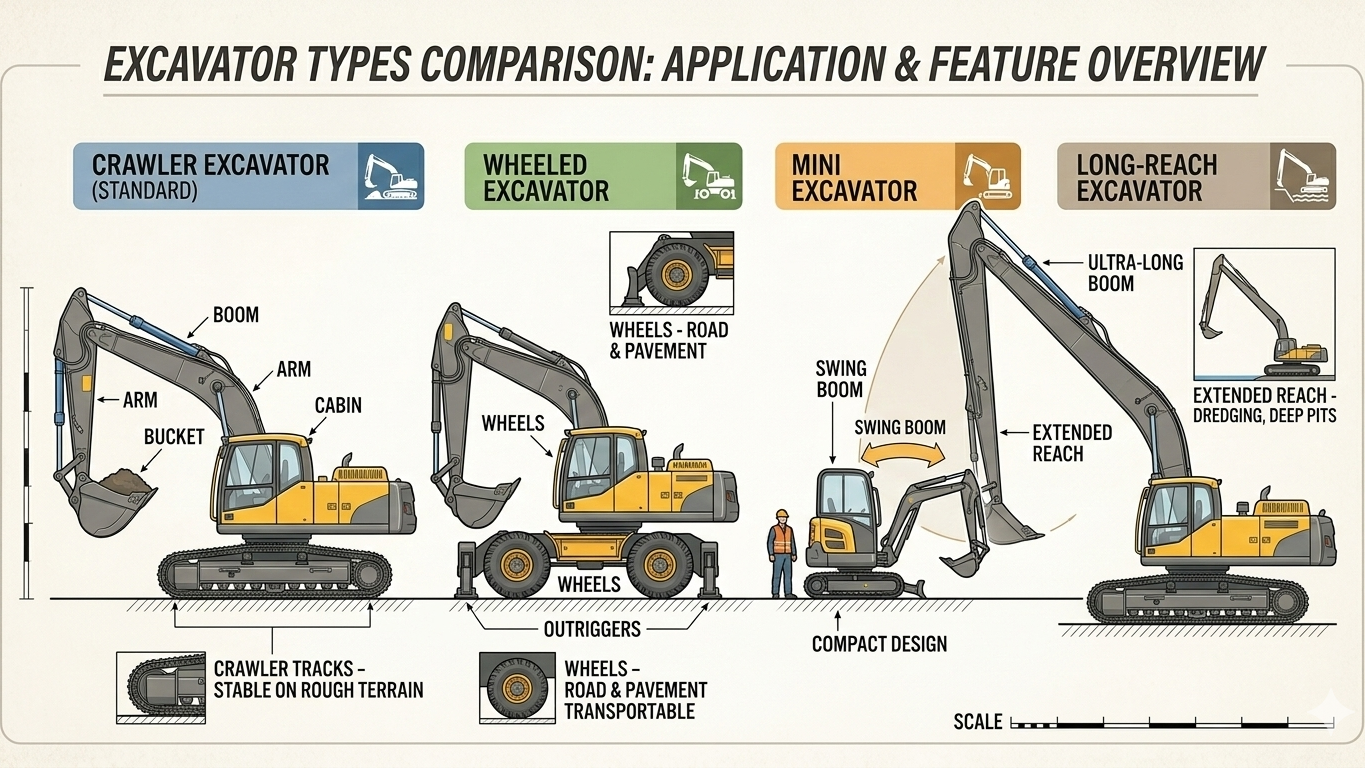
3. Types of Excavators
Different project conditions require different excavator configurations.
Crawler Excavators
These are the most common machines used in construction.
Advantages:
-
Excellent stability
-
High digging force
-
Suitable for rough terrain
Operating weights typically range from 15 tons to more than 90 tons.
Wheeled Excavators
These machines are designed for mobility.
Advantages:
-
Faster travel between work areas
-
Minimal damage to paved surfaces
-
Ideal for city construction and road maintenance
Mini and Compact Excavators
Mini excavators typically weigh between 1 and 10 tons.
Common uses include:
-
Utility installation
-
Landscaping
-
Residential construction
-
Indoor demolition
Their small size allows them to work in confined spaces.
Long-Reach Excavators
These machines use extended booms and arms to reach deeper or farther distances.
Typical applications:
-
Dredging canals and rivers
-
Excavation on slopes
-
Demolition of tall structures
Specialty Excavators
Some specialized machines include:
-
Dragline excavators (used in mining)
-
Suction excavators (used near underground utilities)
-
Amphibious excavators for wetlands
4. Excavator Attachments
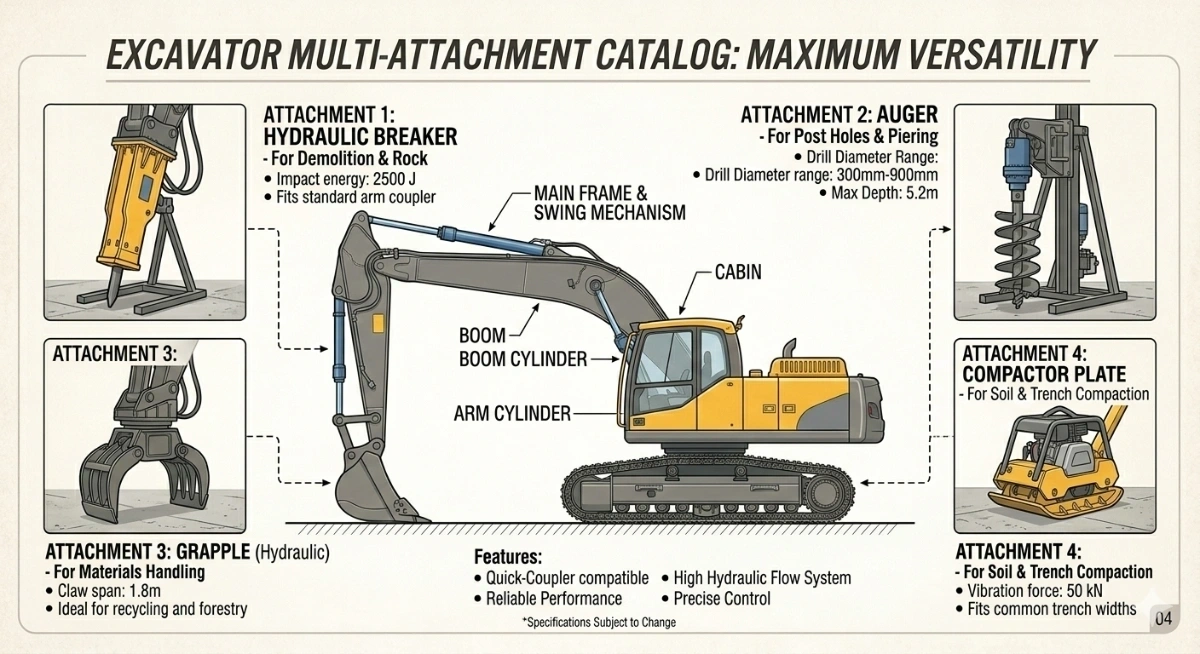
Attachments dramatically increase the versatility of excavators.
Common attachments include:
Buckets
-
General purpose bucket
-
Trenching bucket
-
Rock bucket
Hydraulic breakers
Used for demolition of concrete and rock.
Augers
Used to drill holes for foundations, fencing, or utilities.
Grapples
Used for handling scrap, logs, or demolition debris.
Compactors
Used for soil compaction in trenches.
Tilt buckets and grading buckets
Used for finishing slopes and grading.
Modern quick-coupler systems allow operators to change attachments in minutes.
Excavators are available in many size classes, from small machines used in urban construction to very large machines used in mining and heavy earthworks. The table below shows typical bucket capacities, common applications, and approximate productivity ranges used in construction planning. Actual productivity depends on soil conditions, swing angle, truck positioning, operator skill, and machine technology such as GPS machine control.
| Excavator Class | Operating Weight | Typical Bucket Capacity | Typical Productivity | Typical Uses |
|---|---|---|---|---|
| Mini Excavator | 1 – 6 tons | 0.02 – 0.25 m³ | 5 – 25 m³/hour | Urban work, landscaping, utilities |
| Compact Excavator | 6 – 10 tons | 0.25 – 0.45 m³ | 20 – 40 m³/hour | Small construction sites, trenches |
| Medium Excavator | 10 – 20 tons | 0.45 – 0.9 m³ | 40 – 90 m³/hour | General construction, foundations |
| Standard Construction Excavator | 20 – 35 tons | 0.9 – 1.8 m³ | 80 – 160 m³/hour | Large building projects, roadworks |
| Heavy Excavator | 35 – 50 tons | 1.8 – 3.0 m³ | 150 – 300 m³/hour | Infrastructure, large earthworks |
| Ultra Heavy Excavator | 50 – 90 tons | 3.0 – 5.5 m³ | 250 – 500 m³/hour | Mining, mass excavation |
How Many Cubic Meters Can an Excavator Dig Per Hour?
As a rough planning range, mini excavators may produce about 5 to 25 m³/hour, compact excavators about 20 to 40 m³/hour, medium excavators about 40 to 90 m³/hour, standard 20–35 ton excavators about 80 to 160 m³/hour, heavy excavators about 150 to 300 m³/hour, and ultra-heavy excavators about 250 to 500 m³/hour. Actual production depends on material type, bucket fill factor, digging depth, swing angle, truck positioning, cycle time, operator skill, and whether GPS machine control is used.
5. GPS Machine Control and Smart Excavation
In recent years, excavators have become increasingly integrated with machine control systems.
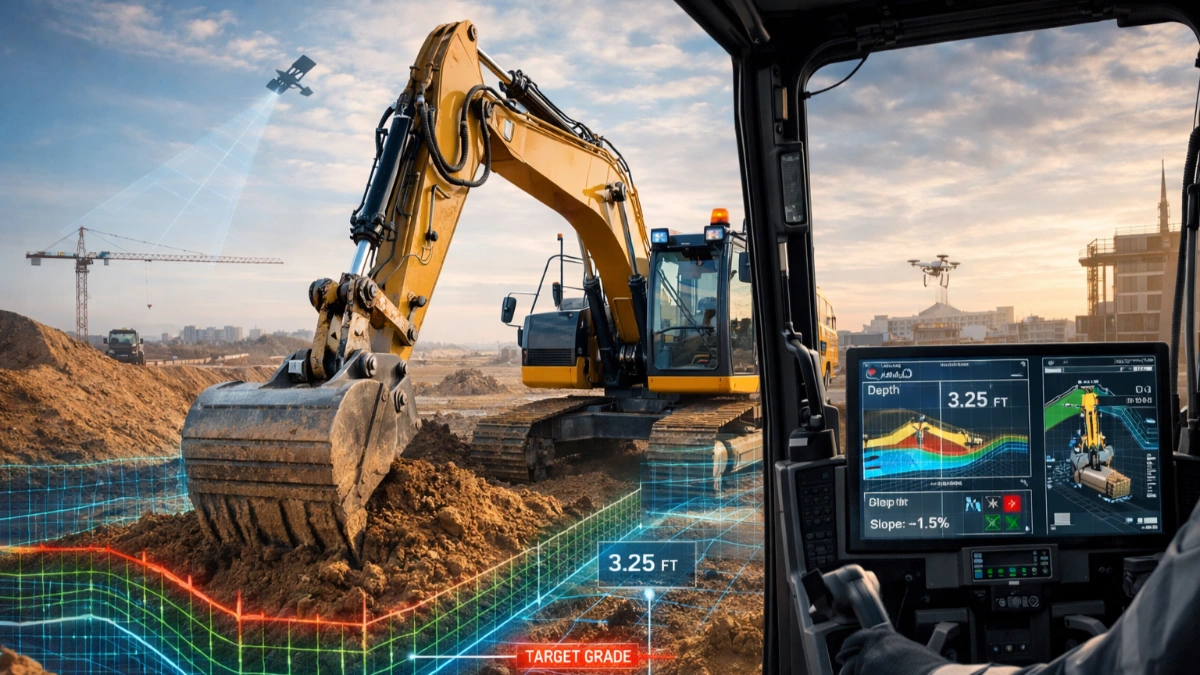
GPS and sensor technology allow excavators to work directly from digital design models.
Two main categories exist.
2D Machine Control
Provides guidance for depth and slope using laser or reference systems.
3D Machine Control
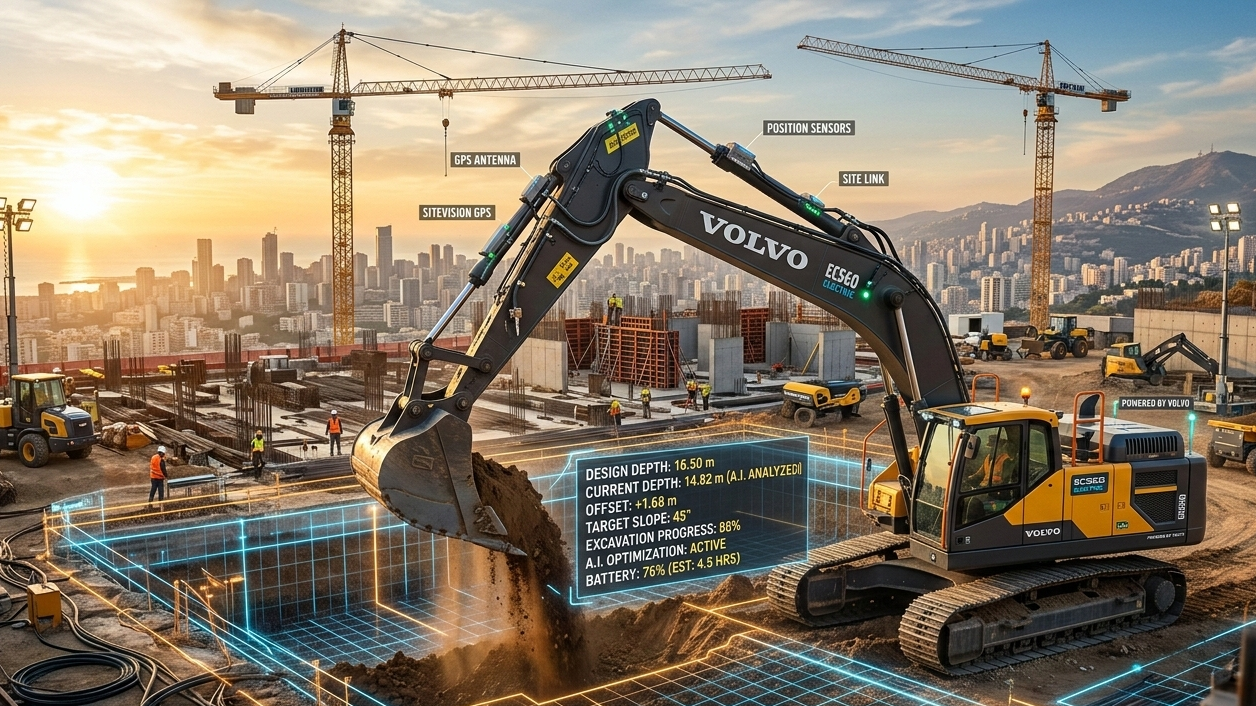
Uses GNSS (satellite positioning) combined with sensors on the boom and bucket to track the exact position of the bucket relative to the design model.
Benefits include:
-
Reduced staking and surveying work
-
Increased excavation accuracy
-
Less over-excavation
-
Faster project completion
Many major manufacturers now offer factory-installed grade control systems.
6. Artificial Intelligence and Operator Assistance
Artificial intelligence is beginning to play a larger role in construction equipment. Current implementations are mostly operator-assist systems rather than fully autonomous machines.
In many cases these systems are described as “intelligent excavators”, a term increasingly used by manufacturers to describe machines combining AI-assisted control, digital grade guidance, telematics, and automated digging features.
Examples include:
-
Automatic bucket leveling
-
Grade assist systems that stop the bucket at the correct depth
-
Intelligent swing control to avoid collisions
-
Automated digging cycles
AI systems analyze machine movement, terrain data, and bucket position to assist operators in real time. In most current machines the goal is augmented operation rather than full autonomy — helping operators dig more accurately, avoid obstacles, and maintain consistent productivity. When combined with GPS machine control and telematics data, these systems can improve grading precision, reduce rework, and provide valuable performance insights for fleet managers.
7. Electric Excavators
Another major trend in the industry is the transition to electric construction equipment.
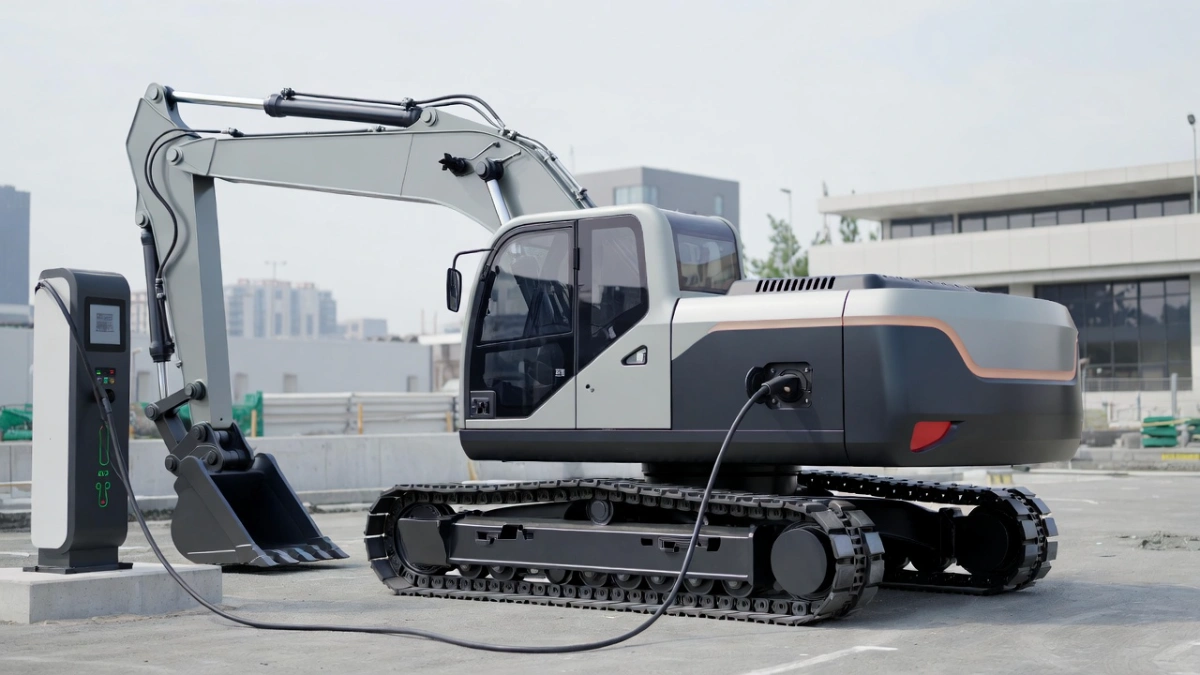
Electric excavators replace the diesel engine with battery-powered electric motors.
Advantages include:
-
Zero local emissions
-
Lower noise levels
-
Reduced maintenance
-
Lower fuel costs in some regions
Electric machines are particularly attractive for:
-
Urban construction sites
-
Indoor demolition
-
Projects with strict environmental regulations
However, challenges remain:
-
Battery charging infrastructure
-
Limited operating hours compared to diesel machines
-
Higher initial purchase cost
As battery technology improves, electric excavators are expected to become more common.
9. Rent vs Buy: A Key Equipment Decision
Contractors frequently face the decision of renting or purchasing excavators.
When Renting Makes Sense
Renting is usually preferred when:
-
The project duration is short
-
Machine utilization is uncertain
-
Specialized equipment is needed temporarily
-
Contractors want to avoid maintenance responsibilities
Rental companies also handle storage, transport, and major repairs.
When Buying Makes Sense
Purchasing equipment may be better when:
-
Excavators are used continuously across projects
-
Utilization rates are high
-
Contractors want full control over equipment availability
-
Long-term costs are lower than rental fees
Many contractors perform a cost per hour analysis comparing rental rates with ownership costs such as depreciation, maintenance, insurance, and financing.
10. Maintenance and Inspection
Excavators operate in harsh environments and require regular maintenance.
Excavator Maintenance Checklists (Free Tools)
To help contractors, operators, and fleet managers implement proper equipment inspections, Quollnet provides a set of excavator maintenance checklists that can be used directly on site.
Each checklist is available in multiple formats:
-
Interactive online checklist
-
Downloadable PDF version
-
Excel version for internal reporting
-
Printable HTML format
Choose a checklist below (interactive, PDF, or Excel) for excavator daily inspections, preventive maintenance, hydraulics, undercarriage, wheeled systems, and GPS/AI calibration.
Tip: The interactive checklists allow operators to complete inspections directly on their phone or tablet and generate inspection records automatically.
- Excavator Daily Pre-Start Walkaround
Checklist page |Interactive: Excavator Daily Pre-Start Walkaround |Excel: Excavator Daily Pre-Start Walkaround |PDF: Excavator Daily Pre-Start Walkaround - Excavator End-of-Shift Shutdown and Reporting
Checklist page |Interactive: End-of-Shift Shutdown and Reporting |Excel: End-of-Shift Shutdown and Reporting |PDF: End-of-Shift Shutdown and Reporting - Preventive Maintenance (Weekly / 50h) – All Excavators
Checklist page |Interactive: Weekly / 50h Preventive Maintenance |Excel: Weekly / 50h Preventive Maintenance |PDF: Weekly / 50h Preventive Maintenance - Periodic Service (250h / 500h / 1000h) – All Excavators
Checklist page |Interactive: Periodic Service (250h / 500h / 1000h) |Excel: Periodic Service (250h / 500h / 1000h) |PDF: Periodic Service (250h / 500h / 1000h) - Undercarriage & Track Wear Inspection – Crawler Excavators
Checklist page |Interactive: Undercarriage & Track Wear Inspection |PDF: Undercarriage & Track Wear Inspection - Tires, Steering & Brakes Inspection – Wheeled Excavators
Checklist page |Interactive: Tires, Steering & Brakes Inspection |Excel: Tires, Steering & Brakes Inspection |PDF: Tires, Steering & Brakes Inspection - Hydraulic System Inspection & Leak Control – All Excavators + Attachments
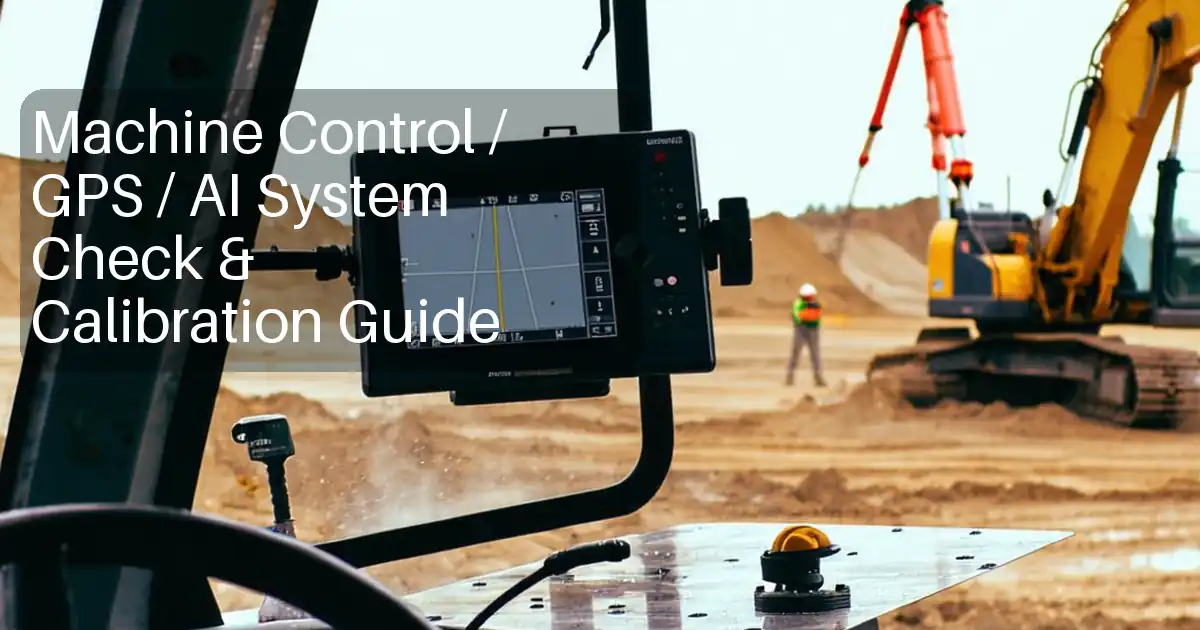
Checklist page |Interactive: Hydraulic System Inspection & Leak Control |Excel: Hydraulic System Inspection & Leak Control |PDF: Hydraulic System Inspection & Leak Control - Machine Control / GPS / AI System Check & Calibration (2026 Tech)
Checklist page |Interactive: Machine Control / GPS / AI Calibration |Excel: Machine Control / GPS / AI Calibration |PDF: Machine Control / GPS / AI Calibration
11. Standards, Codes, Calibration and Testing Plans for Excavators
Excavators are not governed by a single “excavator code.” Instead, compliance and safe operation come from a mix of machine safety standards, performance test standards, and site procedures (inspection + calibration + verification). In practice, contractors and fleet managers typically focus on four areas: safety compliance, lifting verification, hydraulic performance, and machine-control (GPS/AI) validation.
11.1 Safety standards contractors actually rely on
These standards define baseline safety expectations for hydraulic excavators, including guarding, access, controls, stability, and information for use.
-
ISO 20474-1: General safety requirements for earth-moving machinery (applies across machine families).
-
ISO 20474-5: Excavator-specific safety requirements (hydraulic excavators).
-
EN 474-5 (Europe): Safety requirements for hydraulic excavators (harmonized EN in the EU context).
On real sites, this translates into checks like:
-
emergency stops / shutoffs present and functional
-
audible alarms, lights, mirrors/cameras working
-
safe access (steps/handrails), guards in place
-
stability rules followed (slope limits, swing zone control)
11.2 Lifting operations: lift charts and “can we lift this safely?”
Excavators often lift pipes, manholes, precast items, and small loads. When lifting becomes part of the planned work method, the minimum expectation is:
-
Use the manufacturer lift chart (including radius, height, bucket/attachment configuration, counterweight, and undercarriage position).
-
Verify the machine’s rated lift capacity method aligns with ISO 10567 (how lift capacity is calculated and verified).
Typical project testing / verification:
-
confirm the correct lift chart for the exact configuration (boom/arm, coupler, attachment, counterweight)
-
verify load radius on the ground (simple marked radii or machine-control display)
-
do a controlled “trial lift” at low height to confirm stability margin before routine lifting
11.3 Quick couplers and attachments: the biggest preventable hazard
A large portion of serious incidents comes from attachment release or incorrect coupler engagement. If you use quick couplers, treat them as a controlled safety system.
-
ISO 13031: Safety requirements for quick couplers on earth-moving machinery.
Practical site checks contractors implement:
-
coupler engagement verification step in the daily pre-start
-
visual confirmation of locking indicator (and secondary locking where applicable)
-
“shake test” / curl-and-extend test at low height before work begins
-
hose routing and protection checks (pinch points, abrasion points)
11.4 Visibility and operator protection: what gets tested on machines
OEMs certify designs, but contractors still verify functionality and site readiness.
-
ISO 5006: Operator field-of-view test method (visibility).
-
ISO 3471: ROPS performance requirements and lab test method.
-
ISO 12117: TOPS for compact excavators (tip-over protective structure).
What contractors actually do:
-
ensure mirrors/cameras are clean and functional at shift start
-
confirm seatbelt condition/use (small step, huge impact)
-
check ROPS/TOPS structure has no unauthorized drilling/welding/modifications
11.5 Hydraulic performance checks: “is the machine healthy?”
Most fleet downtime is hydraulics (leaks, overheating, contamination, hose failure). Contractors typically don’t run full lab tests, but they do structured field checks.
Common verification items:
-
leak mapping (hoses, fittings, cylinder seals)
-
abnormal pump noise / temperature rise
-
slow/jerky movement symptoms (air ingress, valve issues)
-
basic fluid condition checks and contamination prevention
(If you want to reference a performance test standard in your references list, tool force testing methods are covered in ISO 6015 documents).
11.6 Machine control (GPS/AI) calibration and validation plan
Machine-control accuracy is not “set and forget.” Contractors should treat it like surveying equipment: calibrate, validate, then monitor drift.
A practical calibration + testing plan:
-
Calibration: bucket tip calibration + boom/arm sensor checks at start of project and after transport/repairs
-
Corrections check: GNSS corrections/base connection confirmed before production digging
-
Model verification: confirm the correct surface/model version is loaded (avoid digging to the wrong revision)
-
Accuracy validation (“test dig”): cut a small test section and verify depth/slope with independent measurement
-
Ongoing checks: repeat quick validation after hard impacts, sensor replacement, or abnormal readings
11.7 Regulations (example: U.S. OSHA) — site rules still apply
Even with ISO/EN standards, local regulation and site safety procedures govern operations.
For U.S. readers:
-
OSHA construction standard for earthmoving equipment (Material handling equipment) includes items like seat belts and equipment condition requirements.
- OSHA excavation/trenching rules affect how equipment works around excavations.
ISO Standards for Excavators
-
ISO 20474-1:2017 – General Safety Requirements: Outlines the primary safety specifications and common hazards for all types of earth-moving machinery.
-
ISO 20474-5:2017 – Hydraulic Excavator Safety: Specifies requirements specifically for hydraulic excavators, including stability and protection systems.
-
ISO 10567:2007 – Lift Capacity: Provides the uniform method for calculating and verifying the rated lift capacity of hydraulic excavators.
-
ISO 13031:2016 – Quick Couplers: Focuses on the safety systems required to prevent the unintended release of attachments from the excavator arm.
-
ISO 5006:2017 – Operator's Field of View: Defines the testing method and performance criteria to ensure the operator has adequate visibility around the machine.
-
ISO 3471:2008 – ROPS Standards: Detailed laboratory tests and performance requirements for Roll-Over Protective Structures.
-
ISO 12117:1997 – TOPS for Compact Excavators: Specifically addresses Tip-Over Protective Structures for mini/compact excavators.
-
ISO 6165:2022 – Vocabulary & Classification: The industry-standard guide for terminology and the basic classification of all earth-moving equipment.
OSHA Regulations & Safety
-
OSHA 29 CFR 1926.602 – Material Handling & Earthmoving: The federal regulation governing the safe operation and maintenance of earthmoving equipment on construction sites.
-
OSHA Trenching and Excavation Safety – Official Safety Guide (PDF): A comprehensive manual covering soil classification, sloping, benching, and protective systems for excavation work.
12. Major Excavator Manufacturers and Notable 2026 Models
The global excavator market is led by a handful of major OEMs, and competition is accelerating innovation in automation, fuel efficiency, electrification, and digital machine control.
12.1 Notable 2026 “trend” models to watch
-
Volvo EC560 (56-ton class) — Volvo CE debuted the all-new EC560 at CONEXPO 2026, positioning it as part of its next-generation lineup aimed at mass excavation and material transport.
-
Kubota KX040-5 (mini excavator) — Kubota’s KX040-5 is widely discussed as a top-selling mini excavator in the U.S., with industry coverage calling it “top-selling” and highlighting its next-generation updates.
12.2 Leading brands (with official product pages)
- Caterpillar
- Komatsu
- Hitachi
- Volvo Construction Equipment
- Liebherr
- Hyundai
- Kobelco
- SANY
- JCB
- Develon (formerly Doosan)
Volvo EC560
- Volvo EC560 Model Page:
https://www.volvoce.com/united-states/en-us/products/excavators/ec560/ - Volvo EC560 at CONEXPO 2026:
https://www.volvoce.com/united-states/en-us/about-us/news/2026/volvo-ce-debuts-all-new-56-ton-excavator-at-conexpo-2026/
Kubota KX040-5
- Kubota KX040-5 Brochure:
https://www.kubotausa.com/docs/default-source/brochure-sheets/brochure-_-kx040-5_ktc.pdf?sfvrsn=7b1de157_3 - Kubota Compact Excavators Lineup:
https://www.kubotausa.com/products/construction/compact-excavators - Equipment World KX040-5 Coverage:
https://www.equipmentworld.com/construction-equipment/compact-equipment/compact-excavators/video/15771933/video-kubota-revamps-topselling-mini-excavator-kx0405
Manufacturer Lineups
- Caterpillar Excavators:
https://www.cat.com/en_US/products/new/equipment/excavators.html - Komatsu Excavators:
https://www.komatsu.com/en-us/products/equipment/excavators - Hitachi Excavators (Americas):
https://www.hitachicm.com/us/en/products/ - Hitachi Excavators (EU):
https://www.hitachicm.com/eu/en/machinery/excavators/ - Volvo Excavators:
https://www.volvoce.com/united-states/en-us/products/excavators/ - Liebherr Crawler Excavators:
https://www.liebherr.com/en-int/earthmoving/products/excavators/crawler-excavators-5376587 - Hyundai Excavators:
https://www.hyundai-ce.eu/en/products/excavators - Kobelco Excavators:
https://kobelco-usa.com/excavators - SANY Excavators:
https://www.sanyamerica.com/products/construction-equipment/excavators/ - JCB Tracked Excavators:
https://www.jcb.com/en-US/products/machines/tracked-excavators/ - Develon Crawler Excavators:
https://na.develon-ce.com/en/construction-equipment/crawler-excavators
13. The Future of the Excavator Market
The excavator industry is entering a period of rapid technological transformation.
Several major trends are shaping the future of the market.
Autonomous Excavators
Autonomous operation is one of the most significant developments.
Future excavators may be capable of:
-
Autonomous digging cycles
-
Automated truck loading
-
Remote operation from control centers
-
AI-based terrain analysis
These technologies are already being tested in mining operations, where equipment operates in controlled environments.
Fully Connected Construction Sites
Excavators will increasingly be connected to digital construction platforms.
Machines will share data with:
-
project management software
-
BIM models
-
surveying systems
-
fleet management platforms
This integration allows contractors to monitor productivity and progress in real time.
Electrification and Sustainability
Environmental regulations are pushing manufacturers toward:
-
electric powertrains
-
hybrid machines
-
hydrogen technologies
Sustainability goals are becoming an important driver in equipment procurement decisions.

Conclusion
Excavators remain the backbone of construction projects. Their ability to perform multiple tasks with high efficiency makes them indispensable on modern job sites.
However, the excavator of today is very different from the machines used decades ago. With the integration of GPS machine control, artificial intelligence, telematics, and electric power systems, excavators are becoming smarter, cleaner, and more productive.
As automation and autonomous technologies continue to evolve, the excavator will likely remain the king of construction equipment, but it will increasingly operate as part of a connected and intelligent construction ecosystem.