Can an NCR Lead to Termination? Hidden Risk Behind “Notice to Correct”
An NCR cannot terminate a contract by itself, but it can set the grounds for default termination if it escalates into a formal “Notice to Correct / Cure” and the contractor fails to remedy within the allowed time. This page explains the NCR→notice→default mechanism, shows a simple example timeline, and highlights the hidden risk for contractors and the ethical responsibility for engineers when recommending escalation.
One-line truth: The termination risk is usually triggered by failure to correct after notice — not by the existence of an NCR.
What this page is (and isn’t)
This is not a general guide to termination. It focuses on the short clause found in most contract families that sounds harmless (“notice to correct/cure”) but can become a high-stakes default pathway if mishandled.
NCR vs default: what changes when a notice is issued
- NCR is a QA/QC control record: identify non-compliance, contain it, correct it, verify it, close it.
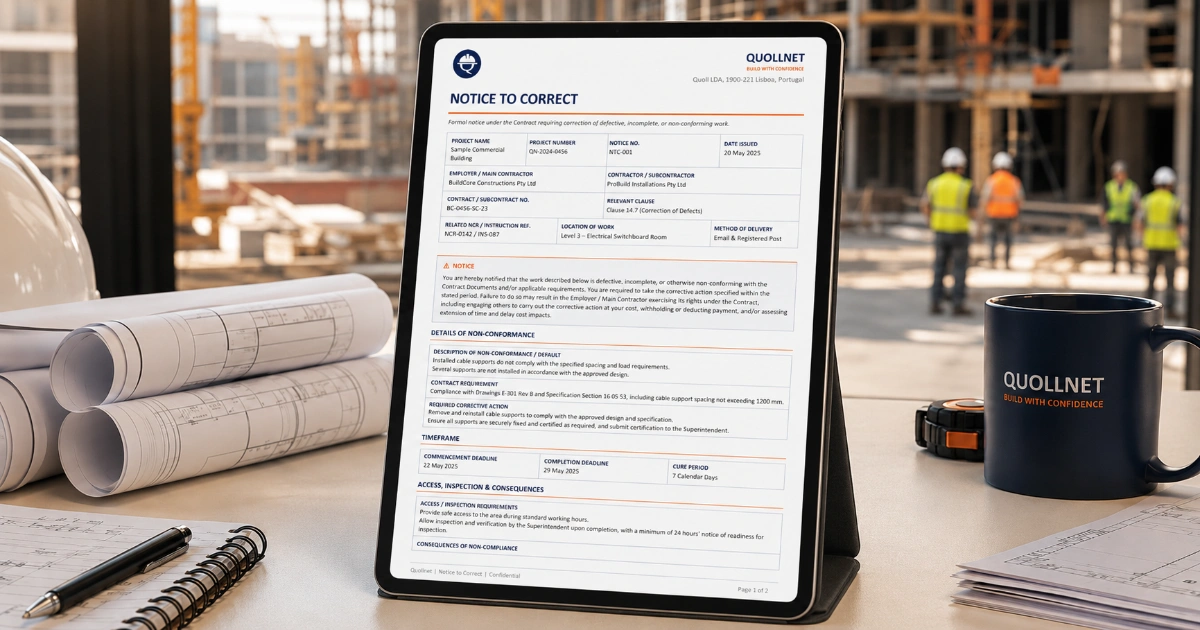
- Notice to Correct / Cure is a contractual escalation: it sets a time-bound obligation to remedy a failure and preserves stronger remedies if the failure continues.
- Termination risk appears when the contractor ignores deadlines, refuses to remedy, or allows issues to remain open beyond the cure period.
If you need the NCR basics first, see NCR Meaning in Construction. For templates, see NCR Form Template and NCR Log Template. For notice discipline, see Timely Notices in Construction.
The escalation ladder (what most projects look like)
- NCR raised (facts + references + containment requirements).
- Instruction to remedy (clear direction and target date).
- Notice to Correct / Cure (formal cure clock starts).
- If still not corrected → default remedies may be triggered (including termination, subject to strict procedure).
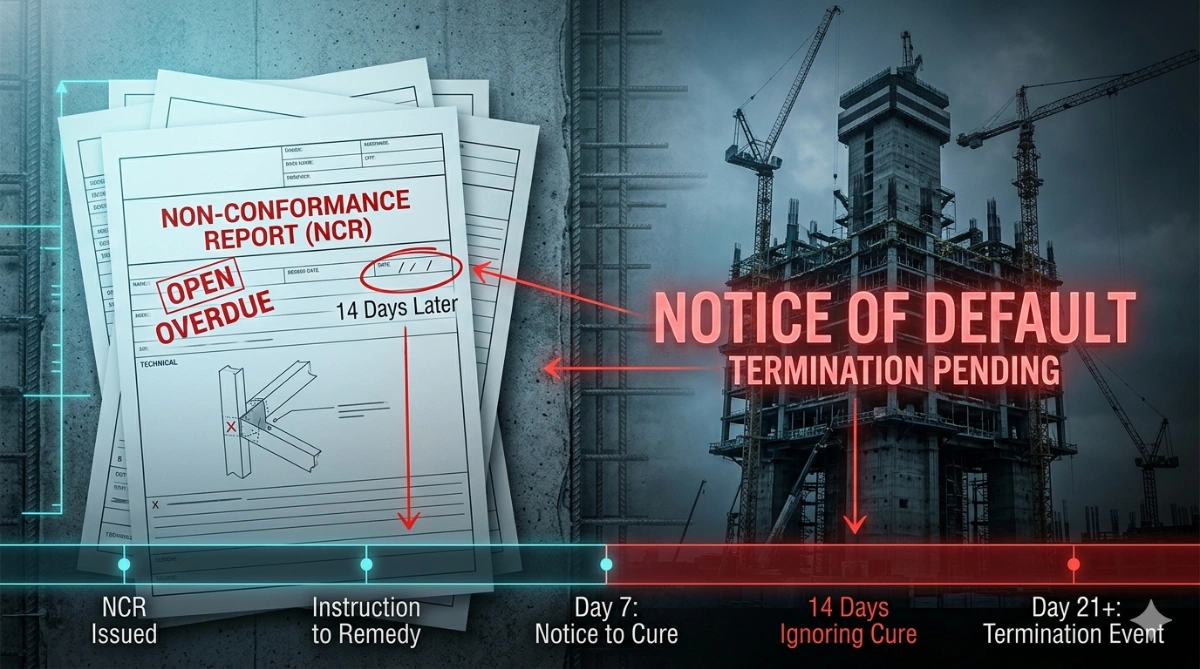
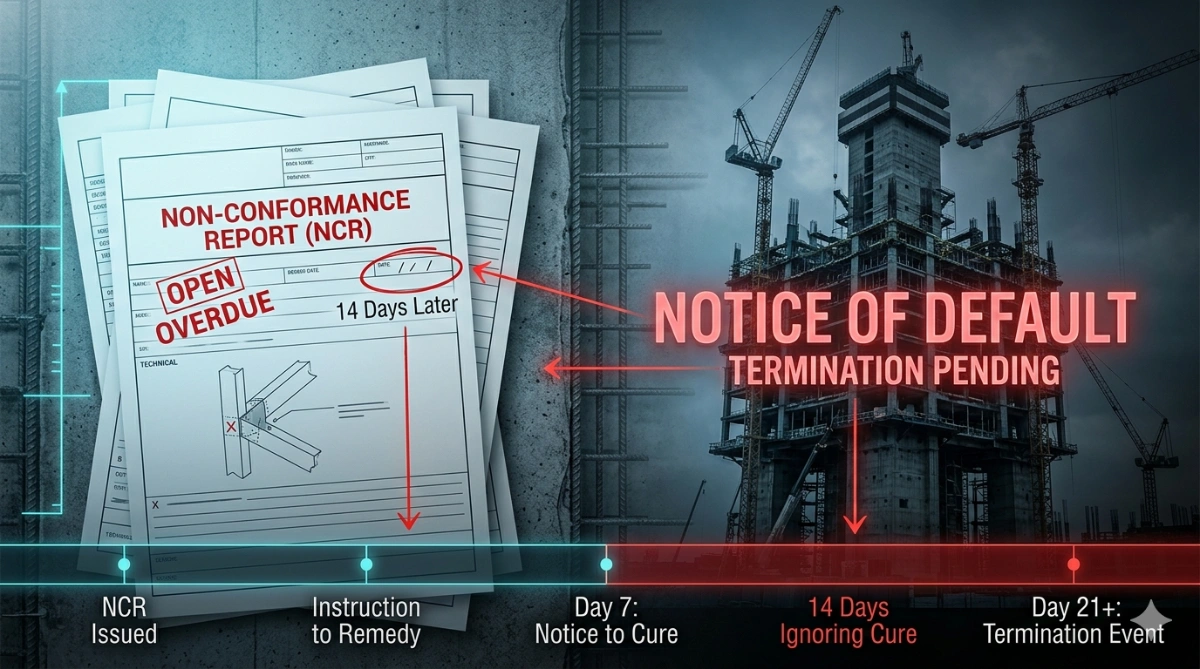
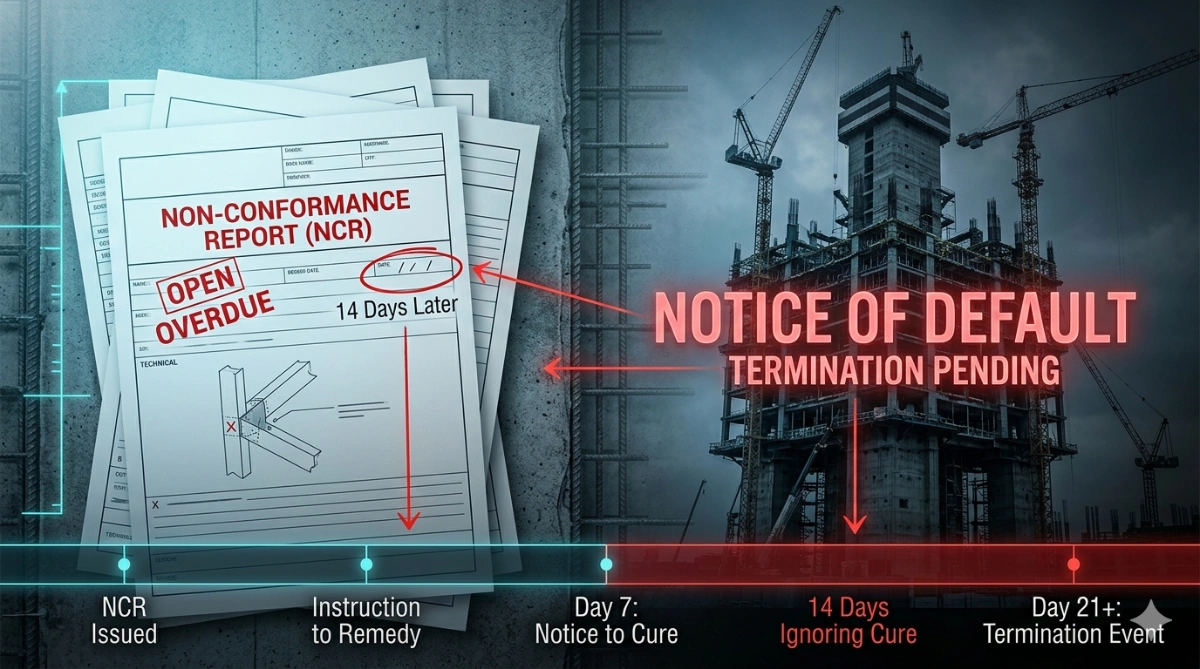
Example timeline (illustrative only)
This is a practical example of how an ignored NCR can become a contractual default. Your project may be faster or slower depending on contract wording and risk severity.
| Day | Record / Issued by | What it means |
|---|---|---|
| 0 | NCR issued Engineer / Consultant or Contractor QA | Non-compliance recorded; containment + corrective action required. |
| 2 | Instruction to remedy Engineer / CA / PM | A clear direction and deadline to correct (technical control step). |
| 7 | Notice to Correct / Cure Employer / Contract Admin authority (per contract) | Contractual escalation: “remedy by X date” or consequences may follow. |
| 21 | Default remedies considered Employer (per contract procedure) | If failure continues after cure, stronger remedies may be triggered (including termination, subject to strict notice rules). |
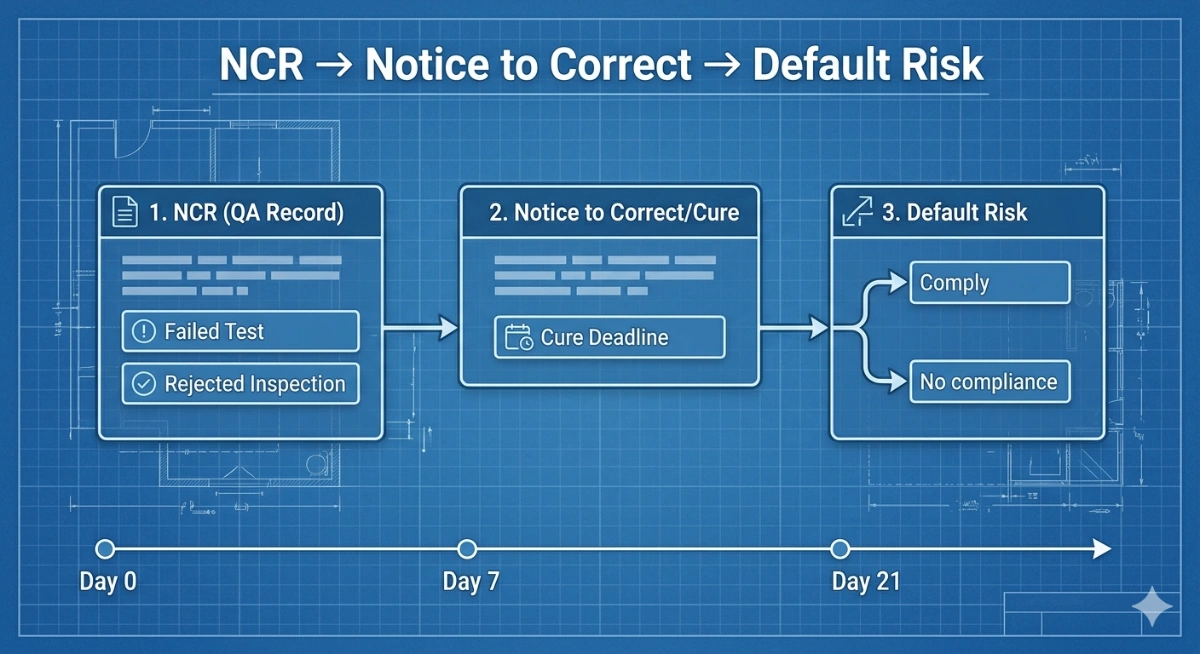 NCR, Notice To Correct, Risk - FLOW CHART
 Why “minor” NCRs can still become high risk
Not all NCRs are about safety or structural integrity. Some are “contract compliance NCRs” such as:
- using a brand not on the approved list,
- using a supplier not in the approved sources,
- using a subcontractor not approved/allowed under the contract or project procedures.
Even if the work operates correctly and meets performance tests, the Employer/Engineer may treat “approved source” requirements as contractual compliance. The hidden risk is when the situation becomes a hard commercial fork:
- Replace (expensive, disruptive), or
- Accept with deduction (often tied to valuation, sometimes disputed if the basis is not transparent).
Contractor warning: A minor compliance NCR becomes dangerous when response deadlines slip. Once a cure notice is issued, it’s no longer “QA paperwork” — it’s a countdown.
Contract clause map (where this mechanism usually lives)
Clause numbers vary by edition and Particular Conditions. The items below are the most common “labels” used in standard forms. Always verify your contract edition.
- FIDIC 1999 (typical): Sub-Clause 15.1 (Notice to Correct) → Sub-Clause 15.2 (Termination by Employer for specified defaults) → Sub-Clause 15.5 (Termination for Employer’s convenience, where applicable).
- AIA A201-2017 (typical): Article 14, including termination for cause procedures (often described as requiring notice and architect involvement/certification depending on the ground).
- JCT (typical): Termination is often a two-stage notice process (initial default notice, then a further notice if default continues after a defined period).
- NEC4 ECC (typical): Termination requires proper notification to the Project Manager and the other party, often required to be a separate communication, then a termination certificate and defined post-termination steps.
What happens after a Notice to Correct (two outcomes)
Outcome 1: contractor complies within the cure period
- Corrective action is completed and verified (re-inspection / re-test / evidence accepted).
- The escalation stops.
- Commercial impacts (holds/deductions) are adjusted according to the project’s valuation rules and documented references.
Outcome 2: contractor does not comply
If the contractor does not remedy within the cure period, the employer may proceed toward default remedies under the contract. While the exact steps differ by form, the practical consequences are consistently serious:
- Termination notice may be served (procedure-sensitive).
- Site control changes: access restrictions, takeover of materials/plant (depending on contract), protection of records.
- Completion by others: the employer appoints others to complete/repair; costs may be pursued through contract mechanisms.
- Valuation becomes aggressive: re-measurement, withheld payments, set-offs, backcharges, final account disputes.
- Security pressure: performance security / surety involvement (where applicable).
- Records become weapons: NCR log, notices log, inspection/test reports, emails, meeting minutes.
Field scenario (both sides): how this becomes “termination leverage”
Scenario (anonymized): During a market downturn on a major project, the Employer later viewed the project as commercially unattractive. A quality paper trail was used to build a “clean” default narrative: NCRs were raised aggressively, cure notices were issued on tight timelines, and any procedural slip by the contractor (late response, incomplete evidence) was treated as continued default. This pushed the termination outcome toward contractor default rather than employer convenience.
- Contractor risk lesson: A contractor can “lose on paperwork” even when the site work is broadly functional, if responses are late or evidence is weak after a cure notice is issued.
- Employer misuse risk: Using notice-to-cure mechanisms as a commercial exit strategy can create disputes and reputational damage—and may trigger scrutiny over procedure, reasonableness, and record quality.
Contractor playbook: how to protect yourself once an NCR or cure notice appears
- Respond fast in writing: within 24–48 hours (even if it’s “under review; plan by X date”).
- Propose compliant paths: replace with approved source or request formal concession with defined acceptance criteria.
- Never miss the cure clock: once a cure notice lands, treat it as a priority risk item.
- Separate technical vs commercial: correct compliance first; reserve rights on deductions separately and ask for basis in writing.
- Log it correctly: NCR log can store “notice ref/date”; a separate notices register should track cure deadlines and follow-ups.
Run this tool: Contractor NCR: What to Do After Receiving a Report.
Engineer/consultant note: use this power carefully
Notice-to-cure clauses are powerful and can change the commercial balance of a project. A professional recommendation should be grounded in:
- Safety and compliance (life-safety, structural integrity, statutory approvals, concealment risk),
- Repeated failures and refusal to cooperate,
- Clear, factual records with realistic remedy expectations and verification paths.
Practical principle: use the “hammer” only when justified. Over-issuing cure notices for low-risk issues can damage collaboration and project outcomes.
Call To Action:
- Notice to Correct Template (PDF)
- Notice to Correct Template (WORD)
- Response to Notice to Correct Template (PDF)
- Response to Notice to Correct Template (WORD)
Related reading:
Timely Notices in Construction, Open NCRs at Taking-Over / DLP, NRC Meaning, Open NCR at handing over, SOR vs NCR vs Snag
References:
Fenwick Elliott: Termination by the Employer under FIDIC (notice to correct and termination pathway)
International Construction Knowledge Hub: FIDIC 1999 Commentary on Clause 15
FIDIC: Termination, Risk and Force Majeure (presentation)
CMS: JCT termination notices — getting the procedure right
Fenwick Elliott: Termination and notice timing under JCT (14 days / 21 days discussion)
NEC: Termination in an NEC4 ECC (notice and communication requirements)
Andrews Myers: Termination for cause under AIA A201 (architect certification and notice)
AIA: A201–2017 General Conditions (reference document)