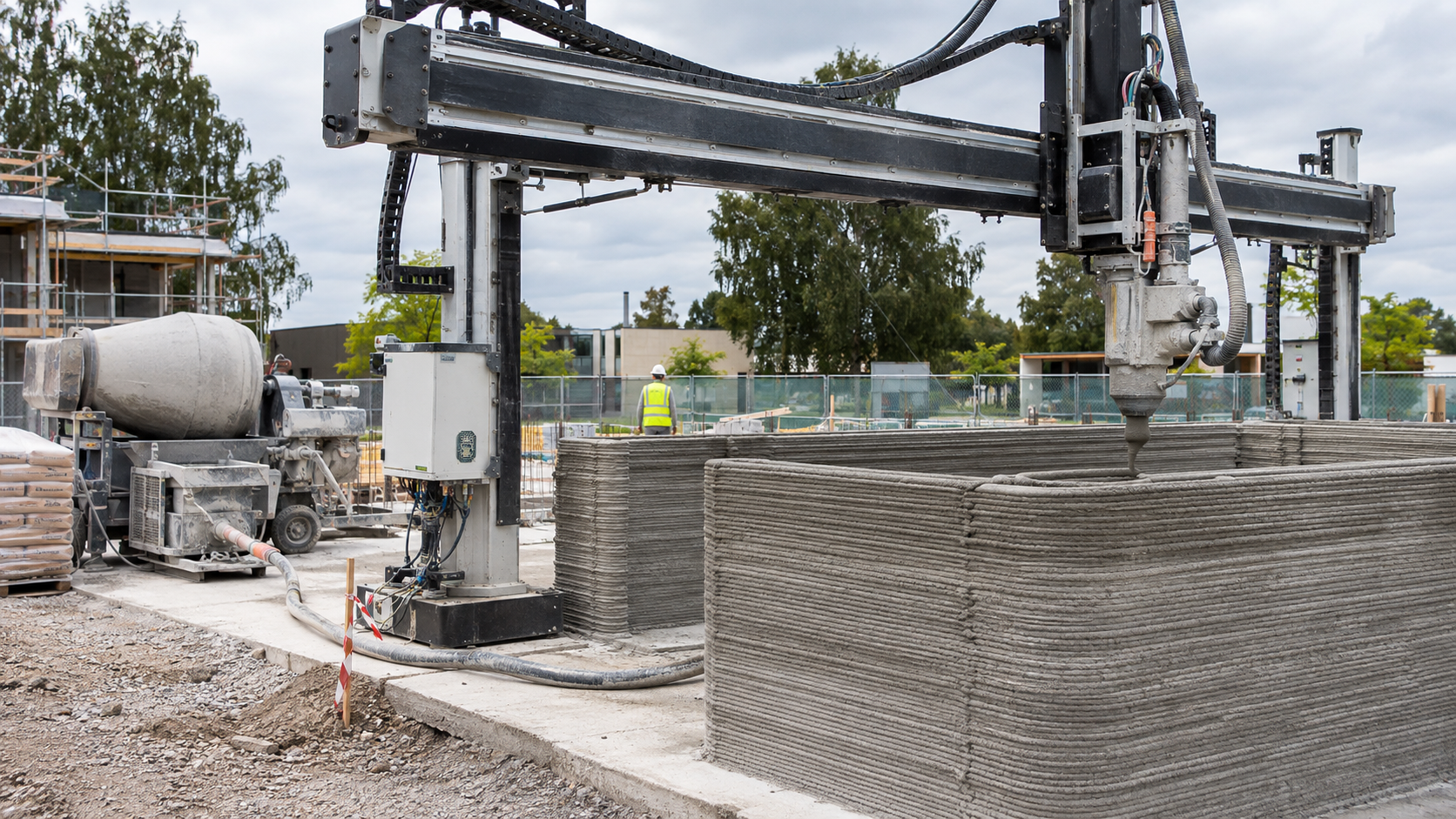
3D Concrete Printing Machines: Types, Specifications, Manufacturers and Prices
A 3D concrete printing machine should be selected for the project's engineered wall system, material supply, printing envelope, site logistics and production workload—not for advertised nozzle speed or headline price alone. Compare gantry, crawler, robotic-arm and modular printers; verify what the supplier's package includes; and calculate the total delivered, installed and maintained investment before committing to a machine.
Contractor's starting point: Define the walls and structures you must deliver, their engineered quantities and the construction programme before selecting the printer. The comparison is about a viable production system and its installed cost, not merely acquiring a robot.
Which types of 3D construction printers are available?
The main configurations for construction-scale material extrusion include: gantry-based systems that move a print head across defined axes; mobile robotic arms on crawler or wheeled platforms; fixed or track-mounted robots primarily used in factories and controlled environments; and modular crane-derived systems. These architectures differ in reach, accuracy, relocation, foundation requirements, service access and safe operating zones.
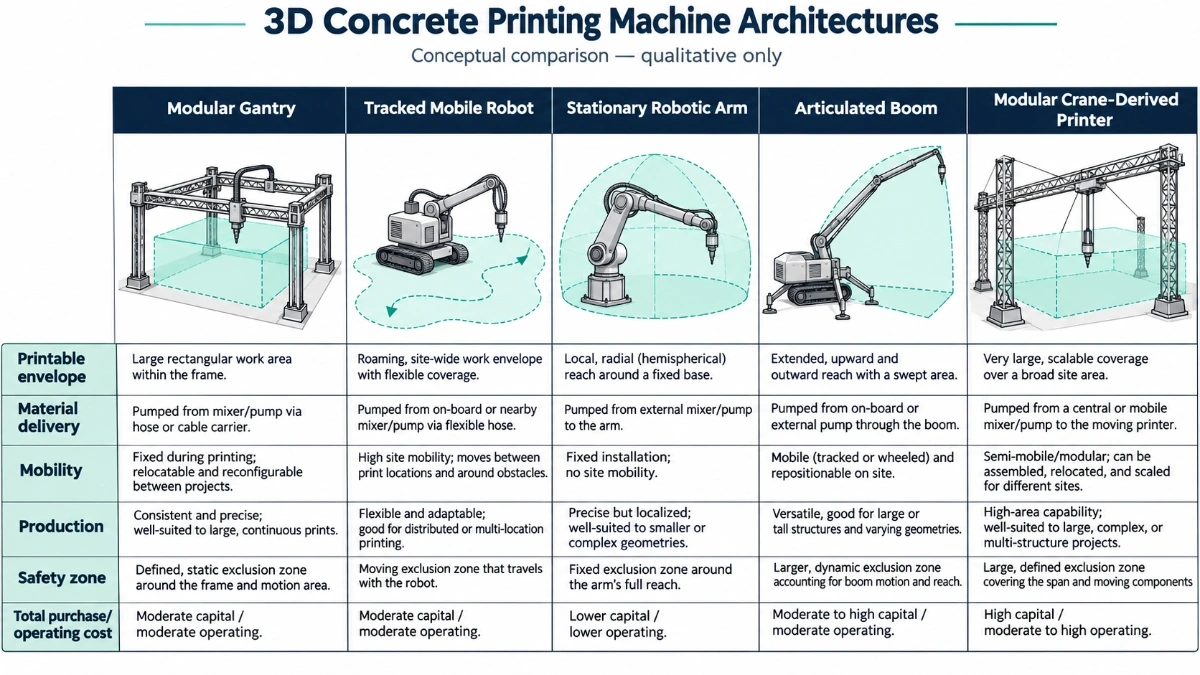
Gantry printers can cover long walls or repeated house plots when the rail and module arrangement suits the site. Mobile robot systems can avoid a full-house gantry but need stable setup locations and an accurate reach/coverage study. Fixed robotic systems may suit prefabricated elements better than an occupied residential plot. A modular system using earth or lime mixes should not be treated as equivalent to a designed, reinforced structural concrete wall without a separate technical qualification.
Technical specifications that matter more than advertised print speed
Request a full model- and configuration-specific technical schedule. Record whether each value is a manufacturer-rated maximum, a tested condition or a demonstrated site production result. A maximum travel speed, for example, does not establish the rate at which an acceptable structural wall can be printed.
| Specification | Contractor verification |
|---|---|
| Machine configuration | Gantry / tracked robot / crane-based module / stationary robot; site movement and reach differ |
| Printable envelope | Verified working geometry, maximum height, width, clearance, nozzle orientation and obstacles |
| Material compatibility | Approved local mix or proprietary mortar; aggregate size, binder chemistry, open time and pump limits |
| Production capability | Extruded volume and accepted wall length per shift at proven geometry; not maximum axis travel speed |
| Site readiness | Foundations/platform tolerances, ground bearing, access, weather limits and lifting requirements |
| Material delivery | Mixer, batching, silo, pump, hoses, material QC and required utilities |
| People and controls | Operator, materials crew, supervision, programming, training and cyber/software support |
| Commercial package | Included machinery, software, licenses, consumables, warranty, commissioning and support |
| Service and maintenance | OEM instructions, trained technicians, spares, response time, downtime and annual cost |
For capacity estimation, calculate design-derived actual extruded volume (excluding cavities and other unprinted portions), toolpath length, layer count, changeovers, start/stop and quality holds. A preliminary print-cycle estimate can use a qualified layer geometry and tested deposition rate, then add mixing and pumping losses, relocations, reinforcement, grouting, inspections and foreseeable downtime. The printable concrete mix-design and qualification guide explains why a compatible mix is part of the machine's usable capacity.
Printing speed and site productivity are not interchangeable. Acceptance records and tests must demonstrate that the output meets the approved requirements; refer to 3D-printed concrete testing and acceptance.
3D concrete printing machine manufacturers and models
The following are representative equipment approaches, not a ranking or paid endorsement. Product availability, factory configuration, specifications and sales arrangements may change. Each link leads directly to the manufacturer's official product information. For later illustrated publication, add appropriately licensed or manufacturer-approved machine photos with descriptive captions linking to these pages.
COBOD — BOD2, BOD3 and BOD XL
Configuration: Modular gantry. Gantry systems for building-scale printing. The BOD2 targets individual structures, the BOD3 is presented for serial housing with movement between structures, and BOD XL serves larger envelopes. Verify module count, printable dimensions, site rails/ground preparation, transport configuration, and local-concrete supply with the actual offer.
Published price / status: Manufacturer advertises starting prices from US$400,000; its BOD3 page also lists this entry point. Configuration and accessories change the offer.
CyBe Construction — RC Robot Crawler, R, RT and GR
Configuration: Mobile robot / fixed / gantry. Robot arm on crawler for mobile on-site work, plus stationary, track and gantry options. The RC's working geometry is not a simple rectangular box; verify robot reach, stable setup positions, safe clearances and how many relocations are needed for a particular house.
Published price / status: The current catalogue lists RC from €195,000 ex works, while other models and limited-stock offers have different starting prices.
ICON — Titan Print Suite
Configuration: Tracked robotic-boom system. Integrated robotic-boom printing ecosystem combining Titan, pump, digital workflow, support and an OEM-managed materials system. Review what the printer buyer owns versus what is supplied as a continuing service; verify local material availability and operating territories.
Published price / status: ICON's Titan programme lists US$899,000 for Titan + Pump; the material mixer and supplied materials follow a different supply arrangement.
Apis Cor — Frank and associated equipment
Configuration: Mobile robot. Mobile robotic printing equipment and associated construction workflow. Seek a complete current datasheet and quotation covering actual print envelope, machine mass and ground loading, batching/pumping, consumables, training, transport and service support.
Published price / status: Obtain a current manufacturer quotation; no directly comparable purchase price is used here.
WASP — Crane WASP
Configuration: Modular crane / gantry. Modular crane-derived printer able to work with different cementitious and earth-based materials. Confirm whether the proposed printed wall is a structural concrete system or another qualified material/application before comparing it with concrete building machines.
Published price / status: Manufacturer lists a starting price of €160,000 for Crane WASP; optional modules, site equipment and final configuration require a quotation.
How much does a construction 3D printer cost?
As checked against the manufacturers' official pages in November 2026, the following are public starting indications rather than comparable turnkey project quotations. Currencies and commercial bases are deliberately left as advertised; no exchange-rate conversion is used.
| Example | Manufacturer-published indication | Important qualification |
|---|---|---|
| COBOD BOD3 / range | From US$400,000 | Actual machine dimensions and accessories determine quote |
| CyBe RC crawler | From €195,000 | Ex works for standard configuration; delivery and taxes extra |
| ICON Titan + Pump | US$899,000 | Integrated materials/mixer and support arrangements differ from standalone machine sale |
| Apis Cor Frank | Request quotation | Define exact system scope and supplied items |
| Crane WASP | From €160,000 | Modular material system; check mix and wall suitability before comparison |
Do not compare these prices as if they buy identical installed packages. One supplier's price may include a mixer, training or software while another excludes them; recurring licensed materials, installation, freight, local taxes, spare parts and maintenance may materially change the delivered cost. Confirm all terms in dated, written quotations.
Calculate total equipment investment, not just machine purchase price
For each quotation, establish a consistent cost boundary: machine and controller; print head and spare parts; concrete mixer and pump; silo and dosing facilities; hoses and utilities; transport and customs; lifting and assembly; commissioning and first-print assistance; licenses and subscriptions; operator training; site enabling works; maintenance contract; and contingencies. Separate one-time capital outlay from per-project mobilization and annual operating costs.
Concrete quality, structural connections and installation scope may also change the economic comparison. This is covered in the 3D-printed house cost and BOQ guide, where quantities are derived from a viable alternative design rather than assumed to be the same for all wall systems.
Free 3D Concrete Printer Comparison and Supplier RFQ Excel Templates
Download two editable Excel resources to evaluate 3D concrete construction printers and request comparable quotations from equipment manufacturers. The templates complement the machine specifications and advertised starting prices discussed above. Complete missing technical data using official supplier responses, not assumptions.
1. 3D Concrete Printer Equipment Comparison and RFQ Workbook — Excel
A five-sheet equipment evaluation workbook for contractors, engineers and procurement teams. Compare nine printer configurations from COBOD, CyBe, ICON, Apis Cor and WASP; review machine types, technical specifications, source-linked indicative prices, installed investment and a 44-question RFQ tracker. It includes a formula-based investment model to compare the costs of a complete printing system beyond the base machine.
Download the free 3D Concrete Printer Equipment Comparison & RFQ Workbook (.xlsx)
2. 3D Concrete Printer Supplier RFQ Form — Excel
A four-sheet manufacturer-facing Request for Quotation template covering project requirements, technical responses, itemized prices, included and excluded equipment, factory and site acceptance, training, warranties, spare parts and supporting documents. Send the same form to each shortlisted supplier for a more consistent technical and commercial comparison.
Download the free 3D Concrete Printer Supplier RFQ Form (.xlsx)
Both files are editable Excel workbooks. Manufacturer-published prices are indicative, may differ by configuration and currency, and are not binding quotations. Confirm the current offer, specifications, delivery scope and regional support directly with each supplier.
Which printer suits individual villas or a large housing development?
For one house, measure the cost and logistics of bringing the system in, setting up, printing, checking the wall and demobilizing. Machine purchase may make little sense for a one-off contract if qualified specialist printing services are available. For repeated villas, consider the number and location of printer setups, relocation time, workface availability, material supply, common design variants, and how civil, print, roofing and MEP crews follow the work.
A project involving hundreds of villas does not automatically justify one machine or many machines. Test alternative fleet sizes and production zones against the full construction master programme, crew capacity and handover sequence. The 3D-printed house CPM master schedule shows how printer operating time can differ substantially from whole-house completion.
Assess a trial unit before scaling: verify geometric tolerances, material performance, MEP interfaces, wall reinforcement, acceptance records and realistic shift productivity. Review our concrete printing inspection checklist collection for the construction QA/QC side of that work.
Maintenance, spare parts and after-sales support
Evaluate equipment availability as carefully as rated output. Ask the manufacturer for model-specific operator manuals, preventive maintenance intervals, cleaning protocols, lubrication schedules, fault history, part replacement intervals, spares prices, remote diagnostics, technician response times and service coverage at the project's location. Annual maintenance costs and expected downtime belong in the ownership model.
Construction quality inspections and equipment maintenance are separate records. The existing Quollnet site checklists cover pre-print readiness, active printing and printed-wall acceptance. A planned companion 3D Concrete Printer — Daily Inspection & Maintenance checklist will cover operator checks and defect recording, with manufacturer instructions controlling technical service procedures and maintenance intervals. It should not be used as a substitute for the applicable OEM manual or qualified technician.
Manufacturer RFQ: the questions to ask before ordering
- What is the exact model, serial configuration, working envelope, minimum clearances and site preparation requirement?
- Which drawings, approved print files, structural details and mix qualification information must be supplied by the purchaser?
- What equipment, software, materials, spare parts, training, commissioning and safety documentation are included?
- What aggregate sizes, material rheology and local batching solutions are approved, and are proprietary materials obligatory?
- What production evidence can the manufacturer provide for comparable walls, including rejected prints and cleaning/restart times?
- What are the transport dimensions, shipping terms, customs exposure, delivery lead time and commissioning requirements?
- What warranty, service-level agreement, response time, spare-parts lead time and maintenance obligations apply locally?
- What are the commercial conditions for trials, acceptance tests, performance guarantees, payments and eventual upgrades?
Request a like-for-like technical and commercial proposal, then evaluate it against the project's actual structural design, quality requirements, site logistics and commercial programme. Manufacturer specifications help shortlist equipment; they do not replace project engineering or qualification.
Conclusion
The right 3D concrete printer is the one that can reliably produce the approved wall system with the required quality, at a viable total installed and operating cost, within the project's construction sequence. First establish design requirements and measured quantities, then assess output and logistics, obtain comparable quotations and review OEM support. This is the foundation for a realistic decision to buy, subcontract or partner with a specialist printer operator.
References
COBOD 3D Construction Printers — product range and published pricing — COBOD International.
CyBe Construction Printers — model catalogue and published prices — CyBe Construction.
CyBe RC — Robot Crawler product page — CyBe Construction.
ICON Titan — technology and integrated system — ICON.
ICON Titan — product programme and pricing — ICON.
Apis Cor — Robotic Construction Technology — Apis Cor.
Crane WASP — Construction printer, specifications and price — WASP.