
How to Create a Construction Project Cash Flow: A Practical Guide for Contractors
A construction project cash flow is created by forecasting project outflows and client inflows separately, placing both on a common time scale, and then calculating the resulting net and cumulative cash position. The lowest cumulative balance shows the project's pre-financing funding requirement. For tendering, negotiation, budgeting, and financing decisions, the model does not need to reproduce a fully detailed construction programme; it needs enough activity, cost, timing, and commercial detail to represent the cash drivers that materially affect the decision.
Construction projects can be profitable on paper and still create serious funding pressure. The reason is simple: costs are usually paid before the corresponding client cash is received. Contractors pay labour, suppliers, subcontractors, plant, preliminaries, and mobilization costs while client payments may be delayed by certification, payment periods, retention, advance recovery, and billing rules.
A useful project cash flow therefore answers a practical question:
Given the execution plan, contract terms, subcontract terms, and current assumptions, how much cash is expected to go out, how much is expected to come in, when, and what funding gap could result?
This guide explains how to build that forecast manually or in a spreadsheet, and then shows where a purpose-built tool such as CashflowPot can make scenario testing and financing analysis easier.
1. Start With the Decision, Not the Software
The level of detail in a cash-flow model should match the decision being made. A contractor preparing a tender, negotiating payment terms, approaching a bank, or updating a project budget usually needs a fast and credible financial model rather than a fully developed critical-path programme.
A detailed Primavera P6 or Microsoft Project schedule can be useful when it is current and appropriately cost-loaded, but it is not a prerequisite for every financial decision. For many cash-flow questions, a master plan with the major cost and timing drivers is enough.
Typical master activities might include:
- mobilization and preliminaries;
- earthworks and substructure;
- superstructure;
- facade;
- MEP procurement and installation;
- finishes;
- external works;
- testing, commissioning, and handover.
The model can later be refined as information improves. The objective is not maximum detail. The objective is a forecast accurate enough for the commercial or financing decision being made.
If the project scope is still being structured, a Work Breakdown Structure (WBS) can help organize the major deliverables before converting them into cash-flow activities.
2. Separate Project Outflow From Client Inflow
This is the most important modelling rule. Project cost and contract value are related, but they are not the same cash-flow series.
Outflow is driven by how and when the contractor expects to spend money. Inflow is driven by how work is valued, billed, certified, retained, recovered, and paid under the main contract.
If inflow is simply assumed to be project cost plus markup in the same period, the model can hide the very funding gap it is supposed to measure.
Practical rule: Build the expected project cost profile first. Build the client receipt profile separately. Then combine them.
3. Gather the Inputs That Actually Move Cash
A contractor does not need every project detail before starting. The first useful model normally needs the following information.
| Input | Why it matters |
|---|---|
| Contract value | Defines the total client-side value represented by the forecast. |
| Major activities | Provide the execution and cost structure. |
| Activity cost | Builds the expected project outflow. |
| Start and duration | Places cost and work in time. |
| Subcontracted share | Separates direct/self-performed cost from subcontract payment terms. |
| Client advance | Creates early cash but is normally recovered later. |
| Retention | Delays part of earned cash until completion and/or the DLP. |
| Payment period | Moves client receipts later than the billing or certification period. |
| WIEB / billing lag | Represents completed work not yet billed in the same period. |
| Subcontract terms | Advance, retention, no-billing periods, payment timing, and DLP can materially change project outflow timing. |
4. Build the Project Outflow Forecast
Project outflow starts with activity cost. Each activity needs a reasonable time distribution over its duration.
A simple early-stage model may spread cost evenly:
Period activity cost = Total activity cost ÷ Activity duration
That is acceptable for some activities, but many construction activities are not linear. Mobilization-heavy, procurement-heavy, structural, MEP, facade, and finishing packages often have different expenditure profiles. Where the profile matters, use a front-loaded, balanced, back-loaded, or activity-specific curve rather than forcing every activity into an equal monthly spread.
Self-performed and subcontracted cost
It is often useful to split each activity into:
- self-performed/direct cost, which is generally paid as the work is executed; and
- subcontracted or supplied cost, which follows the commercial terms agreed with the subcontractor or supplier.
Subcontract terms can create major timing differences. A subcontractor may receive an advance, submit bills after a no-billing period, be subject to retention, and receive payment one or more periods after billing. Those terms can improve or worsen the main contractor's working-capital position.
Include preliminaries and indirect costs
Site staff, temporary facilities, plant, security, utilities, supervision, insurance-related project costs, and other preliminaries should also be time-phased. They can be represented as dedicated activities rather than hidden in a single percentage if their timing materially affects the cash forecast.
5. Build the Main-Contract Inflow Forecast Separately
Client inflow should begin with expected contract-value work, not automatically with project cost.
There are several practical ways to forecast contract-value work:
- use a simple linear or S-curve over the project execution period;
- scale the project activity profile to the contract value when that relationship is reasonable;
- use a Schedule of Values or BOQ-based valuation profile when sufficiently developed;
- use a manually prepared period-by-period valuation forecast.
The correct method depends on the project and the stage of the decision. During tendering, a reasonably shaped contract-value curve may be sufficient. During execution, the forecast can be updated using current progress, procurement, and billing expectations.
6. Apply the Main Contract Terms
Once expected contract-value work has been distributed over time, apply the commercial terms that turn earned value into cash receipts.
Advance payment
An advance payment creates early project inflow and can materially reduce initial funding pressure. However, the advance is normally recovered from later progress payments, so it changes cash timing rather than increasing the final contract value.
For a deeper explanation of advance mechanisms and recovery, see Advance Payment in Construction Contracts.
Retention
Retention withholds part of the contractor's progress cash. A portion may be released at practical completion or handover, with the balance released at the end of the Defects Liability Period (DLP), depending on the contract.
Retention is therefore not simply a reduction in revenue. It is a timing mechanism that can extend the financial horizon beyond the physical completion of the works. See Retention in Construction: Formulas, Bonds & Accounting Guide for a more detailed treatment.
Payment period
If the contractor bills in Month 4 and receives cash two periods later, that receipt belongs in Month 6, not Month 4. This sounds obvious, but payment delay is one of the largest reasons a profitable project can still require substantial working capital.
Work in Excess of Billings (WIEB)
Work in Excess of Billings (WIEB) is work that has been performed but is not billed in the same period. In a forecasting model, it can be represented as the estimated share of current-period work carried into the following billing period.
If 10% of each period's work is expected to remain unbilled until the next period, the first period bills 90% of its work. In later periods, the bill includes 90% of current work plus the 10% carried from the previous period. The final carried amount is billed after the last work period.
WIEB changes timing. It should not change the lifetime value of the contract.
7. Calculate Net Cash Flow and Cumulative Cash Position
Once inflow and outflow are on the same period scale:
Net cash flow in period t = Inflow in period t − Outflow in period t
The cumulative project cash position is:
Cumulative balance in period t = Previous cumulative balance + Net cash flow in period t
The most negative cumulative balance is the project's basic pre-financing funding requirement.
Peak funding requirement = absolute value of the lowest negative cumulative balance
Do not add financing first. Measure the underlying project funding gap before overdrafts, loans, owner contributions, or other facilities are introduced. Otherwise the financing can hide the commercial weakness of the original project cash flow.
8. A Simple Pre-Financing Example
The following simplified example is shown in thousands. It is not intended to represent a particular contract; it demonstrates how a funding requirement emerges even when the project is profitable overall.
| Period | Inflow | Outflow | Net | Cumulative |
|---|---|---|---|---|
| 0 | 800 | 300 | +500 | +500 |
| 1 | 0 | 900 | −900 | −400 |
| 2 | 500 | 1,400 | −900 | −1,300 |
| 3 | 900 | 1,200 | −300 | −1,600 |
| 4 | 1,300 | 800 | +500 | −1,100 |
| 5 | 1,200 | 300 | +900 | −200 |
| 6 | 800 | 0 | +800 | +600 |
The project finishes with a positive cash result of 600, but it still needs up to 1,600 of funding during execution. Profitability and funding requirement are different questions.
9. Test the Variables Before You Commit to the Project
A single cash-flow forecast is rarely enough for a commercial decision. The value comes from testing what changes the funding need.
Useful scenarios include:
- 30-day versus 60-day client payment;
- 5% versus 10% retention;
- with and without advance payment;
- front-loaded versus back-loaded execution;
- different subcontract payment periods;
- different percentages subcontracted;
- faster or slower billing recognition;
- recovery or delay scenarios during execution.
This is particularly useful during tendering and negotiation. A contractor can see whether a requested change in payment terms merely reduces margin slightly or creates a materially larger working-capital requirement.
10. Add Financing Only After the Project Cash Flow Is Understood
Once the pre-financing cash gap is visible, the next step is to determine how it may be funded.
Possible sources include:
- overdraft facilities;
- PPC or payment-certificate discounting;
- letters of credit for procurement;
- working-capital loans;
- equipment finance;
- scheduled project loans;
- contractor or owner contribution;
- a combination of several facilities.
Each facility has its own draw timing, limit, repayment mechanism, interest, fees, and availability period. The objective is not simply to make the project balance positive. The objective is to understand how much external funding is required, when it is required, how long it remains outstanding, and what residual contribution remains with the contractor or investor.
11. How Different Decision-Makers Use the Same Cash-Flow Model
Contractors
Contractors can use the model during tendering, bid/no-bid review, commercial negotiation, facility procurement, budgeting, recovery planning, and periodic reforecasting. A current financial model can be updated without waiting for a complete rebuild of a detailed construction programme.
Banks and lenders
A lender reviewing a contractor's facility request needs more than a peak-number request. A time-phased forecast can show when the facility is expected to draw, when exposure peaks, which project receipts are expected to reduce the balance, and whether the proposed facility limit appears consistent with the project cash cycle.
Investors
An investor can use the same forecast to understand capital exposure: how much cash the project may consume, when that capital is required, how long it may remain tied up, and how sensitive the requirement is to execution or payment assumptions.
12. Using CashflowPot as the Digital Model
The process above can be built in a spreadsheet. However, once the model contains multiple activities, subcontract terms, client terms, scenario comparisons, and financing facilities, the relationships become difficult to maintain manually.
CashflowPot is designed for this construction financial-planning problem. It allows the user to build a practical master model of project execution and then convert that model into a time-phased commercial cash forecast.
Current CashflowPot modelling includes:
- activity-based execution cost and outflow;
- self-performed and subcontracted cost splits;
- subcontract advance, retention, payment timing, WIEB, no-billing period, and DLP assumptions;
- an independent contract-value inflow curve or an activity-linked inflow method;
- client advance, retention, payment period, WIEB, and DLP;
- multiple project scenarios;
- pre-financing cash position and funding requirement;
- financing facilities such as overdraft, PPC discount, letters of credit, working capital, equipment loans, owner contribution, and custom structures;
- facility draws, repayments, interest, fees, limits, outstanding balances, and unfunded shortfalls.
CashflowPot is not a critical-path scheduling engine, accounting system, BOQ measurement application, or delay-entitlement tool. It is a construction project financial-planning and financing-simulation tool. Its purpose is to build the cash-flow view needed for a decision and revise that view as project information changes.
13. Common Cash-Flow Modelling Mistakes
- Using cost as inflow. Project cost and client receipts should be modelled separately.
- Ignoring payment delay. Billing is not the same as receiving cash.
- Treating retention as a permanent cost. Retention normally changes timing and extends the financial horizon.
- Ignoring subcontract terms. Supplier and subcontract payment conditions can materially change contractor outflow.
- Assuming every activity is linear. Procurement-heavy and mobilization-heavy activities often are not.
- Adding financing before measuring the project gap. This hides the underlying working-capital requirement.
- Using one forecast for every decision. Tender, negotiated, current, and recovery scenarios should be tested separately where conditions differ.
- Waiting for perfect planning data. A cash-flow model should be fit for the decision and progressively refined as better information becomes available.
14. The Practical Workflow
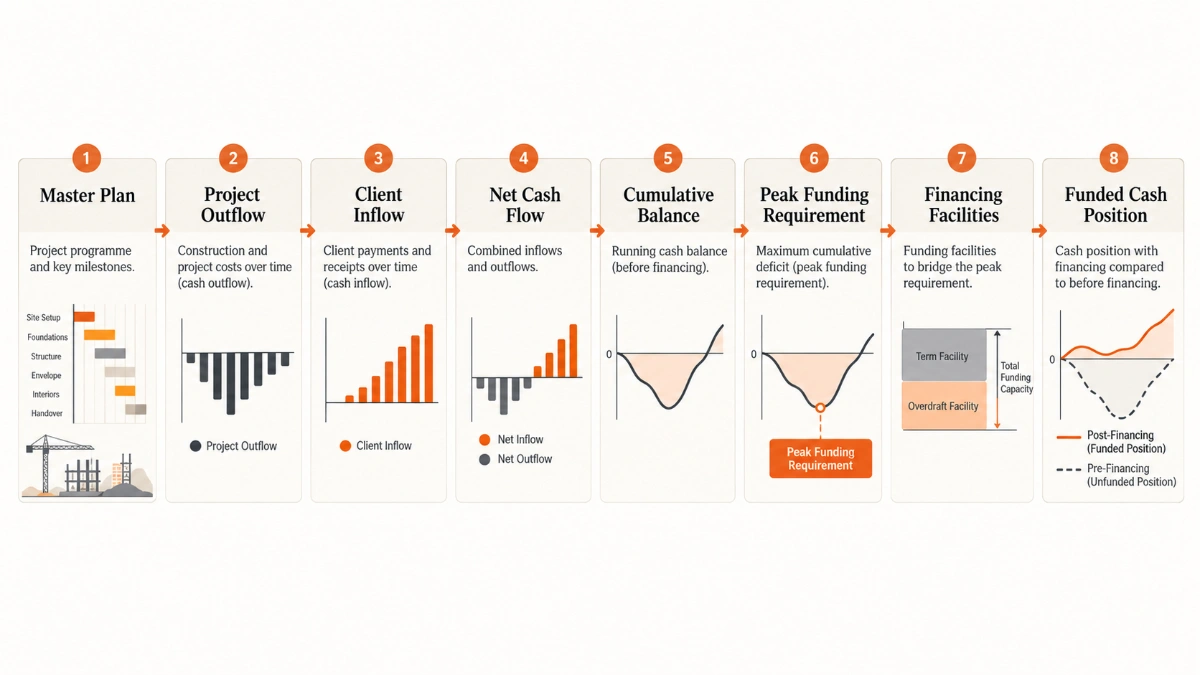
- Define the decision you are trying to make.
- Build a master activity plan at the level needed for that decision.
- Estimate activity costs and time-phase the project outflow.
- Separate self-performed and subcontracted cost where commercial terms differ.
- Build the main-contract value-of-work forecast separately.
- Apply advance, retention, WIEB, payment period, and DLP.
- Calculate period net cash flow and cumulative balance.
- Identify the peak pre-financing funding requirement and its timing.
- Run alternative commercial and execution scenarios.
- Only then add financing facilities and test how the funding gap will be covered.
- Revise the model as actual project conditions change.
A good construction cash-flow model is not the one with the largest number of activities. It is the one that captures the financial drivers accurately enough to support the decision being made.