
Method Statement: Temporary Sanitation Facility Servicing and Maintenance – Method Statement
AI-assisted method statement with matching ITP, PDF download, and Excel export.
More than a static template
Unlike a downloadable Word or PDF template, this method statement is an AI-assisted editable starting point connected directly to a matching Inspection and Test Plan. Every section is structured, project-adaptable, and ready to export.
- AI-assisted drafting — Customize every section with AI for your specific project scope.
- Linked ITP — A matching inspection and test plan is generated alongside the method statement.
- Multiple export formats — Download as a formatted PDF or editable Excel spreadsheet.
- Editable starting point, not a final document — Review, verify, and adjust all content against your project requirements before use.
Static template vs. Quollnet workflow
| Feature | Static template | Quollnet |
|---|---|---|
| Project-specific content | Manual fill-in required | AI-assisted customization |
| Linked ITP | Separate document, no link | Matching ITP included |
| Export formats | Usually PDF only | PDF and Excel |
| Structured sections | Free-form layout | 13 standardized sections |
| Saved to your account | Local file only | Cloud-saved, reusable |
| Content accuracy | You verify everything | AI-assisted, you still verify |
| Cost | Often free but time-intensive | Free to customize and download |
What you can customize
When you save this method statement to your account, every section becomes editable. The following 13 sections are included:
- Scope — Defines the activity and its boundaries.
- References — Standards, specifications, and drawings.
- Responsibilities — Roles and accountabilities.
- Resources — Labour, plant, and equipment summary.
- Materials — Materials and compliance requirements.
- Equipment — Tools and equipment details.
- Prerequisites — Hold points and pre-conditions.
- Method sequence — Step-by-step construction sequence.
- Safety controls — HSE risk controls and PPE.
- Environmental controls — Environmental mitigation measures.
- QA/QC — Quality inspection and test requirements.
- ITP — Inspection and Test Plan table (has its own page).
- Attachments — Referenced drawings and documentation.
Why this method statement is used
This method statement is used to define and communicate the approved procedure for carrying out method statement: temporary sanitation facility servicing and maintenance on site. It ensures the work is planned in advance, the correct resources and controls are in place, and all personnel understand responsibilities, sequence, quality requirements, and safety controls before work begins. It aligns site execution with the documented scope and acceptance expectations.
Who uses this method statement
This method statement is used by contractors, site supervisors, project engineers, QA/QC engineers, HSE officers, consultants, and client representatives. It serves as a shared reference for planning, execution, supervision, inspection, and approval of the activity on site.
When it is prepared and submitted
The method statement is prepared before the work activity starts and submitted as part of the pre-construction documentation package for review and approval.
Who reviews or approves it
The method statement is usually submitted to the client representative, consultant, resident engineer, or project management consultant for review and approval before the work commences.
Important approval note
This method statement is an AI-assisted editable starting point, not a pre-approved document. Before use on any project, all content must be reviewed and approved by the relevant parties (superintendent, principal contractor, or client representative) in accordance with your contract and project quality plan.
For example: if your specification requires a departure from a referenced standard, that departure must be documented and approved separately — this method statement will not capture that automatically. Always verify against your applicable drawings, specifications, and regulatory requirements.
Method statement content
Scope
Scope of Works
- Provide, service, and maintain temporary, non-sewered sanitation facilities (portable toilets, accessible units, urinal pods, hand-wash stations) for construction site personnel.
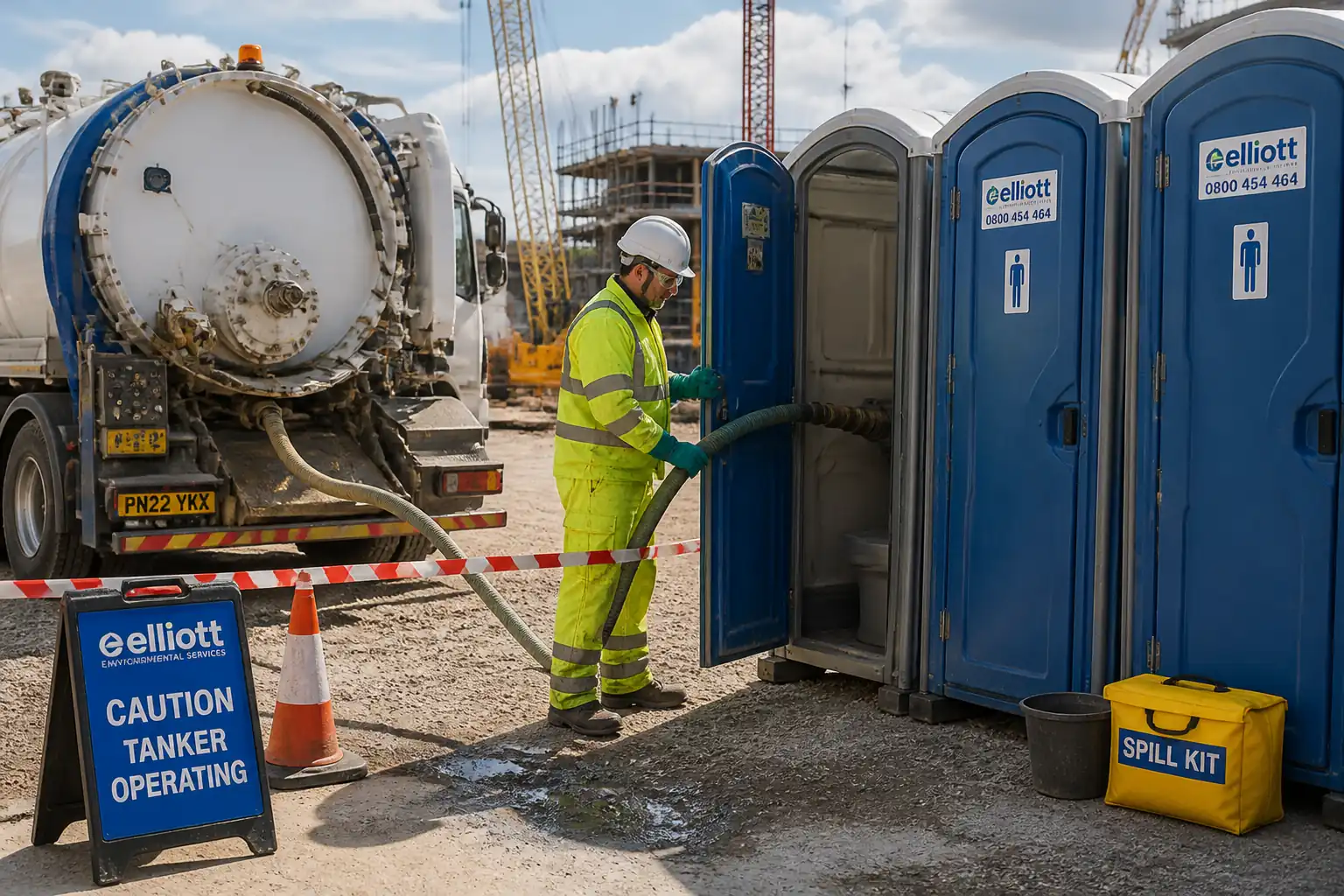
- Activities include daily inspections, routine cleaning/disinfection, consumable restocking, waste extraction via vacuum tanker, tank recharging with deodorizer/biocide, spill prevention and response, and periodic deep cleaning.
- Hygiene verification through visual checks and optional rapid ATP surface testing; recordkeeping (service logs, Waste Transfer Notes, disinfectant batch logs, corrective actions).
- Traffic management and exclusion zoning during servicing and waste removal.
- Environmental protection measures to prevent ground/water contamination; compliant transport and disposal of sewage to licensed facilities.
- Interfaces: Site traffic plan, HSE plan, Waste Management Plan, Emergency Response Plan, Welfare provisions plan.
Out of Scope: Supply/relocation by crane, electrical/plumbing tie-ins to mains sewer, greywater systems; major repairs to cabins (separate method).
References
| Document Type | Reference / Number | Revision | Notes |
|---|---|---|---|
| Standard | BS EN 16194 | ||
| Regulation | OSHA 29 CFR 1926.51 [If applicable] | Use applicable local law where outside US [Verify]. | |
| Guidance/Regulation | UK CDM 2015; HSE L153; EU Directive 92/57/EEC [If applicable] | Use local equivalents [Verify]. | |
| Standard | BS EN 1276; BS EN 13697 (non-porous surfaces) | Follow manufacturer contact time. | |
| Standard | BS EN 1500 (handrub); BS EN 1499 (handwash) | ||
| Standard | ISO 14001 [Guidance] | ||
| Standard | ISO 45001 [Guidance] | ||
| Regulation/Code | Local environmental protection/waste transport laws; EU EWC 20 03 04 (Septic tank sludge) [If applicable] | Use local waste codes where different [Verify]. |
Responsibilities
| Role | Responsibility | Name / Party |
|---|---|---|
| Site Manager | Project/Site Manager | Main Contractor |
| HSE Officer | HSE Officer | Main Contractor |
| QA/QC Engineer | QA/QC Engineer | Main Contractor |
| Sanitation Technician | Sanitation Technician | Specialist Subcontractor |
| Driver | Vacuum Tanker Driver | Licensed Waste Carrier |
| Storekeeper | Storekeeper | Main Contractor |
Resources
| Resource Type | Description | Quantity | Remarks |
|---|---|---|---|
| Labor | 1 Sanitation Technician per 30–40 units for daily checks; add per workload [Verify per project] | As scheduled | |
| Plant | 1 Vacuum tanker + driver per 80–120 units weekly; increase for high-use sites [Verify] | As required | |
| Staff | HSE Officer (part-time during servicing), QA/QC Engineer (weekly audits) | As assigned |
Materials
| Material | Specification / Grade | Quantity | Remarks |
|---|---|---|---|
| Surface disinfectant | QAC or oxygen-based | ||
| Detergent | Neutral pH ~7 | ||
| Deodorizer | Non-formaldehyde | ||
| Consumables | |||
| Spill kit | 120 L kit (typ.) [Verify] | ||
| PPE |
Equipment
| Equipment | Capacity / Type | Quantity | Inspection Required |
|---|---|---|---|
| Vacuum tanker | 3–10 m³ [Verify] | Yes | |
| Hoses | Yes | ||
| Washer | Yes | ||
| Sprayers | Yes | ||
| ATP meter | Yes | ||
| Traffic kit | Yes |
Prerequisites
Pre-Start Requirements
- Approvals/Permits:
- Approved Method Statement and ITP.
- Traffic Management Plan for tanker movements and servicing bay. [Verify per project HSE plan and local regulations]
- Waste carrier license; disposal facility acceptance/contract in place.
- Siting and Access:
- Stable, level hardstanding; gradient ≤5% at servicing face. [Verify]
- Minimum clearance: 1.0 m around doors; access route for tanker (min width 3.5 m) and overhead clearance ≥4.5 m. [Verify]
- Capacity Planning:
- Typical provision benchmark: 1 toilet per 10 workers for 40-hour week with weekly service (PSAI/industry). Adjust to occupancy, shift pattern, climate. [Verify per project specifications]
- Accessible unit provision per local code. [Verify]
- Utilities/Stocks:
- Potable hand-wash water available; minimum flow 2–4 L/min at taps. [Benchmark, Verify]
- Minimum on-site stock: 1 week of disinfectant, deodorizer, soap, sanitizer, paper products; spill kits.
- Training/Competence:
- Operators trained in chemical handling, vacuum tanker operation, spill response, and hygiene procedures; toolbox talk completed.
- Equipment Status:
- Daily plant checks completed; hose integrity confirmed; sprayers labeled with current chemical; SDS available at point-of-use.
- Emergency Preparedness:
- Spill kit staged within 20 m of servicing point; emergency contacts and reporting protocol posted.
Method Sequence
| Step | Activity | Description | Responsibility | Inspection / Hold Point |
|---|---|---|---|---|
| 1 | Plan and schedule servicing | Confirm workforce numbers, shift patterns, and unit-to-staff ratios. Prepare weekly schedule indicating daily checks and weekly deep service with vacuum tanker routing to minimize reversing. Communicate to supervisors and post at welfare boards. | Site Manager / Sanitation Supervisor | Review schedule vs headcount |
| 2 | Pre-service safety setup | Establish exclusion zone around each unit row: cones/barriers 3 m offset; place wheel chocks; engage beacon; display 'Unit Closed for Cleaning' signs. Brief spotter to control pedestrian interface. Shut doors from outside with temporary latch. | Sanitation Technician / Driver / Banksman | HSE spot-check |
| 3 | Initial inspection and restock trigger check | Open unit cautiously; check for damage, leaks, vandalism. Record consumable levels vs triggers: toilet paper ≥2 rolls; soap ≥25% reservoir; sanitizer ≥25%; paper towels ≥20 sheets. Note defects for corrective action. | Sanitation Technician | Visual; odor check |
| 4 | Waste extraction (vacuum) | Connect suction hose with drip tray under couplings; verify tank headroom. Start vacuum at low flow, then full once sealed. Pump to ~90–95% empty (avoid tank collapse). Add 10–20 L rinse water, re-pump to clear lines. Cap hose before disconnecting. | Driver / Technician | Observe for leaks |
| 5 | Mechanical clean | Remove solid debris; scrub bowl/urinal, floor, and touchpoints with neutral detergent. Use dedicated color-coded tools (avoid cross-contamination). Rinse with low-pressure water avoiding electrical accessories. | Sanitation Technician | Visual |
| 6 | Disinfection | Apply EN 1276/13697 disinfectant to high-touch surfaces (door handles, latch, seat, flush lever, handrails, sink, soap/sanitizer dispensers). Maintain wet contact time per TDS (typically 5–10 min). Allow to air dry or wipe with clean cloth after contact time. | Sanitation Technician | Timer-based contact time check |
| 7 | Recharge tank and dose | Add fresh water + deodorizer/biocide per manufacturer dose (typ. 60–120 mL per 20 L tank water; verify). Target blue water depth ≥75–100 mm above tank floor. Close/seal lid. | Sanitation Technician | Visual; measure dose volume |
| 8 | Restock consumables | Replenish toilet paper (min 2 full rolls), soap/sanitizer to 90–100% fill, paper towels sufficient for 2–3 days [Verify]. Check hand-wash water supply; refill portable tanks if fitted. Function-test dispensers. | Sanitation Technician | Functional test |
| 9 | Exterior clean and housekeeping | Wash exterior surfaces; remove graffiti if feasible; ensure unit is stable/level; clear mud from threshold; reinstate floor mat (if any). Remove exclusion when safe and reopen unit. | Sanitation Technician | Visual |
| 10 | Waste transport and disposal | Secure tanker manways; verify spill kit onboard. Transport via approved route to licensed facility. Offload per facility procedure; obtain disposal/weight ticket. File WTN within 24 hours. | Driver / Waste Carrier | Document review |
| 11 | Weekly deep clean | In addition to routine: remove seat/lids (if removable), descale urinal/surfaces, detail clean vents, hinges, and corners; inspect structure/seals; lubricate hinges; replace damaged seals. Sanitize floor-to-wall junction thoroughly. | Sanitation Technician / QA witness | QA witness (W) |
| 12 | Monthly compliance audit | Audit sample ≥10% units or min 5 units: verify schedule adherence, records, ATP spot checks (if used), signage, accessibility, lighting/ventilation, stock management, spill preparedness. | QA/QC Engineer; HSE Officer | Audit checklist |
| 13 | Defects and corrective actions | Log defects (leaks, cracked pans, faulty locks/dispensers). Prioritize: safety-critical within 24 h, hygiene-critical within 24–48 h, minor within 7 days. Tag-out units if unsafe/unhygienic. | Sanitation Technician / Site Manager | Follow-up verification |
| 14 | Emergency spill response (if required) | Stop source; contain using pads/booms; protect drains (drain covers). Recover with vacuum/absorbent granules. Disinfect affected area. Dispose waste as sewage-contaminated absorbents per local law. Report incident. | Driver / Technician / HSE | HSE investigation |
Safety Controls
Task-Specific HSE Controls (Risk-Based)
- Hazard: Vehicle–pedestrian interface (vacuum tanker reversing)
- Likely consequence: Struck-by injury or fatality
- Engineering/procedural control: Implement Traffic Management Plan; designate one-way route; use trained banksman; fit reversing alarm and beacons; avoid reversing where possible; 3 m exclusion zone.
- Required PPE: Hi-vis vest, safety boots, hard hat, gloves
- Collective preventive measure: Physical barriers/cones; spotter with radio
-
Inspection/permit/supervision: Daily TMP check; banksman assigned; site speed limit enforced [Verify per project HSE plan and local regulations]
-
Hazard: Biological exposure (sewage, aerosols)
- Likely consequence: Gastrointestinal/skin infection
- Engineering/procedural control: Keep lids closed; minimize splash; use dedicated tools; wash hands post-task; vaccination per occupational health policy [Verify]
- Required PPE: Nitrile/chemical gloves, splash goggles/face shield, rubber boots, disposable coveralls
- Collective preventive measure: Hand-wash station with soap/handrub; touch-free dispensers
-
Inspection/permit/supervision: SDS at point-of-use; HSE supervision during pump-out
-
Hazard: Chemical disinfectants (QACs/oxygen-based)
- Likely consequence: Chemical burns/respiratory irritation
- Engineering/procedural control: Dilute per TDS; decant using closed systems; label sprayers; avoid mixing chemicals (esp. bleach with acids); provide eyewash within 10 m
- Required PPE: Chemical-resistant gloves, goggles/face shield, apron/coveralls
- Collective preventive measure: Ventilation of unit; training in chemical handling
-
Inspection/permit/supervision: COSHH/chemical risk assessment; container inspection; SDS available
-
Hazard: Hose whip/leak at couplings
- Likely consequence: Impact/injection, spill
- Engineering/procedural control: Verify camlocks locked; use safety clips; depressurize before disconnect; drip trays under joints
- Required PPE: Gloves, goggles, boots
- Collective preventive measure: Exclusion zone; secondary containment
-
Inspection/permit/supervision: Pre-use hose check; annual hose integrity test [Verify]
-
Hazard: Slips/trips on wet surfaces
- Likely consequence: Sprain/fracture
- Engineering/procedural control: Use non-slip mats; control overspray; squeegee floors dry; signage 'Wet Floor'
- Required PPE: Safety boots with slip-resistant sole
- Collective preventive measure: Housekeeping standards; timing outside peak use
-
Inspection/permit/supervision: Supervisor inspections during cleaning
-
Hazard: Manual handling of materials/consumables
- Likely consequence: Strains/musculoskeletal injury
- Engineering/procedural control: Use trolleys; split loads <20 kg; team-lift heavy items
- Required PPE: Gloves, supportive footwear
- Collective preventive measure: Manual handling training
-
Inspection/permit/supervision: HSE officer spot-checks
-
Hazard: Noise from tanker/washer
- Likely consequence: Hearing damage
- Engineering/procedural control: Select low-noise equipment; limit exposure duration; maintain equipment
- Required PPE: Hearing protection where levels exceed 85 dB(A) [Verify]
- Collective preventive measure: Schedule noisy tasks outside quiet hours
-
Inspection/permit/supervision: Noise assessment as required
-
Hazard: Exposure to extreme heat/cold during servicing
- Likely consequence: Heat stress/hypothermia
- Engineering/procedural control: Hydration plan; rest breaks; weather-appropriate PPE
- Required PPE: Weather-appropriate PPE
- Collective preventive measure: Shaded rest area/heated shelter
-
Inspection/permit/supervision: Supervisor monitors environmental conditions
-
Hazard: Unauthorized use during servicing
- Likely consequence: Cross-contamination, injury
- Engineering/procedural control: Lock/flag unit out; signage; attendant present
- Required PPE: Standard site PPE
- Collective preventive measure: Physical barriers
- Inspection/permit/supervision: Supervisor verification
Note: Additional permits/controls may be required by local regulations. [Verify per project HSE plan and local regulations]
Environmental Controls
Environmental Risk Controls
- Sewage spill to ground or drainage
- Control: Secondary containment at hose couplings (drip trays); drain covers available before connection; absorbent booms to ring nearest gully; immediate clean-up and disinfection.
-
Monitoring: Visual during pump-out; incident reporting within 2 h; environmental officer notified.
-
Improper waste transport/disposal
- Control: Use licensed carrier and permitted facility; complete Waste Transfer Notes; maintain chain-of-custody; comply with local waste codes (e.g., EWC 20 03 04) [Verify per local law].
-
Monitoring: Monthly audit of WTNs and facility receipts.
-
Chemical misuse or overdosing
- Control: Dose logs; calibrated containers; store chemicals in bunded area (110% largest container); avoid stormwater exposure.
-
Monitoring: Weekly stock and bund inspection; SDS compliance.
-
Water consumption and runoff
- Control: Use low-flow washers; capture runoff where feasible; avoid direct discharge to soil; prevent silt-laden water release.
-
Monitoring: Spot checks; record exceptional discharges.
-
Odor complaints
- Control: Maintain service frequency per occupancy/climate; adequate deodorizer dose; relocate units away from receptors where practicable; ensure ventilation.
-
Monitoring: Community/neighbor log; corrective actions.
-
Noise and timing of operations
- Control: Restrict servicing to agreed hours; use maintained equipment; avoid idling.
-
Monitoring: Supervisor checks; complaint register.
-
Resource efficiency
- Control: Implement min/max stock to reduce waste; select eco-certified chemicals where available; recycle packaging.
- Monitoring: Monthly KPI review (consumption vs headcount).
QA/QC
Quality Assurance and Control Plan
- Inspection and Test Plan (ITP): Implement per section 'itp' with defined hold/witness points.
- Cleaning Standards:
- Visual: No visible soil, stains, or debris on touchpoints and floors; no standing water; no malodor beyond normal.
- Disinfection: Contact time per EN 1276/13697 manufacturer TDS (typically 5–10 min) [Verify].
- Hygiene Verification (optional but recommended on high-risk sites):
- ATP swabs on 2 critical touchpoints per sampled unit (e.g., door latch, seat lid) weekly. Benchmark: <100 RLU; investigate ≥100 RLU; re-clean and re-test until pass. [Benchmark, Verify per project]
- Water for hand-wash: Potable quality per local standard; free chlorine 0.2–0.5 mg/L where chlorinated supply is used [Verify].
- Service Frequency:
- Daily: Visual inspection, restock as needed.
- Weekly (typical): Pump-out, recharge, full clean and disinfection. Increase frequency for high occupancy/heat (e.g., ≥30°C or >10 users/unit/shift) [Verify per project].
- Defect Management:
- Priority close-out: Safety-critical ≤24 h; Hygiene-critical ≤24–48 h; Minor ≤7 days; tag-out if unsanitary/unsafe.
- Records and Traceability:
- Maintain Unit Service Log (USL) per unit; Dose Log; ATP Log (if used); Waste Transfer Notes (WTN) with carrier license; Deep Clean Checklists; Nonconformance/Corrective Action Reports; Training and Toolbox Talk records; Equipment maintenance logs.
- Calibration/Verification:
- ATP meter monthly verification; sprayer flow check monthly; pressure washer gauge check quarterly.
- Audits:
- Monthly QA/HSE audits; findings tracked to closure within 14 days.
Attachments
Attachments / Appendices
- Unit Service Log (USL) template (daily/weekly)
- Deep Clean Checklist (weekly)
- ATP Testing Procedure and Log (optional)
- Waste Transfer Note (WTN) template and Chain-of-Custody procedure
- Vacuum Tanker Daily Check Form and Maintenance Log
- Spill Response Plan and Drill Checklist
- Traffic Management Plan extract for servicing routes/zones
- SDS for disinfectant, detergent, deodorizer
- Training records: Chemical handling, spill response, tanker operation, manual handling
- Calibration/verification records: ATP meter, sprayers
- Accessible unit compliance checklist (where applicable)
This content is a read-only public reference. Download or customize to get an editable version.
ITP preview
The first inspection activities from the linked ITP for Method Statement: Temporary Sanitation Facility Servicing and Maintenance:
| Activity | Inspection / Test | Acceptance Criteria | Responsibility | Record |
|---|---|---|---|---|
| Mobilization of sanitation facilities (readiness) | Check siting, access, stability, signage, stock, spill kits | Units level/stable; access/clearances as specified; stock at initial setpoints; spill kits available | QA/QC Engineer (W), Site Manager | Readiness Checklist; Photos |
| Daily visual inspection | Cleanliness, stock levels, damage, odors | No visible soil; stock above triggers; defects logged | Sanitation Technician; HSE (spot) | Unit Service Log (USL) |
| Weekly service and waste removal | Pump-out, mechanical clean, disinfection contact time, recharge dose | No spill; disinfectant contact time achieved; dose within ±10%; couplings capped; volume recorded; WTN completed | Sanitation Technician; Driver; QA/QC (W) sample | USL; Dose Log; Tanker Log; WTN |
Showing 3 of 8 inspection activities. View full ITP →
Related Inspection and Test Plan
An Inspection and Test Plan (ITP) is available for Method Statement: Temporary Sanitation Facility Servicing and Maintenance. The ITP defines the inspection activities, acceptance criteria, hold and witness points, responsible parties, and records required to verify the work described in this method statement.
View the Method Statement: Temporary Sanitation Facility Servicing and Maintenance ITP →