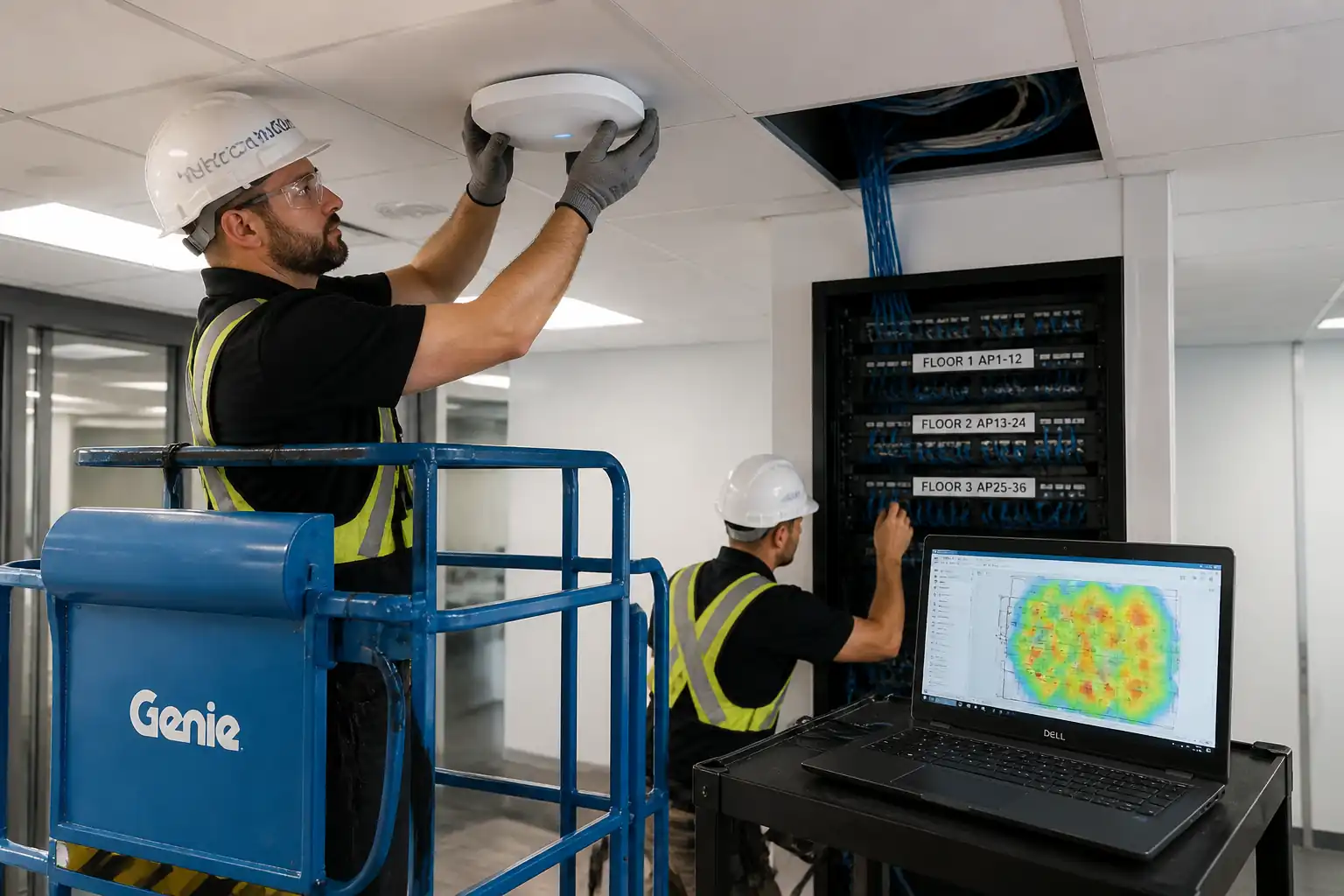

Inspection and Test Plan for Method Statement: High‑Density Wi‑Fi Access Point Deployment, Commissioning, and RF Optimization
AI-assisted inspection and test plan connected to a method statement, with PDF and Excel export.
More than a static template
Unlike a downloadable Word or PDF template, this ITP is an AI-assisted editable starting point directly connected to its method statement. Every inspection activity, hold point, and acceptance criterion is structured and ready to adapt to your project.
- AI-assisted customization — Tailor inspection activities and acceptance criteria to your specific project scope.
- Linked method statement — This ITP is connected to the corresponding method statement describing the work sequence.
- Multiple export formats — Download as a formatted PDF or editable Excel spreadsheet.
- Editable starting point, not a final document — Review and verify all content against your project specifications and standards before use.
What you can customize
When you save this ITP to your account, every inspection row becomes editable. You can add, remove, or modify:
- Inspection activity — Description of what is being inspected.
- Inspection type — Hold point (H), Witness point (W), Review (R), or Monitor (M).
- Responsibility — Contractor, subcontractor, engineer, or client.
- Frequency — How often the inspection occurs.
- Acceptance criteria — Referenced standard or specification requirement.
- Records — Forms, test reports, or checklists required as evidence.
Why this ITP is used
To ensure all Wi‑Fi deployment activities meet measurable standards and are verified with records prior to handover.
Who uses this inspection and test plan
QA/QC engineers, RF and network engineers, client representatives, and project managers.
When this ITP is prepared and submitted
From pre‑installation layout through post‑installation RF optimization and final handover.
Who receives or approves this ITP
Client/Consultant for review and approval prior to works.
Inspection scope
Physical installation quality, cable certification, configuration accuracy, RF performance, security, and user experience metrics.
Typical hold, witness, and review points
Layout verification (Hold), cable certification review (Hold), post‑install active survey (Witness), client roaming test (Witness).
Typical inspection records
Certifier reports, photos, firestop logs, WLC/switch backups, RF heat maps, roaming test logs, witness/hold point forms.
Important approval note
This ITP is an AI-assisted editable starting point, not a pre-approved document. Before use on any project, all inspection activities, hold points, and acceptance criteria must be reviewed and approved by the relevant parties (superintendent, principal contractor, or client representative) in accordance with your contract and project quality plan.
Always verify acceptance criteria against your applicable drawings, specifications, and regulatory requirements. Hold points must be confirmed with the relevant authority before work proceeds past that point.
Inspection and test plan
| Activity | Inspection / Test | Acceptance Criteria | Responsibility | Record |
|---|---|---|---|---|
| Pre‑start layout verification | Check AP marks vs AFC | AP marks within ±150 mm or approved variance | PM / RF Engineer / QA | Hold point form; marked layout photos |
| Ceiling grid readiness | Visual condition; load path | Grid intact; no cracked tiles; structural tether point available | QA/QC / Supervisor | Checklist; photos |
| Mounting hardware installation | Torque/visual check | OEM bracket used; safety tether installed; no tile load | Supervisor / QA/QC | IR; photos |
| Cable pathway compliance | Spot check routing | Support ≤1.2 m; bend radius per spec; separation per TIA‑569‑D | Supervisor / QA/QC | Inspection report |
| Firestop inspection (pre‑closure) | Witness before seal | Listed system applied; labels in place | QA/QC | Firestop log; photos |
| Termination quality check | Visual; polarity/pinout | T568B; no untwist >13 mm; strain relief OK | Supervisor | Checklist |
| Permanent link certification | Level VI/2G field test | PASS to Cat6A per TIA‑568.2‑D/ISO 11801 | QA/QC | Cert reports (PDF/FLW) |
| Labeling and administration | Label scheme audit | TIA‑606‑C compliant; unique IDs | QA/QC | Label register |
| Switchport configuration review | Config diff review | VLANs correct; PoE enabled; security controls set; mGig as required | Network Engineer (peer) / QA | Peer review sign‑off; MOP |
| AP power and link validation | PoE class; link speed | Delivers required PoE class (af/at/bt); link ≥1G (≥2.5G if specified) | Network Engineer | Tester logs; screenshots |
| WLC/RF profile verification | Controller audit | Regulatory domain; channels 20 MHz (5 GHz HD); SSID/VLAN map correct; 802.11k/v/r per design | RF Engineer / QA | WLC backup; audit sheet |
| Post‑install active RF survey | Survey walk; analytics | Coverage ≥‑67 dBm over ≥95% area; SNR ≥25 dB (voice ≥30 dB); CCI ≤3 APs at >‑85 dBm | RF Engineer / Client witness | Heat maps; survey files |
| RF optimization closure | Spot re‑survey | All KPIs met; no unresolved holes | RF Engineer | Optimization log |
| Client roaming performance test | Walk test; iperf3; call test | Roam <150 ms; roam packet loss <1%; jitter <30 ms; throughput ≥100 Mbps at test points [Verify] | RF/Network Engineer; Client witness | Test logs; witness form |
| Security & QoS validation | 802.1X auth; DSCP/WMM | Auth OK; correct VLAN; DSCP preserved | Network Engineer | Auth logs; PCAP |
| Documentation & handover | Document review | Complete O&M pack; all certificates and backups provided | PM / QA/QC | Handover certificate; document set |
This table is a read-only public reference. Download the PDF or Excel version, or customize this ITP to edit it for your project.
Frequently asked questions
Related method statement
This Inspection and Test Plan is associated with the Method Statement: High‑Density Wi‑Fi Access Point Deployment, Commissioning, and RF Optimization method statement, which describes the step-by-step construction sequence, resources, materials, equipment, safety controls, and environmental controls for this activity.
View the Method Statement: High‑Density Wi‑Fi Access Point Deployment, Commissioning, and RF Optimization method statement →