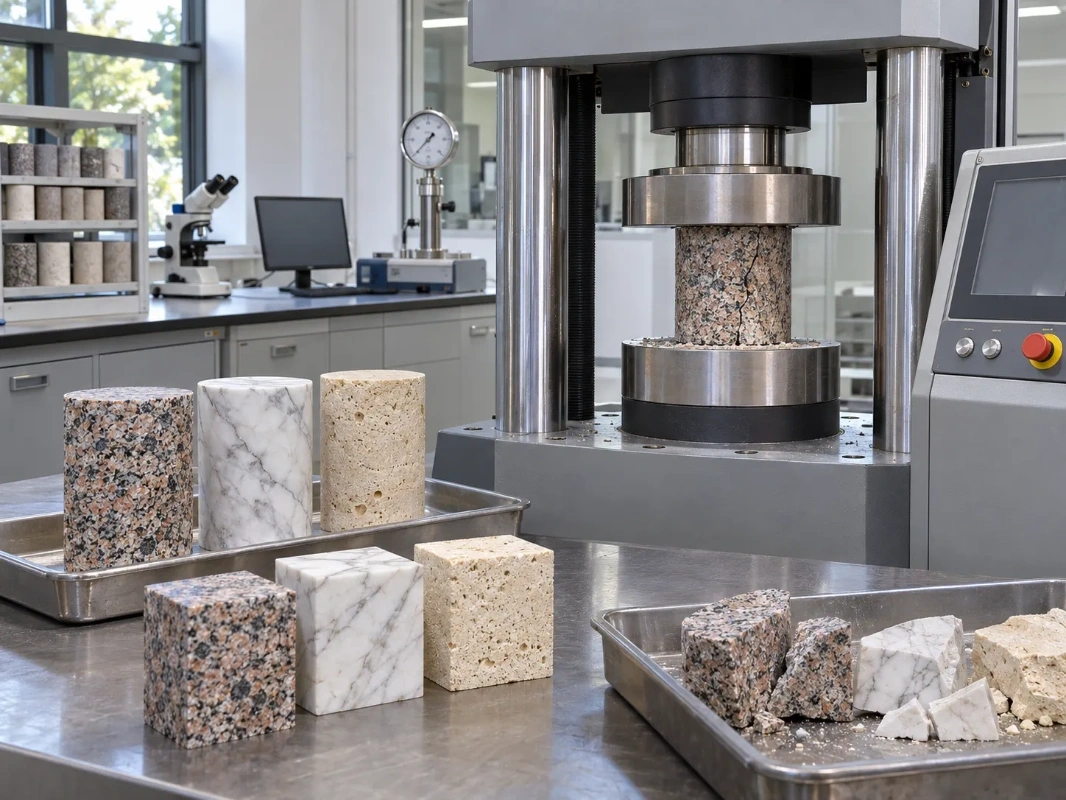
How to Test the Strength of Natural Stone: Methods, Standards and Acceptance Criteria
Quick Answer: Natural stone strength is assessed through laboratory tests selected for the intended application. The principal tests are compressive strength, flexural strength, water absorption and density, abrasion resistance, and, where exposure requires it, freeze–thaw or salt-crystallisation resistance. Use representative samples, the test method specified by the project, and the results together; no single strength number proves that a stone is suitable for every use.
1. Why test natural stone?
Natural stone is a geological material, not a factory-made product with perfectly uniform properties. Its performance can vary with mineral composition, grain size, bedding or foliation, veins, microcracks, porosity, quarry location, and direction of loading. Even blocks sold under the same commercial name can show measurable variation.
Testing provides evidence for selecting stone and verifying that delivered material is consistent with the approved sample and project specification. It is particularly important for exterior cladding, flooring, stairs, paving, countertops, and stone components fixed with mechanical anchors.
Testing should answer a defined project question: will the stone resist the expected compression, bending, wear, moisture, temperature, and fixing actions in its intended location? A high compressive-strength result alone does not answer all of these questions.
2. Understand the properties before selecting tests
- Compressive strength: resistance to crushing under a compressive load. It is relevant to load-bearing stone and to understanding the material, but it does not by itself establish the capacity of a finished panel or assembly.
- Flexural strength: resistance to bending. It is important for slabs, thin panels, paving units, and stone spanning between supports.
- Modulus of rupture: a flexural failure stress calculated using the geometry and loading arrangement in the specified test method. Do not treat results from different bending methods as automatically interchangeable.
- Water absorption and porosity: indicators of how much water a stone can take up and the nature of its pore structure. They help assess moisture-related risks but are not direct strength measurements.
- Abrasion resistance: resistance to material loss from rubbing or foot traffic. It is important for floors, stairs, and paving.
- Durability: resistance to environmental actions such as freezing and thawing, salt crystallisation, thermal shock, or moisture and temperature cycling.
- Slip resistance: a separate surface-performance property for pedestrian areas. It depends on finish, contamination, wetness, and the selected test method; it is not a measure of stone strength.
3. Main laboratory tests for natural stone
3.1 Compressive strength test
The compressive strength test measures the stress at which a prepared stone specimen fails under a compressive load. ASTM C170 is a commonly referenced method for dimension stone; EN 1926 is the European natural-stone test method for uniaxial compressive strength.
In general, the laboratory prepares specimens to the geometry and surface requirements of the selected standard, records the stone orientation and conditioning, and places the specimen in a calibrated compression-testing machine. The load is applied in the manner and at the rate prescribed by the standard until failure. The laboratory records the maximum load and calculates compressive strength using the loaded cross-sectional area:
Compressive strength = maximum failure load (P) ÷ loaded area (A)
When P is in newtons and A is in square millimetres, the result is in N/mm², equivalent to MPa. The report should identify specimen dimensions, moisture condition, loading direction, number of specimens, individual results, average, and failure observations.
Important: Natural stone may be anisotropic, meaning its strength differs with direction. Bedding, foliation, and visible fabric should be identified. Where the stone will be loaded in more than one relevant direction, the test programme should address those directions rather than assuming one result represents all orientations.
3.2 Flexural strength test
Flexural testing evaluates how a stone specimen performs when it bends under load. It is particularly relevant to slabs and panels because stone may fail in bending even when its compressive strength is high.
ASTM C880 measures flexural strength of dimension stone. ASTM C99 determines modulus of rupture using its specified loading arrangement. In the European standards series, EN 12372 determines flexural strength under concentrated load, while EN 13161 covers flexural strength under constant moment.
The laboratory tests specimens with dimensions and surface finishes appropriate to the selected method. Support spacing, loading arrangement, specimen thickness, orientation, and surface condition affect the result. Therefore, the test method and specimen configuration must be stated clearly in the report.
For cladding, the design team should not compare a laboratory flexural-strength value directly with a design load without accounting for panel dimensions, support conditions, fixing details, safety factors, load combinations, and the applicable design procedure. Where relevant, test the complete fixing or anchorage arrangement as well as the stone itself.
3.3 Water absorption, density, and porosity
Water absorption is commonly determined by weighing a dry specimen, conditioning it in water in accordance with the selected method, and weighing it again after the prescribed procedure. A simplified expression for mass absorption is:
Water absorption (%) = [(saturated mass − dry mass) ÷ dry mass] × 100
ASTM C97 covers absorption and bulk specific gravity of dimension stone. EN 13755 determines water absorption at atmospheric pressure. EN 1936 determines real and apparent density and total and open porosity.
These properties help assess the stone's pore structure and potential moisture sensitivity. Higher absorption can be a warning sign for some exposure conditions, but it does not automatically mean the stone is unsuitable. Mineralogy, pore connectivity, climate, installation details, sealers, and maintenance all matter.
3.4 Abrasion resistance
Abrasion testing evaluates resistance to surface wear. It is relevant to floors, stairs, and external paving exposed to repeated pedestrian or mechanical traffic. ASTM C1353 is a Taber-abraser method for dimension stone subjected to foot traffic. EN 14157 is a European method for determining abrasion resistance.
Specify the test method and finish because results are method-dependent. Abrasion resistance should be considered alongside the intended traffic level, maintenance regime, and expected surface appearance. It does not replace slip-resistance testing.
3.5 Freeze–thaw and salt-crystallisation resistance
For stone exposed to freezing conditions while wet, a freeze–thaw test can help evaluate durability. EN 12371 is used to determine frost resistance of natural stone. Results are assessed by comparing relevant properties before and after the prescribed exposure cycles, as required by the method and project specification.
Where stone is exposed to salts, including de-icing salts or saline environments, salt-crystallisation resistance may be relevant. EN 12370 addresses resistance to salt crystallisation. These durability tests are exposure-specific and should be selected based on the actual environment, not ordered automatically for every project.
3.6 Petrographic examination
Petrographic examination, such as EN 12407, describes the stone's mineral composition, texture, grain structure, and relevant features. It can help explain why two stones with similar commercial names behave differently, or why test results vary within one source. It is often useful when qualifying a new quarry or investigating unexpected failures.
3.7 Slip resistance and anchorage testing
For pedestrian surfaces, assess slip resistance using the method required by the project and the relevant jurisdiction. EN 14231 uses a pendulum tester for natural stone; ANSI A326.3 is another commonly referenced dynamic coefficient-of-friction method for hard-surface flooring. The result must be interpreted for the actual surface finish and use conditions.
For mechanically fixed cladding, the strength of the stone around an anchor or dowel may govern. ASTM C1354 addresses the strength of individual stone anchorages. The design may also require evaluation of the complete cladding system, not merely a material coupon.
4. Which standards should be specified?
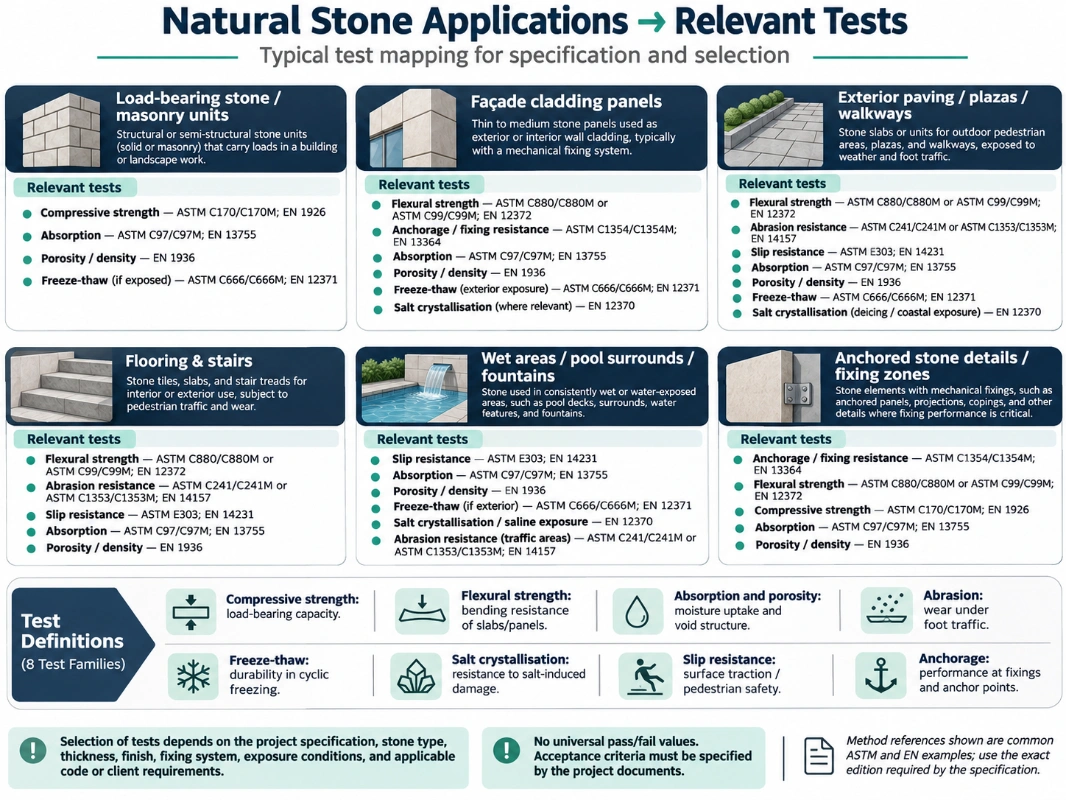
The following table is a practical starting point. Confirm the current edition, national adoption, scope, specimen requirements, and project-specific acceptance criteria before issuing a laboratory request.
| Property | ASTM reference | EN reference |
|---|---|---|
| Compressive strength | ASTM C170 | EN 1926 |
| Flexural strength / bending | ASTM C880; ASTM C99 | EN 12372; EN 13161 |
| Absorption / bulk specific gravity | ASTM C97 | EN 13755 |
| Density / porosity | Check project specification | EN 1936 |
| Abrasion | ASTM C1353 | EN 14157 |
| Freeze–thaw resistance | Project-specific method; verify applicability | EN 12371 |
| Salt crystallisation | Project-specific method; verify applicability | EN 12370 |
| Petrographic description | Project-specific method | EN 12407 |
| Slip resistance | ANSI A326.3, where specified | EN 14231 |
ASTM and EN methods are not automatically interchangeable. Do not combine results from different methods into one acceptance comparison unless the specification or a competent technical assessment establishes that the comparison is valid.
5. How to select and prepare representative samples
- Identify the source: record quarry, supplier, commercial stone name, geological description if known, block or lot number, and production batch.
- Define the intended use: identify whether the stone is for interior flooring, external paving, stairs, façade panels, countertops, or another application.
- Agree the test programme: list each property, standard and edition, specimen quantity, conditioning, orientation, and acceptance criteria before sampling.
- Select representative material: take samples from the actual proposed source and production lot. Avoid selecting only visually perfect pieces if the delivered material will include normal natural variation.
- Record orientation and appearance: mark bedding, foliation, veining, visible defects, and the intended exposed face where relevant. Photograph and label each sample.
- Protect and identify specimens: prevent damage, contamination, or moisture changes during transport. Maintain traceability from the quarry or batch to the laboratory report.
- Use a competent laboratory: use a laboratory with appropriate equipment, trained personnel, and ISO/IEC 17025 accreditation for the relevant test where required by the contract or procurement specification.
Do not prescribe one universal specimen size or number of samples in a generic article. The applicable standard and the laboratory's approved procedure define specimen geometry, preparation, conditioning, and sampling requirements.
6. How to read a natural-stone test report
A useful report should allow the reviewer to understand exactly what was tested and whether the result is relevant to the proposed application. Check for:
- Stone identification, quarry or source, supplier, batch or lot, and sample receipt date.
- Applicable standard and edition, including any deviations from the method.
- Specimen dimensions, number of specimens, surface finish, orientation, and conditioning.
- Individual test results, average, units, and any statistical information required by the specification.
- Failure mode and observations such as visible veins, fissures, or unusual fracture paths.
- Laboratory identification, accreditation scope where applicable, test date, and authorized report approval.
Review the spread of individual results, not only the average. A wide variation may indicate natural variability, mixed material, defects, inconsistent preparation, or differences in orientation. Ask the laboratory or stone specialist to investigate unusual results rather than deleting outliers without a documented technical basis.
7. How to decide whether the stone is acceptable
Acceptance must be based on the project specification, the applicable product standard, design requirements, exposure conditions, and the intended use. There is no single compressive-strength threshold that makes every granite, marble, limestone, sandstone, or travertine acceptable for all applications.
For example, a flooring selection may place particular emphasis on abrasion, slip resistance, water absorption, and maintenance. Exterior cladding may require flexural strength, durability, panel design checks, and anchorage testing. Paving may require abrasion, flexural or breaking performance, slip resistance, and weathering tests appropriate to the climate.
For façade or other safety-critical applications, laboratory material properties are only part of the assessment. The responsible designer must check panel dimensions, support spans, fixing details, wind actions, dead load, local stress concentrations, safety factors, load combinations, and the complete load path in accordance with the governing design requirements.
If a result fails the specified criterion, place the affected lot on hold and follow the project's nonconformance procedure. Verify sample identity, test method, conditioning, and report calculations; then agree whether additional representative testing, technical assessment, redesign, or rejection is appropriate. Do not change acceptance limits after seeing the results without formal approval.
8. Common mistakes to avoid
- Using compressive strength as the only measure of suitability.
- Testing a hand-picked sample that does not represent the supplied lot.
- Ignoring bedding, foliation, or loading direction.
- Comparing results from different standards or specimen conditions as if they were equivalent.
- Applying generic acceptance values that are not stated in the contract or product specification.
- Ignoring individual results and reporting only an average.
- Assuming low water absorption guarantees good durability, or that high compressive strength guarantees good flexural performance.
- Failing to test the stone-anchor interaction for mechanically fixed panels where required.
- Using an unverified or out-of-scope laboratory for contractual acceptance testing.
9. Practical QA/QC checklist for natural-stone testing
- Approved stone type, quarry, supplier, finish, thickness, and intended application are documented.
- Project specification identifies required properties, test standards, editions, frequencies, and acceptance criteria.
- Samples are representative and traceable to the proposed production source and lot.
- Specimen orientation and relevant natural features are recorded.
- Laboratory competence and accreditation scope have been checked.
- Test reports include method, conditioning, dimensions, individual results, average, units, and observations.
- Results are reviewed against the correct project criteria and relevant exposure conditions.
- Nonconforming or inconsistent results are investigated and formally dispositioned.
- Material approval, test reports, sample records, and delivery inspections are retained in the QA/QC dossier.
10. Conclusion
Testing natural stone properly means matching the test programme to the way the stone will be used. Compressive and flexural tests assess important mechanical properties, while absorption, porosity, abrasion, slip resistance, and durability tests address other service conditions. Reliable decisions depend on representative sampling, correct standards, traceable laboratory reports, and acceptance criteria established before testing begins.
For a construction project, the best practice is to submit the proposed stone source and intended application to the designer or Engineer, agree the test matrix and acceptance limits, and obtain results from a competent laboratory before bulk procurement or installation.
Looking for a trusted partner for your next construction or stone project? Discover Mattar Group and explore our expertise.
References and further reading
Natural Stone Institute – ASTM standards for natural stone
Natural Stone Institute – Selecting relevant ASTM standards for natural stone applications
Natural Stone Institute – Natural stone testing services and test scope
International Masonry Institute – New stone construction: codes and standards