Construction Management Standardization: The Business Case for Contractor-Owned Field Operations
Construction management standardization means the contractor—not each individual project manager—defines minimum expectations for field planning, accountability, document control and reporting. This article examines the business case for company-owned operating standards, the operational risks of inconsistent practices, and how contractors can implement and verify a common approach.
Who Owns the Project?
1. The $20 Million Handshake
Consider a general contractor awarded a $20 million municipal facility. The project has a difficult site, an occupied adjacent building, multiple specialty trades, substantial equipment lead times, and a completion date that cannot be moved without consequences. The owner interviews a project manager with twenty years of experience and hires a superintendent with a strong record in similar work. Both are credible. Both know how construction gets built. Both promise to take control. The missing conversation concerns how this particular contractor expects control to be exercised.
Will the project manager issue a common startup responsibility matrix? Will the superintendent produce a rolling look-ahead that identifies access, information, manpower, material, and inspection constraints before crews are assigned? Who confirms the current drawing revision before a foreman releases an installation? When an unanswered RFI threatens a scheduled activity, when must the problem be escalated, and what written record will accompany that escalation? Will all open changes be visible to ownership, including those that are not yet priced or approved? How does the owner know whether reported physical progress agrees with labor burn and actual committed costs? These are not matters of personality. They are requirements for managing risk on behalf of the company.
A contractor that has not answered those questions has allowed the job's management system to be designed by whichever employee arrived first. That person may create an excellent system. A different manager may create a mediocre one. The business has no assurance that either approach will survive the manager's departure or transfer to another project. It has confused professional experience with company-owned operating knowledge.
This is not a criticism of experienced managers. In fact, seasoned personnel are precisely the people a contractor should involve in writing a useful standard. Their expertise helps determine which controls prevent actual losses and which create unnecessary paperwork. The distinction is ownership. A management practice discovered by a superintendent on one project should become a company asset only after leadership evaluates it, documents it, and makes the requirement understandable across other projects. A good standard captures judgment where consistency matters and preservesjudgment where site conditions require adaptation.
The owner does not need to direct the crane pick, set everypour sequence, or approve the daily crew assignment. The owner does need confidence that work is being released against the current information, critical constraints are being brought forward in time to act, and significant cost and schedule exposure is reported while there are still options. The handshake with a capable manager is the beginning of a delegated responsibility, not the substitute for an operating standard.
2. The Hidden Cost of Individual Management Styles
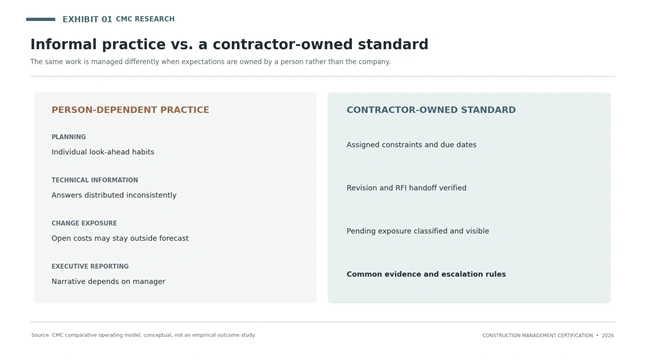
The first visible consequence of inconsistent management is usually annoyance. One project sends useful meeting minutes and another produces a long attendance list with no assignments. One superintendent produces a dependable three-week view while the next gives tomorrow'spriorities orally at the end of each shift. One project engineer maintains a drawing register that identifies superseded documents, while another assumesthe foremen will find the latest sheets in the software. The employees may all be working hard. Yet the business has no uniform basis for verifying that necessary decisions reached the people who were expected to act on them.
The more serious consequences appear at interfaces. A concrete subcontractor is told an embed detail is approved, although the latest RFI changed the assembly. The electrical foreman coordinates overhead rough-in from the previous reflected ceiling plan. The mechanical subcontractor receives a work area before the needed access or supporting steel is ready. A vendor is asked to release equipment that still lacks design approval. Each problem canconsume only a few hours on its own. In combination, they create lostproduction, schedule compression, trade friction, and pressure to accept work that is not ready to proceed.
In the absence of a company-wide standard, even a good manager can be difficult to replace. When a project manager leaves, another manager inherits records organized according to the former employee'spreferences. The owner may discover that unresolved owner directives were neverentered in a change log, informal promises were not confirmed in writing, or an apparent contingency balance excluded known but uncommitted costs. Recovery is expensive because the replacement must first reconstruct the facts. The technical skill required to recover the project is real, but the reconstruction itself is avoidable if the company already requires accurate, transferablerecords.
Individual style is not the enemy. Flexibility is necessary because a small tenant improvement, a $20 million vertical job, and a heavycivil project do not have identical reporting needs. What should remain consistent is the meaning of a project status report, the ownership of a risk, the deadline for escalating a blocked activity, the documented disposition of a change, and the confirmation that field instructions reached the crews. The standard describes the minimum evidence of control; project leaders decide the practical method appropriate to the work.
That distinction protects good people. A foreman should not have to guess whether the superintendent wants daily photos, productionquantities, or a written record of an interference. A new project engineer should not have to learn each project manager's personal terminology for an RFI aging report. A superintendent should know which deviations trigger a call to the PM and which the team is authorized to solve locally. Clear expectations reduce friction while allowing capable people to make decisions within agreedboundaries.
3. Software Is Not an Operating Standard
Digital construction platforms have transformed the speed at which teams can exchange drawings, process submittals, log RFIs, and distributecorrespondence. That is a genuine advance. It is not the same as establishing a management standard. A project can have every Procore module enabled and still release work using the wrong revision. A contractor can own a powerfulscheduling platform yet fail to remove constraints that prevent tomorrow's planned work. A project may display hundreds of open items, but the information is not under control until each critical item has a responsible party, an agreed response path, and an escalation trigger.
The difference is between storing information and governing its use. A submittal register is a tool. A standard requires the team to identify long-lead procurement early, connect approval dates to field need dates, confirm the completeness of packages before submission, monitor overduereviews, and elevate decisions that threaten the work. An RFI log is a tool. A standard requires the project engineer to capture the field question clearly, attach the current context, assign responsibility, track the response, and ensure the answer is transmitted to the people building the work. A daily report is a tool. A standard defines which production facts, constraints, weather impacts, manpower changes, inspections, and directions must be recordedcontemporaneously.
The Construction Industry Institute recognizes processes such as change management, quality management, project risk assessment, and lessons learned as construction best practices [4]. Those process disciplines predate any particular software subscription and can be implemented through sophisticated systems or controlled simple tools. A small contractor using a shared document register and a disciplined weekly meeting can outperform a larger company whose teams fail to use the expensiveplatform consistently. Conversely, a mature contractor can use software toautomate reminders, approvals, and dashboards once the underlying operating requirements are clear.
Owners should therefore ask a different technology question. Rather than beginning with what software they should buy, they should first decide what evidence of control they expect from the field. What must the team know before starting work? Who has authority to act? How will an unresolved decision be aged and escalated? What constitutes an accurate percent complete? Which financial risks need executive attention? Only after those questions are answered can software be configured to reinforce the standard rather than substitute for it.
The Financial and Operational Case
4. What Does Inconsistency Actually Cost a Contractor?
The financial damage from poor field coordination is difficult to measure because the costs rarely arrive on one invoice labeledmanagement inconsistency. A crew may spend a morning waiting for access; those labor hours appear in a normal cost code. A mechanical subcontractor may perform a second mobilization after a trade conflict; its cost might appear ina disputed change request. The general contractor's project manager may spend six hours rebuilding a document trail after an owner meeting; that timedisappears into project overhead. A badly coordinated installation may require demolition and replacement, but the field team may record the work as additional quantity rather than rework. If the contractor's accounting structure cannot distinguish these events, management can mistake losses for the ordinary cost of doing business.
Rework research demonstrates both the magnitude and the difficulty of the problem. The 2009 paper by Hwang, Thomas, Haas, and Caldasused 359 projects from a Construction Industry Institute database and examined how rework affects construction cost performance [1]. Its abstract notes that the direct costs of rework have often been reported at about 5% of total construction costs. It also finds meaningful differences across project characteristics. A separate longitudinal study by Love andcolleagues examined 19,605 rework events on 346 projects delivered by one contractor from 2009 to 2015. Among those events, 88 accounted for approximately 34% of rework costs; only 98 of the projects supplied complete cost data, permitting a mean recorded rework cost of 0.39% of contract value for that subset [3]. A paper published online in October 2025 by Peter E. D. Love, subsequently printed inthe ASCE journal's January 2026 issue, found average precompletion field-rework costs of 0.38% of contract value in an exploratory contractor-based dataset. The author reported 300% underreporting in the cost-collection process; quality managers suggested that postcompletion costs, which had not been collected, could be comparable to the observed precompletion costs. The resulting 0.76% isan estimate, not a second measured population [2]. These are not interchangeable estimates. They involve different definitions, samples, and measurement methods, and some include costs that others exclude.
The practical lesson is not to select the highest number. Itis to build an internal loss record that a controller, project manager, and superintendent can reconcile. Rework should be distinguished from authorized scope changes; a design revision ordered by the owner should not automatically be classified as contractor failure. Preventable production disruption should be distinguished from a weather event or a genuine labor market constraint. Administrative duplication should be measured through actual time records or defensiblesampling rather than a generic assumption that everyone wastes the same portion of the day. Without these distinctions, even a useful management program canacquire a fictional return on investment.
A 2018 survey-based PlanGrid–FMI report estimated thatnon-optimal activities including rework, searching for project information, and conflict resolution contributed to $177.5 billion in annual U.S. construction labor costs [11]. That number iswidely quoted, but it is an industry-scale survey estimate from 2018, not a current audited loss total and certainly not the amount recoverable through CMC training or contractor SOPs. Its defensible role in this paper is to identify information management as a recognized operational concern. It does not supportpromising that any single contractor can recover a fixed share of revenue.
What should a company measure? On a completed or activeportfolio, management can review the cost of redoing incorrectly released work, recurring field-work stoppages with identifiable preventable causes, document-reconstruction labor, repeated subcontractor mobilizations arisingfrom failed coordination, and missed contractual notice or change documentation. A loss ledger should record an event date, project, causecategory, responsible control, actual paid cost, recoveries, and whether the event was in fact avoidable. If a $42,000 corrective demolition event resulted from an unforeseen condition, it may not belong in the avoidable pool. If a$12,000 replacement event resulted from a superseded detail being used after the current revision had been distributed, the company should investigate the revision-control handoff. The analysis matters more than the dramatic total.
An owner should also separate profit exposure from cashflow. A $30,000 cost that cannot be recovered may reduce gross profit dollar for dollar, but it does not imply the contractor's revenue or overall netmargin changed by an identical percentage. A $30,000 unresolved potential change may not yet be a realized loss, and a $30,000 subcontractor claim may or may not be valid. The management standard's purpose is to keep those categories visible until the disposition is known. Better visibility can protect the owner's options even before a direct saving is measurable.
5. The Economics of Standardization
A contractor should approach standardization as a smallcapital-allocation decision rather than as a motivational initiative. The investment is the cost of writing a usable standard, training existing employees, verifying their understanding, coaching the actual jobsite behavior, updating the requirements when necessary, and reviewing the evidence that the system is working. The potential return is the reduction of losses that are both documented and addressable by the selected controls. Training is an input. The output is changed project behavior.
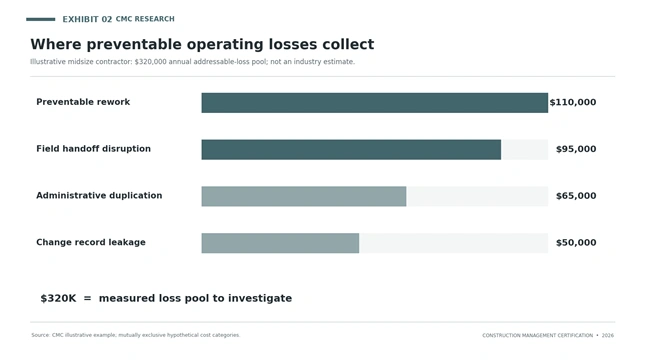
Construction management standardization should be evaluatedas a control investment. The first analytical step is to define the loss pool. Suppose a contractor has identified $320,000 in annual, documented, potentiallyaddressable operating losses across a set of similar projects. This pool might contain $110,000 of preventable rework, $95,000 of production disruption caused by unresolved constraints and failed handoffs, $65,000 of documented administrative duplication, and $50,000 of unrecovered costs linked to poor change documentation. These are illustrative figures, not construction-industryaverages. The contractor must ensure each event appears only once. An incidentcannot be counted as both the cost of rework and the same labor hours as schedule disruption. The question then becomes how much of this $320,000 mayrealistically be avoided after the company establishes and enforces a standard.
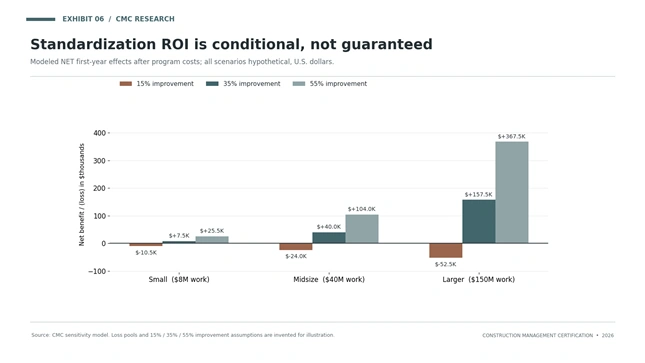
The model applies three annual reduction assumptions to the addressable pool: 15% in a conservative scenario, 35% in a moderate scenario, and 55% in an optimistic scenario. These labels describe the sensitivity of the calculation, not the probability or expected distribution of outcomes. These percentages are not results measured in the research literature and are not forecasts of what CMC education will deliver. They are deliberately transparentsensitivity assumptions. A 35% reduction of the $320,000 addressable pool produces $112,000 of modeled annual benefits, provided the contractor's measurement is sound and the reductions are causally related to implementation. The program still has to pay for development, training time, oversight, and maintenance. If its first-year cost is $72,000, the moderate modeled net first-year benefit is $40,000. The same program loses money under the 15%scenario, which produces only $48,000 of savings.
Training cost can be larger than the price of the course. Suppose an experienced superintendent spends eight hours learning the new method, discussing examples, and demonstrating the expected reporting practice. The company pays for those hours whether they are charged directly to a project or absorbed in salary. When the project manager conducts a field verification, that too is labor. The cost model should include development and review time; trainer time; staff hours and their loaded labor rates; any training licenses; administrative setup; field observation and coaching; and first-year updating. Omitting employee time to make the program look inexpensive undermines the credibility of the return.
The returns also have a time dimension. If a company invests$72,000 over the first year and the improvement generates $112,000 ofannualized benefits at a steady run rate, the simplified payback calculation is$72,000 divided by $112,000 times twelve months, or approximately 7.7 months. Actual cash payback could be slower because training begins before fulladoption and because losses occur unevenly across the construction calendar. The calculation is a decision aid, not an audited project forecast. A responsible evaluation should record when costs occur, when savings become measurable, and when recoveries are legally or contractually realizable.
The same logic applies across company sizes, but operating scale changes the proportions. A small contractor may need only a compact set of procedures and an owner-led meeting rhythm. It may achieve meaningfulconsistency without hiring a full-time compliance administrator. A midsize contractor may need a designated standards steward, shared training, and monthly sampling of project records. A larger multi-project business may need role-based program ownership, version control, and a formal review calendar. The objective is not to create paperwork in proportion to company headcount. Itis to place the least burdensome effective controls at the points wheremistakes become expensive.
The model below treats the annual volume as the contractor's hypothetical portfolio of examined work. It does not assume the revenue figures are a benchmark for company size, nor that the addressable-loss pool is atypical share of annual revenue. For small, midsize, and larger examples, weassume respectively $8 million, $40 million, and $150 million of annual work; assumed addressable-loss pools of $90,000, $320,000, and $1,050,000; and all-infirst-year standardization costs of $24,000, $72,000, and $210,000. At the moderate 35% improvement assumption, modeled gross benefits are $31,500,$112,000, and $367,500. After first-year program expense, modeled net effects are $7,500, $40,000, and $157,500. Those numbers say nothing about the probability of achieving the 35% assumption: that probability must come from the firm's pilot evidence, not from the rhetoric of a publication.
The conservative cases are instructive. A 15% reductionyields gross benefits of $13,500, $48,000, and $157,500, leaving negative first-year net effects of $10,500, $24,000, and $52,500. In the optimistic 55%cases, gross benefits are $49,500, $176,000, and $577,500, with net effects of$25,500, $104,000, and $367,500. These ranges are deliberately wide. They make clear that a training certificate does not create financial savings by itself. Costs decline only if field behavior changes and if the changed behavioraddresses a measured source of loss.
6. Employee Development, Retention, and the Working Environment
The workforce case for standardization begins with clarity. A foreman who has been an excellent craft worker may be promoted because of technical performance, then expected to lead an entire crew without being taught how the contractor requires daily planning, production reporting, inspection coordination, or issue escalation to work. A superintendent who hassucceeded under one contractor may arrive at another and discover a different reporting vocabulary, approval sequence, and change-control culture. Even capable employees can be placed in an avoidable position of uncertainty. Clear company operating expectations give employees a framework within which to use the experience they already possess.
That does not mean a checklist is a retention strategy. People change jobs for compensation, advancement, management relationships, commute, project continuity, and many other reasons. General U.S. workforce research from Gallup indicates that employee development is an ongoing employerchallenge and that fewer than half of U.S. employees participated in education or training for their current job during 2024 [8]. Gallup's broader retention research also identifies multiple causes of voluntary turnover, including pay, advancement, management, and unrealistic expectations [9]. These studies are not controlled construction-specific trials demonstrating that field SOPsreduce employee departures. They support a more careful proposition: development and role clarity are plausible components of an environment inwhich employees understand what is expected and see a path to increased responsibility.
The construction-specific labor context heightens the importance of retaining useful institutional knowledge. The AGC–NCCER 2026survey found substantial difficulties filling both craft and salaried positionseven amid uneven project demand [6]. Replacing a superintendent does not merely require finding someone with the right title. The new hire must learn the contractual commitments, subcontractorpersonalities, permit limitations, owner concerns, delivery constraints, andunique work sequence. A written operating standard does not replace thatorientation. It makes the transition less chaotic because the new hire alreadyknows what records exist, how decisions move, and which reports reveal the project's condition.
Professional development also gives a contractor a more objective way to evaluate readiness for promotion. A craft leader may be excellent at production but inexperienced in documenting an interference andcommunicating its commercial impact. A project engineer may process RFIsefficiently but struggle to anticipate the field date when a response must bein hand. A superintendent may coordinate the daily trades while underestimatingthe importance of maintaining an accurate three-week constraint view. Role-specific training can explain the expectations, a knowledge assessment can test understanding, and supervised field observation can show whether the employee applies them. Those are three different measures; none should bemislabeled as proof of the others.
There is a risk of creating a hostile environment if standardization is administered as surveillance. Workers will hide problems if they believe every late RFI or missed milestone automatically becomes anaccusation of incompetence. OSHA's management-leadership guidance emphasizesdefining responsibilities while encouraging the reporting of hazards and concerns without fear of retaliation [7]. Although that guidance addresses safety management, the lesson for broader project reporting is relevant: a standard that punishes early disclosure can produce cleaner dashboards and worse projects. A credible field operating standard rewards accurate information and timely escalation. It distinguishesan unavoidable problem raised early from an avoidable problem concealed until recovery is costly.
A contractor should measure its own people outcomes before making claims about retention. Indicators may include new-hire time to independent responsibility, repeat clarification requests, supervisor turnover within six and twelve months, voluntary departure interviews, and the share of employees who complete both training and observed task verification. A trendtoward better retention after implementation is encouraging, but management should still consider changes in local wages, market conditions, project mix, and leadership. The business benefit of a strong standard is not that every employee will stay. It is that capable people have clearer expectations while the company retains the way it operates when an employee leaves.
Establishing the Contractor-Owned Field Operating Standard
7. Leadership Must Establish the Standard
A contractor-owned operating standard is not created byannouncing that everybody must communicate better. Leadership must make adeliberate distinction between what is required, what is recommended, and what remains a project-management judgment. The company may require every project to maintain a controlled drawing set, identify the owner of each material procurement risk, document changes before the cost becomes invisible, and issuea weekly status report in common terms. It need not require every project to hold precisely the same number of meetings or use identical scheduling detailregardless of size. Overstandardizing the means can be as counterproductive as failing to standardize the result.
A practical standard begins with recurring project failure points. Executives can review three completed jobs: one profitable, one difficult but recoverable, and one with material loss. They should ask what information leadership received while the work was unfolding, not merely what was reconstructed after final billing. If an owner learned about pending change exposure only after a project manager left, the required control is not another monthly slide presentation. It is a rule defining when pending changes must be logged, how they are valued or marked unpriced, and who independentlyreconciles the log with the forecast. If subcontractor crews repeatedly arrived before areas were ready, the required control may be a look-ahead review that confirms constraints and assigns their removal before labor is committed.
The CMC framework organizes those controls around four operating principles. Delegation and Accountability means that every significant task or decision has an identified owner, a due point, an authorityboundary, and visible follow-through. Planning Over Reacting means that the field identifies upcoming constraints, handoffs, information needs, and workface readiness before production depends on them. Field Transmission means that decisions and current information r each the people actually installing the work, not merely the individuals copied on a distribution email. Operational Transparency means that executives receive accurate evidence of progress and exposure rather than commentary designed to reassure them.
Safety Above All and professional site conduct arenon-negotiable foundations beneath those principles. OSHA's construction guidance emphasizes management leadership, worker participation, hazard identification, prevention, training, evaluation, and coordination among employers on sharedsites [7]. CMC's field-management standard should not replace required safety plans, task analyses, competent-person duties, regulatory compliance, or employer responsibilities. Rather, routine planning and transmission should work with the establishedsafety program so crews do not face conflicting instructions. Site conduct also matters: when coordination requires people to challenge a sequence or identifya mistake, the company must expect professional communication and reliable follow-up.
Leadership should document each operating requirement in a compact form that answers five questions. What condition triggers the requirement? Who is responsible? What action or decision is expected? What evidence shows it occurred? When must an unresolved issue be escalated? A rule that cannot answer those questions is likely a slogan rather than a control. A procedure that consumes more time than the problem it prevents should be reconsidered. Employees will judge a new standard by whether it helps them build the work, and executive sponsorship will be credible only if senior managers use the reports themselves and respond promptly when an escalation is justified.
The standard needs ownership over time. Someone must approverevisions, retire obsolete forms, correct confusing requirements, and audit whether a change is actually understood in the field. Without that discipline, projects drift into competing versions. This is not a call for a new corporatebureaucracy; the steward can be an existing operations leader in a smaller company. The central governance decision is that project managers may adapt themechanics for legitimate project conditions, but they may not privately discardthe controls that leadership has determined are necessary to protect thecompany's work.
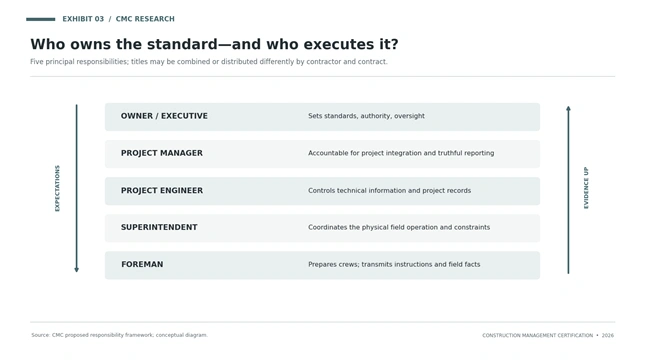
8. Responsibilities Across Field Management
Construction organizations vary. A specialty contractor maycombine project management and project engineering functions in one person. Aheavy civil general contractor may have multiple superintendents, areaengineers, and a separate quality team. A small commercial builder may have an owner who still performs project-management responsibilities. The CMC framework does not prescribe a universal organization chart. It identifies the principalresponsibilities that must have an owner somewhere within the actual project team.
The owner or executive officer establishes the expected operating method and the boundaries of delegated authority. That leader decideswhich financial exposures require executive approval, what constitutesacceptable reporting, and when a developing risk must be elevated. The owner should not spend each day resolving ordinary trade conflicts. The owner should know that significant conflicts cannot remain hidden merely because a project manager is confident of resolving them later. Executives need both a dependable reporting rhythm and the ability to call for evidence when conditions change.
The project manager holds overall project-management accountability. That includes the coordination of contractual, financial, administrative, and project-team responsibilities within the company's delegated authority. The PM must understand what the superintendent is planning, which technical responses the field is waiting for, how approved and pending changes affect the forecast, and whether the project record supports the status being reported. The PM cannot transfer accountability simply by assigning the RFI log to a project engineer or the three-week look-ahead to thesuperintendent. Delegation changes who performs the work; it does not eliminate the PM's obligation to verify that required work is complete.
The project engineer translates technical information into controlled project records and actionable field intelligence. Drawings, specifications, submittals, RFIs, inspection results, correspondence, and change documentation often pass through this role. The value of the PE is not the number of documents uploaded. It is that the field team can identify current information, unresolved decisions, review status, and the consequence of an overdue response. A technically complete RFI answer that never reaches the affected foreman has not completed its operating purpose. A submittal approval recorded after fabrication has already been released may have come too late to control the risk.
The superintendent organizes the physical constructionoperation: site access, sequencing, trade coordination, workface readiness, manpower and equipment interactions, production expectations, and the execution of work plans. The superintendent's planning discipline must connect the larger project schedule to the actual field conditions of the next several weeks. That does not require the superintendent to personally author every critical-path schedule calculation. It requires the field to identify the constraints and conditions that determine whether promised work can be performed. A useful look-ahead includes the decisions that are missing, not merely a list of tasks that the team hopes will happen.
The foreman is where company management expectations reach the crew. Crew assignments, daily coordination, available materials, current drawings, workmanship requirements, hazard controls, and productionobservations must become concrete instructions before work begins. The foreman also has to report the truth back up the chain. If an access problem blocks six people for four hours, if an installation detail conflicts with existing conditions, or if an inspection cannot be completed, the information musttravel quickly enough to change the plan. A foreman who is taught only to produce work but not to transmit problems will create blind spots for everyoneabove that role.
These responsibilities are connected, not isolated. A project engineer can flag an unanswered RFI, but the superintendent must connect its deadline to the work sequence. A foreman can identify an unexpectedcondition, but the PM must decide whether contractual notice is required. An owner can demand an accurate forecast, but the PM needs actual field quantitiesand known issues to prepare it. The operating standard makes those handoffsexplicit. It is a chain of responsibility through which evidence moves in both directions, rather than a hierarchy in which the most senior title is presumedto know everything automatically.
9. The Basic Operating Requirements Every Contractor Should Establish
The purpose of a field operating standard is to make critical work repeatable without turning the project into an office exercise. Its most important controls occur at predictable moments: before work is started, when crews are assigned, when technical information changes, when anexception arises, when completed work must be accepted, and when management reports the project's condition. A contractor should establish the minimum controls around those moments, then scale the level of detail to the project and the risk.
Project startup and the first transfer of responsibility. The execution team should receive a controlled understanding of the contract, drawing and specification status, major exclusions, unresolved design questions, required milestones, permit and inspection constraints, key subcontractor responsibilities, and anticipatedprocurement concerns. Startup is the point when assumptions can become facts without anyone noticing. A standard startup transfer should expose the assumptions that require confirmation and identify who owns each decision. Theemphasis is the handoff into project execution, not a replacement forestimating or corporate bid procedures.
Look-ahead planning and workface readiness. A master schedule can describe the intended path to completion while failing to expose why next Tuesday's installation cannot begin. A superintendent needs a rolling view of activities, access, preceding-trade completion, approved information, material availability, manpower, equipment, inspection readiness, and temporary conditions. The discipline lies in removing constraints before the work reaches the crew. If a procurement approval is due in two weeks and fabrication requires six weeks, that is not just a document-control issue; it is a field commitment that may already be at risk. The standard should identify who checks the constraint, when it must be cleared, and what happens if it cannot be cleared.
Daily crew preparation and the foreman's transmission duty. A brief daily huddle can confirm planned work, current instructions, work areas, interfaces with other trades, hazards, quality hold points, and the expected quantity or completion condition. The meeting is useful only if employees know what changed and what to do. A foreman should not be rewarded for repeating a schedule that everyoneknows is unrealistic. The better measure is whether the crew starts with the information, tools, access, and safe conditions required to make the promisedprogress. If a condition changes during the shift, the process must allow the foreman to stop, clarify, or revise the plan within the company safety program and delegated authority.
Coordination meetings that produce decisions. A project meeting is not complete becauseparticipants attended. Each material decision needs a responsible party, a due date, and a record of its distribution. The agenda should be built around interfaces: which areas are ready, which inspections are pending, which submittals or RFIs control upcoming work, which changes affect cost or time, and which trade-to-trade conflicts remain open. Meeting minutes should distinguish information received from action assigned. A project may choosedifferent meeting frequency based on complexity, but the requirement to closethe loop on critical commitments should not vary with the manager'spersonality.
Controlled drawings, submittals, and RFIs. The standard should define where the current contract documents reside, how revisions are communicated, how superseded documents arerestricted or marked, and how field confirmations are recorded. A submittal process should identify material procurement dates, required review dates, vendor obligations, and the release condition for fabrication or purchase. The RFI process should distinguish a question that can be resolved from an existing detail, a formal request to the design authority, and a change that might carry cost or schedule implications. Issuing an answer into a project platform is only one step; the field must acknowledge receipt where the answer changes installation work.
Change visibility andcontemporaneous records. Many disputes begin when the project team performs work before its scope, pricing, authorization, or time impact is understood. Contract terms vary, and some work must proceed promptly under directions even while the price is unresolved. The operating standard cannot override the contract. It can require that the PM identify and document the direction, preserve supporting photographs and daily records, give required notices, classify the event as pending or approved, and bring material exposure into the forecast with an appropriate confidence level. An unapproved change should not besilently treated as revenue, nor should an exposure disappear simply becausenegotiations are uncomfortable.
Daily field documentation with evidence. The daily report should record what will matter later: actual work performed, approximate production, labor and equipment conditions where relevant, material deliveries, inspections, abnormaldisruptions, directions, and significant weather or site conditions. Photographs should be dated and traceable to location and subject when they support a future decision. The goal is not to photograph every wall or fillspace with generic comments. It is to create a factual record that helps managers reconstruct the work and supports timely corrective action. A daily report produced a week later from memory is not equivalent to contemporaneousdocumentation.
Quality verification before concealment. Standards should identify acceptance criteria and hold points before critical work becomes inaccessible or difficult to correct. Aforeman checks workmanship and readiness; the superintendent coordinatesinspections and trade interfaces; the PE records required technical approvals; and the PM verifies that risks affecting cost and acceptance are being managed. The relevant criteria may come from contract documents, specifications, approved submittals, codes, and project-specific quality plans. Thecompany-owned part is the management expectation that verification occurs and is recorded by the proper responsible party. An internal certificate alone cannot substitute for required inspections or engineering approval.
Accurate progress and cost reporting. Progress reporting should explain the basis for the claimedpercentage rather than rely on impression. For instance, a project may report mechanical rough-in as 80% complete while major overhead zones remain inaccessible and substantial punch work is unmeasured. Cost reporting should separate actual cost, committed cost, credible estimate to complete, approved changes, probable exposure, and unresolved items. Where accounting systems do not integrate automatically, the PM should document the reconciliation process. An executive standard that tolerates optimistic percentages but refuses to expose the underlying quantity or cost basis will eventually produce unpleasantsurprises.
Closeout and record transfer. The final weeks should not be the first time the team rememberstest records, equipment manuals, warranties, as-builts, final inspections, outstanding changes, or customer acceptance conditions. A controlled closeout approach begins as work packages are completed, assigning records and responsibilities while subcontractor staff remain available. If the project manager changes during closeout, a common file structure and responsibility record can prevent the company's unfinished commitments from becoming somebodyelse's mystery. These are the field-execution practices the standard protects; they need not expand into an enterprise-wide restructuring exercise.
The strength of such a system is its connection between actions. A document register alone does not protect the field unless the look-ahead reveals when approvals are needed. A look-ahead alone does not protect production unless constraints have owners and escalation points. A daily report alone does not protect the contract unless material facts reach the PM's risk and change registers. A financial report alone is unreliableunless field production and pending issues are reflected in the estimate to complete. The operating standard is the relationship between these controls, not the total number of forms in use.
10. Operational Transparency: The Owner's Right to Know
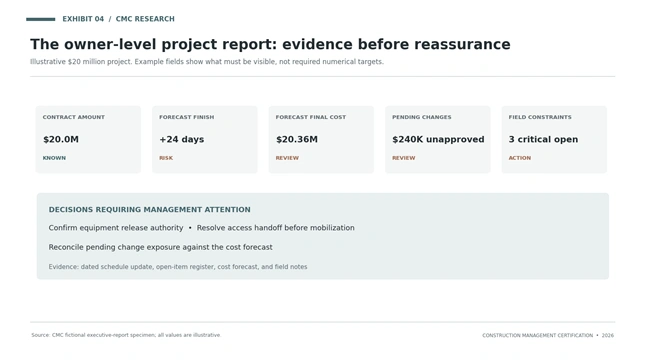
Owners do not need a forty-page weekly packet to know whether a job is under control. They need a concise, reliable statement of current conditions, with access to the evidence behind it. The question for each project manager is not whether the report looks professional. It is whether the owner can understand the schedule position, the current forecast, the major unresolved decisions, and the points at which executive help may be required. A report should distinguish facts from assumptions and markunresolved exposure rather than concealing it behind an attractive summary.
For a $20 million project, consider a weekly owner-level report showing the contractual completion date, current forecast completion date, major milestone variances, actual committed costs, estimate to complete, forecast final cost, approved changes, pending changes, unpriced directives, major procurement constraints, and three to five decisions that require attention. A report may also identify quality hold points, major inspections, and safety issues that must be elevated through the applicable safety program. The owner should be able to trace a significant reported condition to the underlying schedule update, subcontractor notice, cost record, or field observation. That evidence does not have to be attached to every report, but it must exist and be accessible.
Reporting integrity becomes particularly important with changes. Imagine the PM reports that the forecast is within budget, but the change log contains $240,000 of probable subcontractor exposure that has not been entered into the estimate to complete. The headline may be arithmeticallycorrect in the cost system and still be misleading. Or the superintendent reports that the critical path is on track while the equipment release approval needed for a major installation remains unresolved. The schedule file may show no variance, but the underlying assumption is weak. A standard report should identify what is known, what remains uncertain, and what management has doneabout each material condition.
An escalation threshold creates a practical division between field autonomy and executive intervention. The PM should be authorized toresolve routine coordination problems. A change likely to exceed the delegated financial authority, a forecast movement beyond an agreed tolerance, athreatened contractual milestone, an unresolved technical decision thatendangers near-term work, or a serious safety matter may require immediate escalation instead of waiting for the next monthly report. Thresholds shouldreflect contract size and risk, and legal notice periods should always behandled under the governing contract. The purpose is to preserve time for action, not to increase the number of phone calls reaching the owner.
A useful reporting culture also acknowledges bad news. Owners sometimes unintentionally train their managers to delay disclosure by reacting angrily to early warnings but rewarding reports that sound positive. The result is operational theater: polished narratives, minimal visible problems, and a final reckoning after the losses are unavoidable. Leadership should distinguish between an employee who identifies an emerging issue with evidence and options and one who conceals a known problem. The most valuable report is not the one that says everything is green. It is the one that allowsmanagement to intervene while the outcome can still be changed.
The independent construction management literature does not establish that any single dashboard format produces a fixed cost saving. CII'semphasis on benchmarking, risk assessment, quality, change management, and lessons learned supports the broader principle that performance requires defined processes and information [4]. Federal contractor-responsibility standards likewise recognize the importance of adequate organization, accounting and operational controls, and technical skills for prospective contractors [10]. A privately chosen executive report is not itself a federal certification requirement. It is a way the business can verify that its delegated managers are protecting the project the company is obligated to deliver.
Developing and Assessing the Field-Management Workforce
11. Experience Is Valuable. Consistent Expectations Must Be Taught.
Experience should be respected, but experience cannot tell anew employee which standards a particular contractor has chosen to enforce. Aforeman may have led crews successfully for fifteen years without ever being required to produce a written daily production record. A superintendent may beextremely skilled at sequencing trades while accustomed to handling almostevery conflict by telephone. A project engineer may be proficient with submittal software yet unaware of the company's required escalation time for an overdue technical decision. None of those employees is necessarily incompetent. Each has brought a different operating background into a company that isentitled to define how its projects will be managed.
A useful training program begins by explaining why the standard exists. Experienced workers will resist an arbitrary requirement that adds paperwork while apparently doing nothing for production. They are more likely to adopt a control when it is connected to an actual field loss. A superintendent who understands how a three-week constraint review prevents crew mobilization into an unavailable area will see the value of the process more clearly than one who is simply instructed to upload a schedule every Friday. Aforeman who has lived through a disagreement over which detail was used may understand revision acknowledgement immediately. The training should put real project decisions at the center rather than treating the standard as a vocabulary test.
The four CMC principles provide a common language, but instruction must remain role-specific. Delegation and Accountability meanssomething different to a project manager managing contractual obligations than to a foreman confirming who is responsible for tomorrow's crew preparation. Planning Over Reacting requires the superintendent to anticipate trade constraints and the foreman to convert the plan into ready-to-execute tasks. Field Transmission requires a project engineer to pass along current technical answers and a foreman to confirm the crew understood them. Operational Transparency requires a PM to reconcile the forecast while requiring thesuperintendent to give accurate production and constraint information. A sharedphilosophy can create consistency without teaching every role to perform every other role's job.
Instruction must also preserve professional judgment. A standard can require a documented control point before equipment is released to fabrication, but only qualified people can evaluate the design and procurementcircumstances of a particular package. A standard can define reporting obligations and decision authority, but only those with contractual and technical competence should make the corresponding decisions. The objective is not to replace experienced judgment with a fixed script. It is to prevent critical knowledge from depending solely on a particular employee's memory and preferences.
Structured supervision is particularly important when someone is newly promoted. A skilled carpenter who becomes a foreman may need coached practice in planning, leading a coordination huddle, reportingquantities, documenting a delay, and bringing a technical question forward before work continues. A superintendent moving into larger work may need coaching in multi-trade look-aheads and owner-facing reporting obligations. The education program should recognize such development as a normal progressionrather than a failure to know the trade. Companies that offer a coherentpathway can judge readiness on observable operating behaviors, not just yearsemployed or confidence expressed in an interview.
12. Mandatory Training, Assessment, and Onboarding
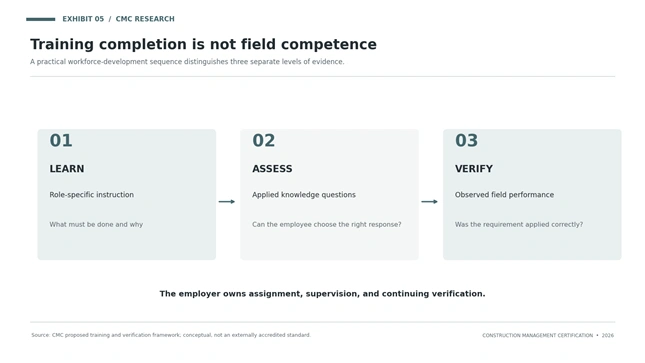
A contractor can document a standard without achievingconsistent field behavior. The missing mechanism is usually implementation: employees never receive common instruction, knowledge is not checked, exceptions are not coached, and new hires are left to absorb company expectations from whoever happens to be available. The solution is a repeatableonboarding and reinforcement process tied to real responsibilities. OSHA's safety-program guidance specifically emphasizes that managers, supervisors, and workers must understand program structure, procedures, and role-specific duties, and that training can include field demonstration and peer-to-peerlearning [7]. That safety guidance cannot be treated as proof that a general management certificate improves a contractor's profit, but it provides a credible model for connecting written expectations to behavior.
The first level is documented learning. A role-specific curriculum should explain the company's operating requirements and userecognizable construction cases. For the foreman, that may include daily work preparation, current information, basic documentation, workmanship verification, and escalation. For the superintendent, it includes workface readiness, trade interfaces, constraints, look-ahead commitments, inspection planning, and accurate progress reporting. For the PE, it includes document status, the flow of technical answers, RFI and submittal aging, and evidencepreservation. For the PM, it includes the integration of field status with contractual notices, cost forecasts, delegated authority, and executive reporting. The curriculum must be adjusted to project type, employee responsibility, and company risk.
The second level is a knowledge assessment. A meaningfulexamination asks the employee to apply the operating requirements to situationsrather than repeat slogans. A superintendent might be shown a three-week plan with an equipment approval missing and asked what constraint must be assigned, to whom, and by when. A project engineer might be asked how an RFI answer affecting an already-started installation must be transmitted. A PM might be shown a report with large pending changes omitted from the forecast and asked what must be disclosed. Passing such a test provides evidence that the employee understands the expected answer in a structured setting. It does not prove that the employee will consistently apply it under pressure.
The third level is workplace verification. An assigned coachor manager reviews selected real tasks: a properly prepared look-ahead, a controlled revision handoff, a documented issue escalation, a closeout record, or a report accurately reflecting an identified cost risk. The reviewer should confirm both the presence of a record and its practical usefulness. Ten pages of meeting minutes may be inferior to a one-page action record if neither the assigned party nor the due point is clear. An inspection checklist may be complete while critical work has already been covered. Verifying performance means observing whether the process worked at the point where a mistake could have affected the project.
Onboarding should begin before a new project leader is left alone with substantial risk. A new PM should receive the company standard, current project condition, decision authorities, open contractual exposure, and an explanation of how the executive report is reconciled. A superintendent should receive the current field sequence, constraint status, key subcontractor handoffs, safety requirements, and reporting expectations. The foreman should know where current instructions live and how to report blocked work or unsafeconditions without ambiguity. Existing employees should receive the same baseline instruction; it is difficult to ask new hires to follow a procedure that incumbent leaders ignore.
Refresher training should be triggered by need, not only bya calendar. Changes to a major process, repeated nonconformances, a new project type, or evidence of misunderstanding may justify focused re-instruction. Supervisors should be able to record that a requirement was taught, assessed, observed, and later reinforced. The contractor must also give employees access to the resources needed to comply: adequate time, current information, reporting tools, and managerial responses to escalations. Declaring a process mandatory while failing to support it is a predictable way to createsuperficial compliance.
The distinction between course completion, examination, anddemonstrated competence must remain visible in all CMC publication language. Completion documents participation in education. A passed knowledge assessment documents performance against the assessment's tested content. Verified workplace competence requires observation in a real context, and in manyprofessions additional licensing, experience, or third-party approval may apply. These measures reinforce one another, but they are not interchangeable. The contractor remains responsible for assigning qualified personnel to the work and verifying performance under applicable project and legal requirements.
13. What Does a Trained and Certified Field Workforce Mean to a Customer?
Owners awarding construction work are evaluatingorganizational reliability as well as price. The exact weight placed on experience, safety, financial condition, key personnel, technical approach, and past performance depends on the customer and procurement method. A contractor cannot assume that any particular private education certificate is accepted by every agency or that a client will award work because employees completed a course. The defensible commercial value lies in being able to demonstrate a repeatable management capability with credible supporting evidence.
Federal Acquisition Regulation 9.104-1 identifies organizational capacity, experience, accounting and operational controls, technical skills, quality measures, and safety programs among the factors relevant to determining contractor responsibility [10]. That regulation does not require CMC certification or endorse a particular SOPproduct. It does show why a contractor's ability to explain and document its operating controls can be relevant in a serious procurement environment. FAR42.1501 also identifies quality of workmanship, cost control, scheduleadherence, and customer-oriented performance among the subjects of federal past-performance records [12]. A polished training program cannot erase poor performance, but it can form part of the evidence that the company is actively managing performance risks.
The difference between a claim and evidence is important ina bid interview. Saying that all superintendents are highly trained may invitea polite nod. Explaining that the company requires a weekly constraint review, measures closure of critical commitments, controls technical revisions through documented field transmission, and verifies superintendent competency on real projects tells the customer how the work is expected to be managed. If thecompany can provide a sanitized sample report, recent audit results, and examples of corrective action, the discussion becomes more credible. The supporting records should be truthful, representative, and permitted by the customer'sconfidentiality rules.
The contractor also needs to be precise about credentials. Some qualifications are statutory or tied to a license, jurisdiction, trade, owner requirement, or recognized external accreditation. A provider-issuedconstruction management course certificate may be useful documentation of education and assessment without belonging to those categories. Calling it agovernment license, independent accreditation, or proof of guaranteed field performance would misrepresent its meaning. A sensible customer-facingstatement identifies the issuing organization, the role-specific subjectmatter, what the learner completed, how knowledge was assessed, and whether actual field performance was separately verified by the employer.
Competitive benefit is therefore conditional. A well-implemented standard may help an owner trust that the contractor has organizational discipline; it may help the contractor prepare better interviews and answer prequalification questions; and it may help employees step into new assignments. Whether it changes bid success rates is an empirical question. The contractor would have to track prequalification feedback, interview responses, and award outcomes over time while accounting for price, backlog, relationships, project type, and market conditions. A publication intended toeducate owners should not promise awards merely because the contractor hascertificates to display.
Part V — Implementation, Measurement, and Return on Investment
14. Implementing Standardization Without Disrupting the Company
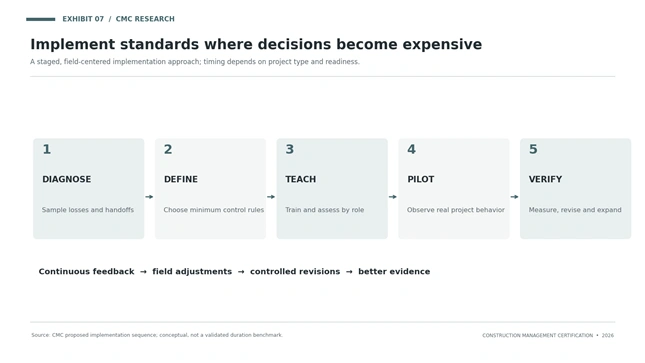
Standardization fails when it is introduced as a new administrative system that competes with the production of the work. A contractor cannot stop every project for a month to rewrite procedures, retraineveryone, and demand perfect compliance on Monday morning. A practical implementation begins with evidence, chooses a few costly handoffs to control, tests them on live work, and expands only when the requirements prove useful. The object is to change how crews and managers make decisions, not to produce ahandsome set of manuals.
The first phase is diagnosis. Select a manageable sample of completed and active projects, and compare their existing approaches to field planning, document transmission, change tracking, and executive reporting. Identify where reliable practice already exists and where the methods varymaterially. Speak with project managers, project engineers, superintendents, and foremen. They can identify the forms nobody uses, the data entered twice, and the decisions that routinely arrive too late. The owner should insist on evidence of project outcomes rather than confusing the loudest preference witha proven operating method.
The next phase is setting the minimum rules. Choosehigh-value requirements that can be stated clearly and verified without a large administrative burden. For example, require that all projects maintain a live look-ahead constraint record for upcoming field work, that current drawing revisions be transmitted through an identified process, that changes and directions be logged promptly, and that an executive project report disclose major pending exposure. Define each requirement's owner, trigger, output, and escalation point. The company should identify the underlying evidence but permit different software or meeting formats where they can satisfy the same control objective.
A pilot should follow on one or two projects with engagedfield leaders and enough complexity to reveal whether the method works. Selecting only the easiest project may produce misleading confidence; selecting the most distressed job may make interpretation impossible. Training should be delivered to the actual people responsible, not only to a central manager. Reviewers should observe whether the superintendent's constraints are clear, whether the foreman received current instructions, and whether the PM's reportexposes real issues. If a requirement adds delay without preventing loss orimproving decisions, revise it. If crews disregard a process because it conflicts with available tools or field conditions, determine whether the process is defective or the support inadequate before attributing the failure to attitude.
The owner should be visible during implementation. When a project manager escalates a risk under the new process, the executive must respond or delegate a response. When a superintendent identifies a problem early, the company should encourage the disclosure rather than turn it into apenalty. When a PM submits a report with unexplained percentages, leadership should request the basis consistently. These actions establish that the operating standard represents how the company actually runs projects, not a temporary initiative that employees can wait out.
After a suitable pilot, the contractor can expand the method by project type and role. A smaller contractor may roll it out through a weekly operations meeting, a single shared resource folder, and short fielddemonstrations. A midsize firm may need formal employee onboarding, controlledtemplates, and periodic cross-project reviews. A large firm may require an internal standard owner and sample-based audits across divisions. In all cases, management should keep a mechanism for field feedback, make revisionsintentionally, and retire obsolete requirements. A standard that does notimprove when the business learns becomes another source of inefficiency.
The schedule for implementation should be planned around actual project demands. Personnel training can be divided into short role-specific sessions, while existing project meetings can be used to demonstrate the new review structure. The first six weeks might be devoted to diagnosis and defining controls, the next six to pilot training and observation, and the following quarter to refinement and expansion. These are planning illustrations rather than a universal timetable. A contractorperforming short-duration projects might test several cycles more quickly, while a large infrastructure contractor might need a longer period to observe technical handoffs and progress trends. What matters is disciplined implementation, not an arbitrary date by which every document is signed.
15. Measuring Whether the Investment Is Working
An operating standard should be measured at two levels. Process measures show whether the company is executing the controls it adopted. Outcome measures show whether project performance improves. Process measures might include on-time closure of critical field constraints, the age of overdueRFIs affecting production, the completeness of weekly executive reporting, the time needed to transmit revised instructions, the percentage of observed tasksperformed to the standard, and the portion of newly assigned leaders who have completed training and workplace verification. Outcome measures might include documented preventable rework costs, avoidable work stoppages, change-documentationrecoverability, project forecast reliability, delay recovery effort, and project closeout time. A company needs both sets, because completing forms is not proof of better performance.
Measurement should start with baseline definitions that remain stable long enough to support comparison. For example, a preventable rework event should be defined before managers begin reporting incidents; otherwise an apparent increase after implementation may simply mean the company is documenting problems it previously ignored. A completed RFI should mean that the necessary answer has been accepted and transmitted to the affected users, not only that an item changed status in a database. A look-ahead constraint should be considered removed only when the field can actually proceed, not whensomebody promises to address it. Such definitions are what make project reporting useful beyond a single individual's habits.
The most credible comparison combines before-and-after analysis with information about other changes. A contractor might see reworkfall after introducing the new standard, but project mix may also have shiftedfrom technically difficult renovations to repetitive new construction. Workforce conditions, weather, owner behavior, design completion, subcontractorstability, and procurement can all influence outcomes. Management should compare similar work where possible, disclose major differences, and interpretshort pilot periods cautiously. If a department improves, review the specific events and controls rather than assume that every positive trend was caused by training. Independent or cross-project review can reduce the temptation tocount favorable events and omit disappointments.
The financial calculation is straightforward, but its inputsrequire discipline. First-year net benefit equals verified avoidable cost reduction minus fully loaded first-year program cost. A simplified ROI percentage equals net benefit divided by the program cost, multiplied by 100. The break-even improvement rate equals program cost divided by the measured addressable-loss pool. For the hypothetical midsize contractor, $72,000 of first-year program cost divided by a $320,000 measured loss pool produces a22.5% break-even reduction rate. If the pilot supports a sustained reduction below 22.5%, the initiative does not repay its first-year cost under these assumptions. If it supports a sustained reduction above that threshold, a positive return becomes possible. The exact program timing and cost allocation may change the calculation.
The accompanying scenarios make the range explicit. In the small-company example, $8 million of examined annual work supports an assumed$90,000 addressable loss pool and a $24,000 first-year program cost. The modeled net effects are negative $10,500 at 15% improvement, positive $7,500 at35%, and positive $25,500 at 55%. The break-even improvement is 26.7%. In the midsize example, $40 million of work supports an assumed $320,000 addressable pool and $72,000 program cost. The modeled net effects are negative $24,000, positive $40,000, and positive $104,000; break-even is 22.5%. In the larger-company example, $150 million of work supports an assumed $1,050,000pool and $210,000 cost. The net effects are negative $52,500, positive$157,500, and positive $367,500; break-even is 20%. Every loss-pool amount, improvement assumption, and program cost is illustrative.
These numbers do not include an assumed increase in contract awards, an automatic safety improvement, a reduction in insurance premiums, aguarantee of schedule completion, or a staff-retention dividend. Such effects could be investigated if a contractor can eventually measure them, but addingthem prematurely would inflate the case. The first commercial purpose is protecting existing project profitability through fewer identifiable operating failures and more reliable oversight. Any secondary benefit should be supportedby separate evidence. The owner should prefer a modest saving that can be verified to a spectacular industry-wide claim that cannot be reconciled to the ledger.
The most revealing measure may be the time between thediscovery of a serious problem and the point when a decision-maker receivestrustworthy information about it. A company that consistently discovers cost exposure earlier may preserve recovery options that did not exist before, even if the final loss on an individual project cannot be attributed wholly to the new process. In this sense, the standard is also a mechanism for reducinguncertainty. It helps management identify which risks are actionable, which are merely possible, and which have already become committed costs. That is a durable business capability independent of the particular employee holding the project-manager title.
Part VI — The Contractor's Responsibility
16. The Standard Must Outlast the Employee
Return to the $20 million project. Six months after mobilization, the project manager resigns. On a poorly controlled project, the replacement begins by asking which submittals are current, whether thesuperintendent's actual sequence matches the schedule, which changes have been directed but not priced, and why the cost forecast shows a contingency balance that does not seem to match the field conditions. The answer to each question depends on finding the right person, the right email, or the right folder. Before the new PM can manage the project, the company must pay someone to reconstruct its history.
On a project operating under a durable company standard, the new manager does not inherit a perfect job. Construction remains full of uncertainty. What changes is the ability to understand the job quickly. The look-ahead explains the near-term field constraints. The technical registers identify outstanding decisions and the dates the field needs them. The change log separates approved value, pending exposure, and unpriced directions. The cost forecast contains the assumptions and reconciliation behind its estimate to complete. The executive report shows which risks ownership already understands and which decisions still need attention. The company's knowledge is preserved in controlled evidence rather than trapped in one person's habits.
That continuity has value even when employees do not leave. A superintendent may be reassigned temporarily, a project engineer may cover a second job, or an operations executive may need to investigate a troubledmilestone while the PM is unavailable. A common standard reduces theorientation required to interpret another project's records. It also makescomparisons between jobs more useful because the same terms mean the samethings. Without such consistency, a report showing 85% completion on one job may not be comparable to a report with the same number on another. The business cannot manage portfolio-level risk reliably if each project invents its own measurement language.
A standard cannot make every worker interchangeable. Local knowledge, relationships, judgment, licenses, and experience remain valuable. The goal is not to eliminate the consequences of losing a good manager; it isto ensure that management knowledge developed while that person represented the contractor remains accessible to the contractor. That is a reasonableexpectation when the company continues to carry the bond, the warranty, the contract, and the financial exposure after an individual moves on.
17. From Individual Certification to a Company-Wide Operating Standard
Construction Management Certification provides role-specific education for foremen, superintendents, project engineers, and project managers. Existing program pages describe foreman leadership training, superintendent training, project engineer training, and project manager education. Theselinks describe available educational programs, not proof of externallyvalidated project outcomes. The broader CMC direction described in this paper is a developing Field Operating Standard that contractors can adapt to their projects and reinforce through documented expectations, mandatory role-specific instruction, knowledge assessment, onboarding, and workplace verification. Those elements are related but should not be confused. An individual can complete a course without an employer adopting a standard, and a contractor canwrite an internal standard without teaching anyone to apply it. Durable improvement requires the two to meet in actual project execution.
The contractor remains the owner of its chosen method. It must identify its contractual and project risks, approve the operating requirements, give employees the resources to comply, supervise the work, and respond to the information its own standard produces. CMC's educationalframework can support that effort; it cannot assume the contractor's contractual responsibility or independently certify that every employee will perform correctly in all field conditions. The developing company-level standard, any future employer licensing, or implementation offerings should be described as available only when their release and scope have actually been verified.
A sensible rollout would begin with the company's own executive expectations. Leadership identifies the minimum reporting and field-control requirements, maps them to actual job responsibilities, and thendecides which role-specific education is needed for incumbent and incomingpersonnel. Employees study, demonstrate knowledge of the required procedures, and receive field coaching before the company treats the procedure as operationally adopted. In that approach, certification is not a decorativecredential placed over old habits. It is one documented component of a larger effort to establish consistent performance expectations.
The test of credibility is what happens after a difficult week on the jobsite. When the schedule compresses, does the superintendent still surface the constraint rather than hide it? When a drawing revisionarrives late, does the PE transmit the instruction and confirm that affected crews received it? When a change is uncomfortable, does the PM disclose the probable exposure before it becomes an unrecoverable cost? When a new foremanarrives, can the company explain exactly what good daily leadership and reporting look like? A standard that survives pressure and personnel change isworth far more than a binder that demonstrates good intentions.
18. Conclusion — The Company Must Own Its Standard
The case for construction management standardization is not that every contractor is badly managed or that every manager needs a formalscript. Many organizations already have mature procedures, strong personnel, and excellent outcomes. The issue is whether the contractor's essential project-management controls are owned by the company, consistently taught, appropriately verified, and preserved when the individuals who perform the work change. That question matters for a small specialty contractor managing three crews and for a large general contractor managing a portfolio of complex publicprojects.
The evidence supports caution and action in equal measure. Rework research documents measurable cost exposure, but studies produce different results because their samples, definitions, and reporting quality differ. Workforce research shows continuing difficulty recruiting and retainingqualified construction personnel, but it does not prove that a particular training certificate will solve that shortage. Federal responsibility criteria recognize the value of organizational and operational controls, but they do not endorse one private certification. The financial model demonstrates possible returns on controlled losses, but it also shows negative outcomes when the improvement is too small. These are not weaknesses in the argument. They are the conditions under which a serious owner should make an investment decision.
The practical choice is straightforward. Contractors cancontinue to let every new project leader bring a private operating method, thenattempt to recover project history whenever something goes wrong. Or they can define the minimum ways that work will be prepared, decisions transmitted, field conditions verified, risks escalated, and project performance reported. They can train employees in those requirements and test both knowledge and actual application. They can revise the method when evidence proves that something is not working. They can demand accurate information without takingback every delegated decision.
A capable field team should run the project. The contractor should own the operating standard under which the work is run. The people run the project; the contractor owns the standard.
Appendix A — Financial Model, Assumptions, and Interpretation
The model is a first-year, pre-tax sensitivity analysis. Itis not a discounted-cash-flow valuation and excludes financing, inflation, changes in work volume, and effects extending into future years. The assumed loss pools represent documented, avoidable, nonoverlapping events identified by the hypothetical contractor, not all project losses. The modeled percentagesrepresent the share of those measured events eliminated after implementation, not the share of contract value saved. There is no assertion that a contractor with $40 million in revenue normally suffers $320,000 of addressable losses or that 35% of such losses can reliably be prevented. The purpose is to demonstrate the calculation a company could perform using its own records.
Illustrative first-year assumptions. Small company: $8,000,000 examined annual work volume; $90,000 documented addressable losses; $24,000 program expense. Midsize company: $40,000,000 volume; $320,000 losses; $72,000 expense. Larger company:$150,000,000 volume; $1,050,000 losses; $210,000 expense. Reduction scenarios for all three: conservative 15%, moderate 35%, optimistic 55%. Formula: grossbenefit = baseline addressable loss × improvement rate; net benefit = grossbenefit − full first-year program expense; ROI = net benefit ÷ program expense; break-even improvement = program expense ÷ addressable-loss pool. Simplifiedpayback, where gross benefit exceeds zero, equals full expense ÷ annual grossbenefit × 12 months, assuming an immediate constant benefit rate. These are model outputs, not measured customer outcomes.
The first-year program-cost assumptions include employee and manager time for drafting, instruction, knowledge assessment, field coaching, periodic observation, and revision; a smaller amount may be allocated to learning content and administrative support. To use the model operationally, the contractor must replace each assumed cost with loaded staff labor and actual vendor invoices. The addressable loss pool must be reconciled against project financial records; claimed reductions must be checked for recoveries, scope changes, different project mixes, shifts in field labor hours, and otherconfounding conditions. No hypothetical benefit from increased contract awards or improved retention is embedded in the totals. Separate qualitativeimprovements may be described, but not monetized without a defensiblemethodology.
How the hypotheticaltotals were assembled. For comparability, the model gives each company four mutually exclusive loss categories: preventable rework; productive hours lostto avoidable field handoff failures; documented administrative reconstruction or duplication; and unrecovered cost tied specifically to late or incompletechange documentation. The program-expense side contains standard development and review; employee training plus assessment time; field coaching and verification; and first-year administration and maintenance. The numbers below are invented bookkeeping examples, not audited contractor accounts. A real company must replace each one with evidence, remove overlaps and credits, and exclude losses caused by unavoidable conditions, owner-directed changes, or ordinary construction risk.
Illustrative pool / cost component | Small contractor | Midsize contractor | Larger contractor |
Preventable rework | $30,000 | $110,000 | $370,000 |
Avoidable field handoff disruption | $28,000 | $95,000 | $310,000 |
Administrative duplication / reconstruction | $18,000 | $65,000 | $200,000 |
Unrecovered change-documentation losses | $14,000 | $50,000 | $170,000 |
Standard drafting and review | $5,000 | $18,000 | $60,000 |
Training, assessment and staff time | $8,000 | $25,000 | $70,000 |
Field coaching and verification | $7,000 | $20,000 | $58,000 |
First-year administration and maintenance | $4,000 | $9,000 | $22,000 |
Total addressable loss pool | $90,000 | $320,000 | $1,050,000 |
Full first-year expense | $24,000 | $72,000 | $210,000 |
The midsize example provides a useful breakdown of the$320,000 baseline pool: $110,000 preventable rework, $95,000 workface disruption tied to avoidable handoff failures, $65,000 documented administrative duplication, and $50,000 unrecovered change-documentation costs. These buckets are mutually exclusive by assumption. In practice, companies often record these costs imperfectly. A pilot may initially cause the apparenttotal to increase because more issues are identified. That would not necessarily mean performance deteriorated. The correct comparison requires consistent recognition methods and a sufficient sample of similar work.
First-Year Financial Sensitivity — Illustrative, Not CMC Customer Results
Contractor | Improvement assumption | Gross modeled benefit | Full program expense | Net first-year result | First-year ROI |
Small | 15% | $13,500 | $24,000 | −$10,500 | -43.8% |
Small | 35% | $31,500 | $24,000 | $7,500 | +31.3% |
Small | 55% | $49,500 | $24,000 | $25,500 | +106.3% |
Midsize | 15% | $48,000 | $72,000 | −$24,000 | -33.3% |
Midsize | 35% | $112,000 | $72,000 | $40,000 | +55.6% |
Midsize | 55% | $176,000 | $72,000 | $104,000 | +144.4% |
Larger | 15% | $157,500 | $210,000 | −$52,500 | -25.0% |
Larger | 35% | $367,500 | $210,000 | $157,500 | +75.0% |
Larger | 55% | $577,500 | $210,000 | $367,500 | +175.0% |
Net financial effects are gross modeled avoided losses less the complete first-year expense. A negative net outcome is a real possibilityeven when training is completed. These calculations exclude second-orderrevenue, employee-retention, insurance, and market-share assumptions. The break-even reduction in the addressable pool is 26.7% for the small contractor,22.5% for the midsize contractor, and 20.0% for the larger contractor.
Appendix B — Research Limitations and Editorial Integrity
Construction research spans different countries, trades, project types, contract forms, and measurement practices. A well-controlled single-contractor study may reveal accurate local records while lacking broadrepresentativeness. A large survey can identify trends but depends onrespondents' definitions and recollection. An industry association publication may contain valuable primary findings but also represent the interests of itsmembers. This paper treats those differences as central to interpretation rather than as minor caveats.
The CMC company-level Field Operating Standard is described as developing. No research reviewed for this manuscript demonstrates that CMC's particular certification courses cause a defined reduction in rework, improveemployee retention by a fixed rate, or increase bid awards. The financial scenarios are designed for decision-making discussion, not marketing claims. The publication is also not presented as an externally accredited standard, a professional license, or a substitute for regulatory training. Its recommendations should be tailored to the contractor's project delivery method, contracts, state and federal obligations, and actual operating controls.
The intended owner-focused article should be kept distinctfrom student-facing marketing copy. It should include an accurate byline, publication date, research methodology, and accessible source references. Updates should identify substantive changes in evidence rather than refreshingthe date without revisiting the analysis. Any financial exhibit should carry the word 'Illustrative' prominently, while data-based exhibits should state the source and year. This editorial separation is essential to the credibility of the publication.
Research References
[1] Hwang, B.-G., Thomas, S. R., Haas, C. T., and Caldas, C. H. (2009). “Measuring the Impact of Rework on Construction Cost Performance.” Journal of Construction Engineering and Management, 135(3),187–198. https://doi.org/10.1061/(ASCE)0733-9364(2009)135:3(187). Project sample: 359 CII database projects; cost definitions and project characteristics matter.
[2] Love, P. E. D. (published online October 28, 2025; print January 2026). “Quantifying the Costs of Field Rework in Construction.”Journal of Construction Engineering and Management, 152(1). https://doi.org/10.1061/JCEMD4.COENG-17026. Contractor-specific exploratory investigation; recorded precompletion average of 0.38% of contract value; estimated 0.76% postcompletion-inclusive resultassumes uncollected postcompletion costs equal precompletion costs; the 0.38%observed figure and 300% underreporting are described separately.
[3] Love, P. E. D., Smith, J., Ackermann, F., Irani, Z., and Teo, P. (published online October 31, 2018). “The Costs of Rework: Insightsfrom Construction and Opportunities for Learning.” Production Planning & Control, 29(13), 1082–1095. https://doi.org/10.1080/09537287.2018.1513177. Single-contractor longitudinal research on 19,605 rework events across 346projects, with complete cost data for 98 projects. The 0.39% contract-value mean refers only to the complete-data subset.
[4] Construction Industry Institute. “CII Best Practices.” https://www.construction-institute.org/cii-best-practices. Institutional reference describing change management, quality, project risk assessment, benchmarking, and lessons learned as formal project practices.
[5] Construction Industry Institute. “Front End Planning.” https://www.construction-institute.org/front-end-planning. Research-based explanation of early project definition and structured planning; broader scope than the field-execution standard proposed here.
[6] Associated General Contractors of America and NCCER(2026, September 3). “Construction Workforce Shortages Remain Acute Despite‘Soft’ Market Conditions As Data Centers Strain Labor Supply, Survey Finds.” https://www.agc.org/news/2026/09/03/construction-workforce-shortages-remain-acute-despite-soft-market-conditions-data-centers-strain. Survey: 1,830 individuals answered at least one portion in July–August 2026; sample sizes differ by question; results are self-reported.
[7] Occupational Safety and Health Administration (2016). Recommended Practices for Safety and Health Programs in Construction, OSHA3886. https://www.osha.gov/sites/default/files/publications/OSHA3886.pdf. Also see OSHA online guidance: https://www.osha.gov/safety-management/education-trainingand https://www.osha.gov/safety-management/management-leadership. Safety-program recommendations, not general field-management certification evidence.
[8] Gallup (2025, July 21). “Addressing the BarriersBlocking Employee Development.” https://www.gallup.com/workplace/692642/addressing-barriers-blocking-employee-development.aspx. General U.S. workforce study; not construction-specific causal evidence.
[9] Gallup. “Global Indicator: Employee Retention & Attraction.” https://www.gallup.com/467702/indicator-employee-retention-attraction.aspx. U.S. voluntary-turnover reasons and workforce preferences; general labor market research.
[10] U.S. Federal Acquisition Regulation, 9.104-1, “General standards.” https://www.acquisition.gov/far/9.104-1. Contractor responsibility criteria, not a private training requirement.
[11] PlanGrid and FMI (2018, August 1). “ConstructionDisconnected” survey findings, announced in “New Research from PlanGrid and FMI Identifies Factors Costing the Construction Industry More Than $177 BillionAnnually.” https://www.prnewswire.com/news-releases/new-research-from-plangrid-and-fmi-identifies-factors-costing-the-construction-industry-more-than-177-billion-annually-300689826.html. Historical modeled industry-wide estimate from a survey of approximately 600leaders; not a direct saving attributable to standards.
[12] U.S. Federal Acquisition Regulation, 42.1501,“General.” https://www.acquisition.gov/far/42.1501. Past-performance information and its possible relevance to future sourceselection.
[13] Construction Management Association of America.“Construction Management Standards of Practice.” https://www.cmaanet.org/bookstore/book/construction-management-standards-practice. Professional CM practice framework; not equivalent to a contractor's project-specific operating procedures.
[14] Procore (updated 2025, August 21). “Using Standard Operating Procedures for Better Contract Management.” https://www.procore.com/library/sops-contract-management. Commercial-provider guidance used only for the search-intent comparison and practical SOP terminology.
[15] Google Search Central. “Creating Helpful, Reliable, People-First Content.” https://developers.google.com/search/docs/fundamentals/creating-helpful-content. Editorial SEO principles; not evidence of construction-performance outcomes.