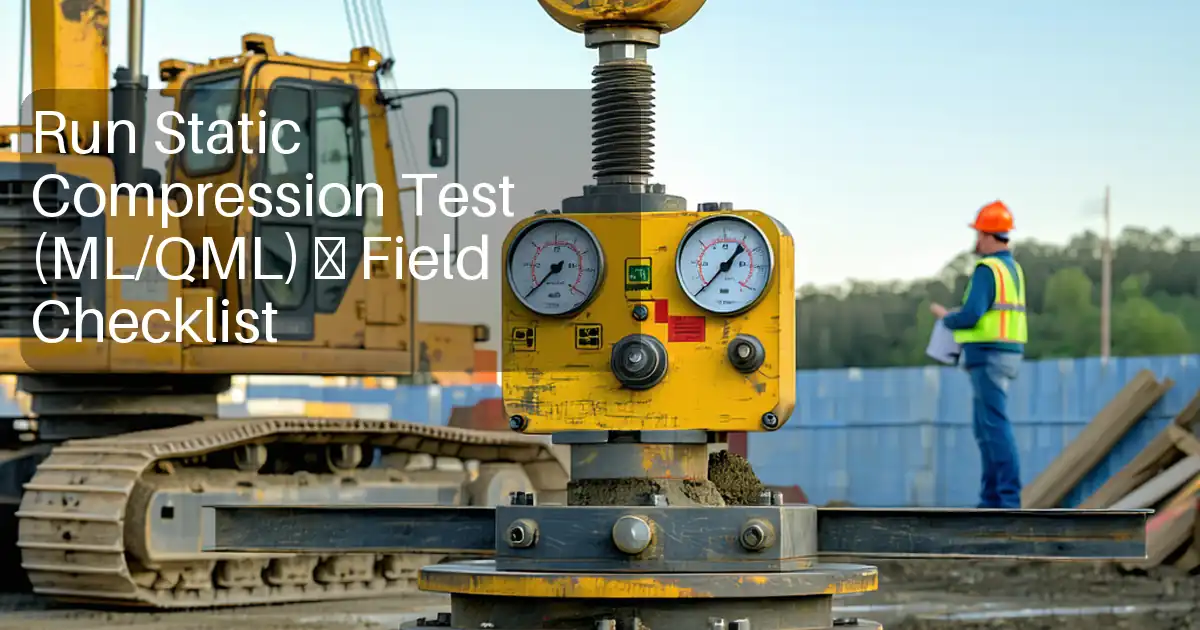
Static Lateral Load Test Checklist
Definition: Static Lateral Load Test checklist guides site engineers through setting reaction systems, applying horizontal loads, measuring deflection and rotation, and acceptance decisions for foundations and piles, explicitly excluding any tension testing.
- Set safe reaction systems and horizontal jack alignment, exclude tension.
- Measure deflection and rotation with calibrated LVDTs and inclinometer.
- Define acceptance using load–movement behavior per approved specifications.
- Interactive, commentable, exportable with QR code verification.
Static Lateral Load Test confirms how a foundation or pile responds to controlled horizontal loading. This checklist supports site engineers conducting a horizontal load test, also called a lateral pile test or static horizontal loading, by detailing reaction setup, instrumentation, data capture, and acceptance evaluation. The scope is strictly lateral; tension or uplift testing is excluded. Following these steps helps avoid common risks: inadequate reaction capacity, misaligned jacks inducing unintended moments, under-embedded reaction piles, instrument drift, and incomplete time–movement records. You will configure reaction frames or piles, align the hydraulic jack and load cell, measure deflection with LVDTs and rotation with an inclinometer, and document hold periods until movement rates stabilize. Acceptance is determined against project criteria for maximum movement, residual movement, and rotational limits at service and factored loads. Use this interactive checklist during planning and execution; tick items as you go, add comments or photos for evidence, and export your filled record to PDF/Excel with a QR for secure verification.
- Purpose-built checklist that walks you through reaction setup, jack alignment, calibrated instrumentation, incremental loading, hold periods, and movement monitoring, delivering defensible data for acceptance without performing any tension or uplift testing.
- Practical instrumentation guidance ensures accurate deflection and rotation readings using independent reference frames, minimizing bias from frame flexure and capturing time-stamped data to verify stabilization at each load increment.
- Acceptance focuses on lateral performance: maximum deflection under service and factored loads, residual movement after unloading, and rotation limits, recorded with photos, serial numbers, and calibration certificates for full traceability.
- Interactive online checklist with tick, comment, and export features secured by QR code.
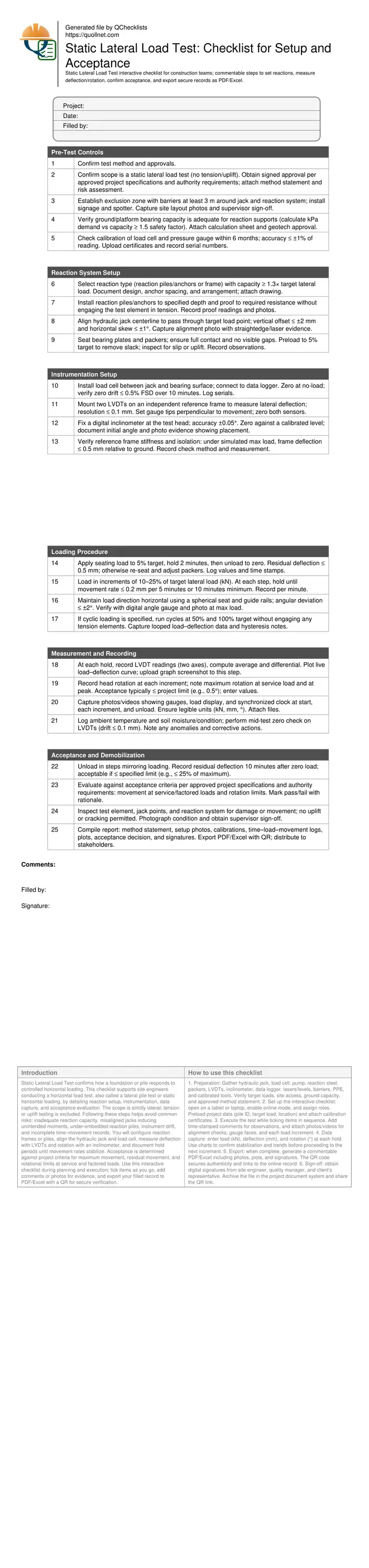
Pre-Test Controls
Reaction System Setup
Instrumentation Setup
Loading Procedure
Measurement and Recording
Acceptance and Demobilization
Build a Safe, Accurate Reaction System
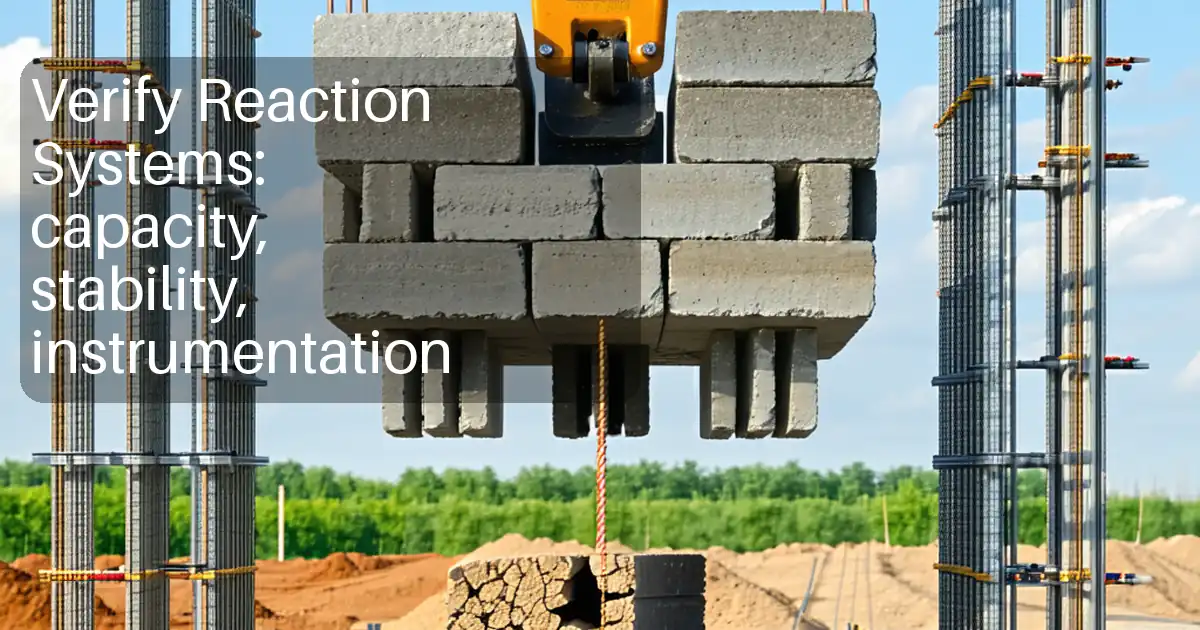
A reliable static lateral load test starts with a reaction system that can resist the full horizontal demand without introducing unintended vertical or torsional components. Choose reaction piles, ground anchors, or a steel frame with verified capacity at least 1.3 times the target load. Keep the load path clean: center the hydraulic jack so the force passes through the intended height on the test head, and use a spherical seat to prevent bending from misalignment. Preloading removes slack and seats packers. The datum/reference frame must be mechanically isolated from the reaction system and the test element, so its measurements reflect only the foundation’s movement. Confirm platform bearing and anchor installation quality, proof anchors where used, and document everything with calculations, layout photos, and serial numbers. Establish an exclusion zone and brief the crew, since stored energy in jacks and anchors poses significant risk if components slip or fail. These controls reduce error, protect people, and produce trustworthy data.
- Reaction capacity ≥ 1.3× target horizontal load.
- Align jack centerline; skew ≤ ±1°, offset ≤ ±2 mm.
- Independent datum frame deflection ≤ 0.5 mm.
- Preload to seat packers and remove slack.
- Maintain a 3 m exclusion zone with a spotter.
Instrumentation and Stabilization for Deflection and Rotation
Measurement quality depends on calibrated devices and stabilization criteria. Use a load cell with known accuracy (≤ ±1%), LVDTs with ≤ 0.1 mm resolution, and a digital inclinometer at ±0.05° accuracy. Mount two LVDTs orthogonally on an independent frame to detect lateral movement and any out-of-axis drift. Zero instruments before loading, conduct a mid-test drift check, and record ambient conditions. Apply loads in clearly defined increments (10–25% of target), holding at each level until rates of movement fall below an agreed threshold or a minimum duration passes. This ensures you are capturing near-fully mobilized soil–structure response rather than transient seating. Photographs or videos at each step must show gauge faces and a synchronized clock to support time-based analysis. Continuous plotting of load versus deflection highlights nonlinearity, stiffness degradation, and potential failure points before they become unsafe.
- Calibrations within 6 months; certificates uploaded.
- LVDT resolution ≤ 0.1 mm; inclinometer ±0.05°.
- Hold until movement rate ≤ 0.2 mm/5 min.
- Log readings per minute with time stamps.
- Photo evidence at every increment and unload.
Acceptance, Reporting, and Excluding Tension
Acceptance is judged against project-specific criteria: maximum lateral deflection at service and factored loads, residual movement after unloading, and rotation limits at the test head. Because this procedure excludes tension, ensure the reaction design and execution do not engage uplift elements in the test element or introduce vertical components. After unloading, wait and recheck residual deflection to capture elastic rebound. Assemble a comprehensive package: method statement, setup verification, calibrations, time histories, load–deflection plots, rotation logs, ambient conditions, and photographs. Clearly mark pass/fail with references to the approved specifications and authority requirements, and obtain digital signatures. Export the result set to PDF/Excel with a QR for traceability. Good data stewardship makes later audits and design verifications straightforward and defensible.
- Assess movement at service and factored loads.
- Residual deflection typically ≤ 25% of maximum.
- No uplift components; lateral loading only.
- Reference approved specifications for acceptance.
- Export signed report with QR verification.
How to Use This Checklist for a Static Lateral Load Test
- Preparation: Gather hydraulic jack, load cell, pump, reaction steel, packers, LVDTs, inclinometer, data logger, lasers/levels, barriers, PPE, and calibrated tools. Verify target loads, site access, ground capacity, and approved method statement.
- Set up the interactive checklist: open on a tablet or laptop, enable online mode, and assign roles. Preload project data (pile ID, target load, location) and attach calibration certificates.
- Execute the test while ticking items in sequence. Add time-stamped comments for observations, and attach photos/videos for alignment checks, gauge faces, and each load increment.
- Data capture: enter load (kN), deflection (mm), and rotation (°) at each hold. Use charts to confirm stabilization and trends before proceeding to the next increment.
- Export: when complete, generate a commentable PDF/Excel including photos, plots, and signatures. The QR code secures authenticity and links to the online record.
- Sign-off: obtain digital signatures from site engineer, quality manager, and client’s representative. Archive the file in the project document system and share the QR link.
Call to Action
- Start Checklist Tick off tasks, leave comments on items or the whole form, and export your completed report to PDF or Excel—with a built-in QR code for authenticity.
- Download Excel - Static Lateral Load Test
- Download PDF - Static Lateral Load Test
- View Image - Static Lateral Load Test
Cite & Embed
“Static Lateral Load Test by Quollnet”
with a link to
this source page.

FAQ
Question: What is the difference between a static lateral load test and a tension test?
Question: What instruments are required to measure deflection and rotation accurately?
Question: How are load increments and hold times selected for lateral testing?
Question: What acceptance criteria are commonly applied to lateral load tests?
Question: How do I ensure the reaction system does not introduce unintended tension?
Related Articles
Broader reading and guidance connected to this checklist topic.


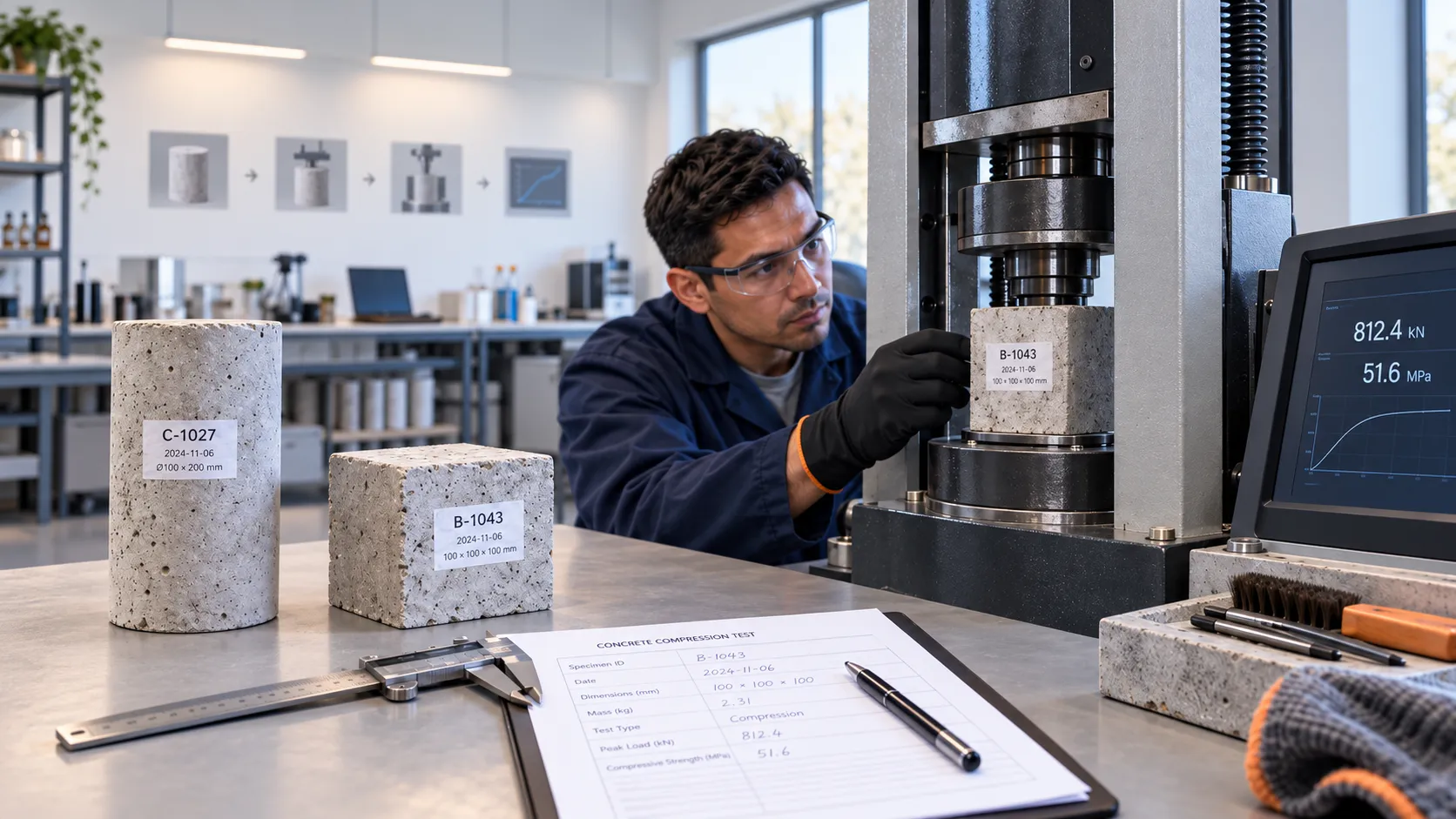
How To Perform a Concrete Compressive Strength Test: Cubes & Cylinders

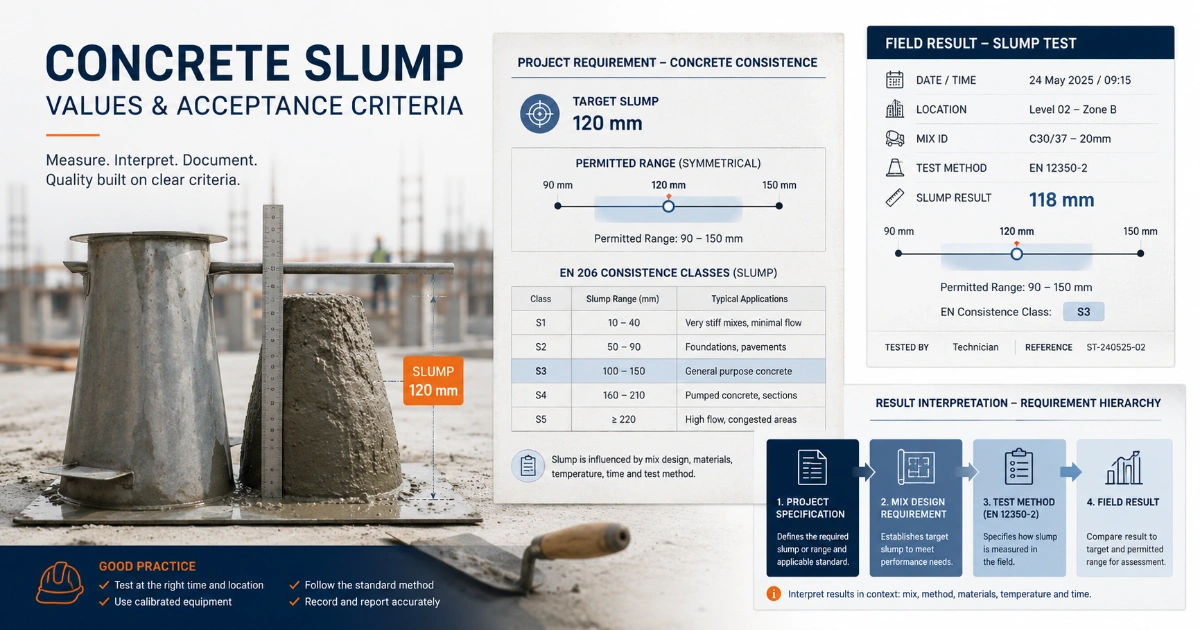
Concrete Compressive Strength Acceptance Criteria: Aci 318-25 Vs En 206
Related Checklists
Keep the workflow moving with nearby templates chosen from similar checklist content.