Staged Excavation Under Retention Checklist
Definition: Staged Excavation Under Retention checklist for contractors and inspectors ensures sequenced excavation, intermediate supports, monitoring updates, and hold points for retained digs, explicitly excluding any mass grading activities.
- Confirms excavation sequence, stage boundaries, and mandatory hold points.
- Verifies struts, walers, or anchors installed and preloaded to design.
- Updates survey and instrumentation readings against trigger thresholds.
- Interactive, commentable, export ready; authenticate records via QR code.
Staged Excavation Under Retention is the controlled, sequenced removal of soil behind a temporary works system while maintaining stability. This checklist supports retained excavation operations, including props, walers, struts, and anchors, focusing on excavation staging, monitoring updates, and formal hold points. It excludes mass grading and broad earthworks. By confirming the sequence and installing intermediate supports at defined depths, teams maintain performance of the retention system, limit wall movement, and reduce risks such as collapse, base heave, and service strikes. The checklist aligns supervision, survey, and monitoring teams on trigger levels, preload requirements, tolerances, and documentary evidence. Acceptance cues—such as RLs within tolerance, preload within ±5%, and verified clearances—provide objective go/no‑go criteria before work advances. Use this tool to coordinate daily briefings, inspection test plans, and sign-offs with the engineer, keeping records organized and traceable. Start in interactive mode to tick items, add comments, and export PDF/Excel with a QR-secured audit trail.
- Coordinate sequenced excavation beneath temporary retention with defined stage limits, hold points, and verified intermediate supports. This checklist provides practical tolerances, evidence requirements, and sign-off flow so teams can proceed safely while controlling wall movements and groundwater during each controlled dig stage.
- Integrate survey and instrumentation updates at each stage to track deflection, pore pressure, and excavation level against trigger thresholds. Document preloads, torque, calibrations, and baseline readings to create a defensible record for engineers, clients, and authorities without slowing production on constrained sites.
- Interactive online checklist with tick, comment, and export features secured by QR code.
Pre-Excavation Controls
Sequence and Hold Points
Intermediate Supports Installation
Monitoring and Survey
Excavation Stage Execution
Sequencing Under Retention and Clear Stage Boundaries
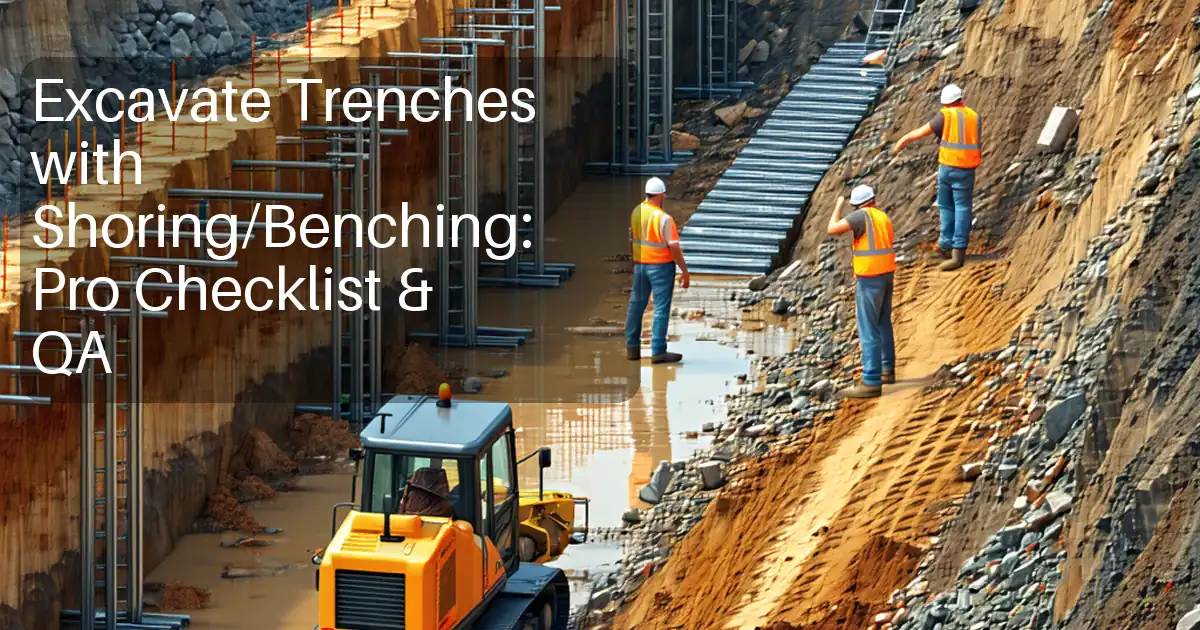
Sequenced excavation under retention depends on disciplined depth increments, reliable set-out, and formal hold points before proceeding. Crews must treat each stage as its own operation: excavate in thin passes, verify reduced level (RL), and obtain approvals before advancing. This approach limits wall movement, reduces basal instability risk, and avoids damaging utilities or undermining adjacent assets. Align your team on the latest temporary works drawings and ITPs; superseded data is a frequent root cause of nonconformances. Clear stage boundaries, marked at 5 m intervals with coordinate tags, keep machines within the dig envelope and away from walers and anchors. Plant access routes must be planned to prevent impact loads on supports. Acceptance cues include RL within ±20 mm, benches within tolerance, and hold-point sign-offs in sequence. Evidence is crucial: combine survey extracts, geotagged photos, and digital approvals for a defensible record and efficient audits.
- Treat each stage as a standalone, approved operation.
- Confirm latest drawings and ITPs before soil removal.
- Mark stage limits and access routes clearly.
- Verify RLs within ±20 mm at hold points.
- Capture photos and survey files for evidence.
Intermediate Supports: Walers, Struts, and Anchors
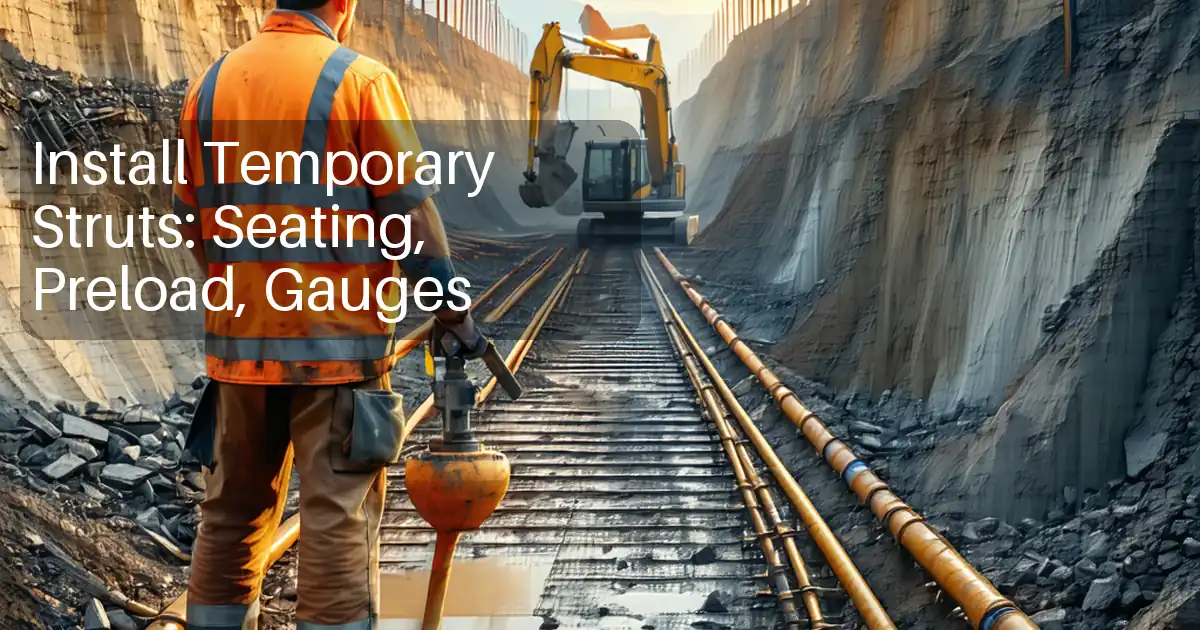
Intermediate supports sustain the retained excavation as depth increases. Walers must be level and aligned; struts need correct bay spacing and preload; anchors require proof testing and creep checks. Use calibrated tools and record serial numbers to validate results. Preloading struts to the design load ±5% reduces initial deflection when the next soil layer is removed. Bolted or pinned connections should be torqued to specification with a calibrated wrench, and hydraulic gauges photographed at peak and locked values. Where anchors are used, follow the anchor schedule precisely, documenting grout batches and test curves. Physical protection—scaffold fans or bumpers—prevents plant contact with supports. Only proceed to the next stage when all support criteria pass and the engineer clears the hold point.
- Level walers within ±5 mm before locking.
- Preload struts to design load ±5%.
- Proof-test anchors and check creep limits.
- Torque-check connections with calibrated tools.
- Protect supports from plant contact.
Monitoring, Triggers, and Responsive Actions
Monitoring converts risk into measurable trends. Establish targets and baseline readings before digging. During each stage, capture wall deflection, strut loads, and groundwater levels. Compare results with design trigger bands: green indicates proceed, amber requires review and mitigation, and red demands stop-work and engineer direction. Survey RLs at hold points and reconcile against the model. When triggers are exceeded, typical responses include increasing strut preload, installing additional props, adjusting excavation sequence, or pausing to allow pore pressure to stabilize. Always log actions, time, and personnel. Data integrity matters: maintain instrument calibration certificates and keep raw files with timestamps. Consistent, verifiable monitoring enables safe advancement while preserving the performance of the retention system.
- Baseline instruments before any excavation.
- Use green/amber/red trigger bands.
- Record readings and actions daily.
- Retain calibration and raw data files.
- Stop and escalate on red triggers.
How to Use This Staged Excavation Under Retention Checklist
- Preparation: assemble staging plan, temporary works drawings, ITPs, calibrated gauges, laser levels, total station, measuring tapes, pumps, and PPE; brief team on sequence, supports, triggers, and hold points.
- Project setup: create a checklist instance per stage, assign roles (supervisor, surveyor, temporary works engineer), and preload drawing revisions and reference RLs.
- Start interactive mode: tick items as completed, attach geotagged photos, upload survey extracts, instrument logs, and calibration certificates.
- Comment in context: use the commentable fields to flag nonconformances, propose corrective actions, and request engineer decisions at hold points.
- Monitor progress: update readings at defined frequencies, classify triggers, and document applied mitigations before proceeding to the next stage.
- Export and sign: generate PDF/Excel with embedded evidence; obtain digital signatures from supervisor, surveyor, and engineer.
- Archive and share: store the signed pack; distribute via QR-authenticated link to client and authorities.

Call to Action
- Start Checklist Tick off tasks, leave comments on items or the whole form, and export your completed report to PDF or Excel—with a built-in QR code for authenticity.
- Download Excel - Staged Excavation Under Retention
- Download PDF - Staged Excavation Under Retention
- View Image - Staged Excavation Under Retention
Cite & Embed
“Staged Excavation Under Retention by Quollnet”
with a link to
this source page.
FAQ
Question: What is the difference between staged excavation under retention and mass grading?
Question: How often should I take monitoring readings during staged excavation?
Question: What actions are required if trigger levels are exceeded?
Question: Which evidence is essential at each hold point sign-off?
Related Articles
Broader reading and guidance connected to this checklist topic.


What Is Construction Defect Liability Period - Dlp

Retention In Construction: Formulas, Bonds & Accounting Guide

Related Checklists
Keep the workflow moving with nearby templates chosen from similar checklist content.