Control Polymer Slurry: Viscosity, Density, Contamination
Definition: Control polymer slurry for deep foundation work with a field-ready checklist guiding viscosity, density, contamination, and recyclability assessments for engineers, inspectors, and foremen.
- Verify viscosity and density using calibrated field instruments and logs.
- Detect contamination via turbidity, pH, hydrocarbons, and suspended solids tests.
- Prove recyclability using settling, shear-recovery, and reactivation trials.
- Interactive, commentable, export, QR code for secure jobsite records.
Control polymer slurry is critical to maintaining excavation stability and concrete quality in bored piles, CFA shafts, and diaphragm walls. This checklist focuses on polymer support fluid, also called polymer drilling slurry or polymer-based drilling fluid, and establishes practical field controls for viscosity, density, contamination, and recyclability. It excludes bentonite controls, sand content checks, and gel-strength procedures. Using calibrated instruments and repeatable methods, crews can quickly detect fines loading, cement ingress, hydrocarbons, or saline groundwater effects before they jeopardize stability or cover fresh concrete. The result is fewer stoppages, consistent cut-off levels, and lower waste-handling costs through verified reuse. Each step specifies tools, acceptance cues per approved project specifications and authority requirements, and the evidence to capture for traceability. Use this interactive checklist to tick tasks, add comments, attach photos, and export PDF/Excel with a QR-secured audit trail.
- Establish a repeatable field regime for polymer slurry control, focusing on viscosity, density, pH, temperature, turbidity, and suspended solids. Clear acceptance cues and evidence capture reduce uncertainty, delays, and rework while aligning with approved project specifications and authority requirements.
- Prevent defects by detecting contamination early: monitor groundwater fines, concrete/cement ingress, hydrocarbons, and salts. Practical thresholds, methods, and escalation steps help crews isolate tanks, adjust dosing, or segregate waste before it affects excavation stability or fresh concrete quality.
- Extend slurry life responsibly through recyclability checks, including settling observations, shear-recovery assessments, and controlled reactivation trials. Document dosage, mixing energy, and results so reuse decisions are transparent, defensible, and environmentally sound under the project’s environmental management plan.
- Interactive online checklist with tick, comment, and export features secured by QR code. Field teams collect photos, instrument calibrations, and signatures, then export to PDF/Excel for daily reports, quality records, and rapid stakeholder reviews without duplicating data entry.
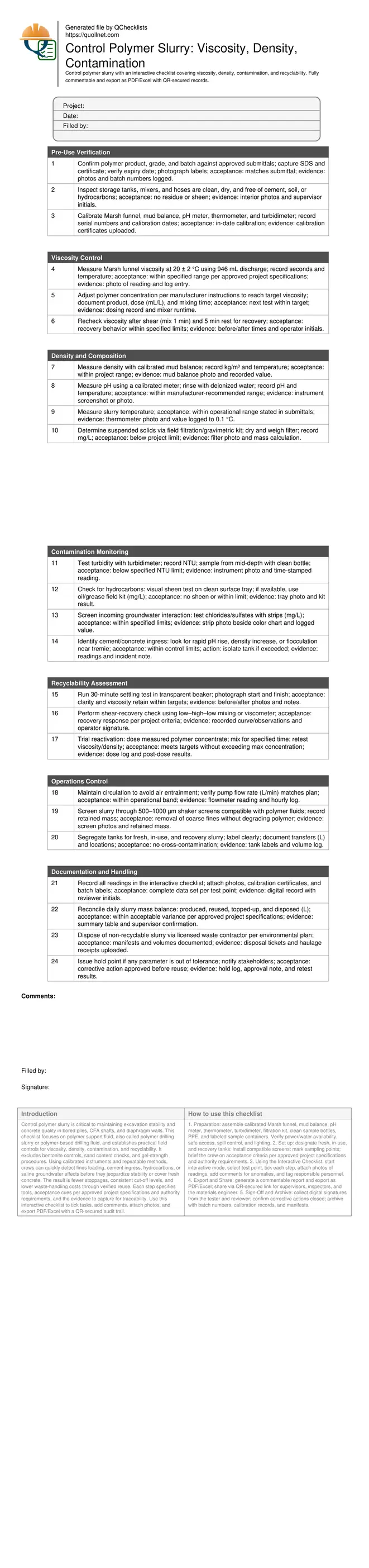
Pre-Use Verification
Viscosity Control
Density and Composition
Contamination Monitoring
Recyclability Assessment
Operations Control
Documentation and Handling
Field Measurements That Keep Polymer Slurry Within Control
A robust field routine focuses on the few parameters that drive performance: viscosity, density, pH, temperature, turbidity, and suspended solids. Viscosity sets carrying capacity and filterability; measure with a calibrated Marsh funnel at controlled temperature and observe recovery after shear. Density in kg/m³ highlights fines loading or concrete ingress; cross-check with pH and turbidity to distinguish causes. Turbidity and gravimetric suspended solids track clarity and recyclability. Use clean bottles and mid-depth sampling to avoid surface films or settled sediments. Temperature affects viscosity and instrument readings; always log it alongside each test. Acceptability thresholds must align with the polymer manufacturer’s guidance and per approved project specifications and authority requirements. On real sites, crews photograph instrument displays, note serial numbers, and add initials to lock traceability. When two parameters drift together—such as density and turbidity—investigate upstream screens, excavation technique, or water source before resuming excavation or tremie operations.
- Record temperature with every viscosity and density test.
- Calibrate instruments and capture certificates before operations.
- Sample from mid-depth using clean bottles and procedures.
- Verify acceptance against approved project specifications.
- Attach photos of readings for auditability.
Detecting and Managing Contamination Before It Spreads
Common contamination sources include groundwater fines, cement or grout ingress near tremie starts, hydrocarbon residues from equipment, and dissolved salts. Visual checks alone are insufficient; quantify turbidity (NTU), suspended solids (mg/L), and pH trends. A sudden density jump with pH rise suggests cement contamination; isolate the affected tank, stop recirculation to clean tanks, and retest before reuse. Hydrocarbon sheen requires removing the source, skimming, and verifying with a field kit. For saline intrusion, assess chloride/sulfate levels and consult the polymer supplier on compatibility. Maintain separate tanks for fresh, in-use, and recovery slurry to prevent cross-contamination. Screens sized for polymer fluids remove coarse fines without stripping polymer chains. Document all anomalies with time-stamped photos and immediate notifications so supervisors can authorize corrective actions per approved project specifications and authority requirements.
- Isolate contaminated tanks immediately and retest.
- Use NTU and mg/L, not visual estimates alone.
- Adjust screens to match polymer, not bentonite.
- Record source, action, and retest outcomes.
- Notify stakeholders before reuse decisions.
Proving Recyclability with Simple, Defensible Field Tests
Recyclability depends on whether the slurry can regain target properties without excessive dosing. Start with a 30-minute settling observation for clarity and fines behavior, then perform shear-recovery checks to confirm thixotropic response. If viscosity under-recovers, trial a small, recorded dose of compatible polymer concentrate and remeasure. Compare the final viscosity, density, turbidity, and suspended solids against acceptance criteria. Avoid aggressive desanders meant for clay systems; polymer fluids respond better to gentle screening and controlled dilution. When repeated dosing cannot restore targets, or when contamination indicators remain high, designate the batch for disposal through licensed contractors under the project’s environmental plan. Recording doses, mixing energy, and results allows transparent, defensible decisions and supports cost forecasting for future shifts.
- Use settling, shear, and reactivation trials together.
- Dose incrementally; record mL/L and mix time.
- Prefer screening and dilution over heavy desanding.
- Dispose when restoration fails project criteria.
- Keep a recyclability log for each tank.
How to Use This Polymer Slurry Control Checklist
- Preparation: assemble calibrated Marsh funnel, mud balance, pH meter, thermometer, turbidimeter, filtration kit, clean sample bottles, PPE, and labeled sample containers. Verify power/water availability, safe access, spill control, and lighting.
- Set up: designate fresh, in-use, and recovery tanks; install compatible screens; mark sampling points; brief the crew on acceptance criteria per approved project specifications and authority requirements.
- Using the Interactive Checklist: start interactive mode, select test point, tick each step, attach photos of readings, add comments for anomalies, and tag responsible personnel.
- Export and Share: generate a commentable report and export as PDF/Excel; share via QR-secured link for supervisors, inspectors, and the materials engineer.
- Sign-Off and Archive: collect digital signatures from the tester and reviewer; confirm corrective actions closed; archive with batch numbers, calibration records, and manifests.
Call to Action
- Start Checklist Tick off tasks, leave comments on items or the whole form, and export your completed report to PDF or Excel—with a built-in QR code for authenticity.
- Download Excel - Polymer Slurry Control Checklist
- Download PDF - Polymer Slurry Control Checklist
- View Image - Polymer Slurry Control Checklist
Cite & Embed
“Polymer Slurry Control Checklist by Quollnet”
with a link to
this source page.
FAQ
Question: Which instruments should I use to measure polymer slurry viscosity and density?
Question: How often should polymer slurry be tested during operations?
Question: How do I decide if polymer slurry is still recyclable?
Question: Can I apply bentonite control methods with polymer slurry?
Question: What records should I keep for quality and traceability?
Related Articles
Broader reading and guidance connected to this checklist topic.



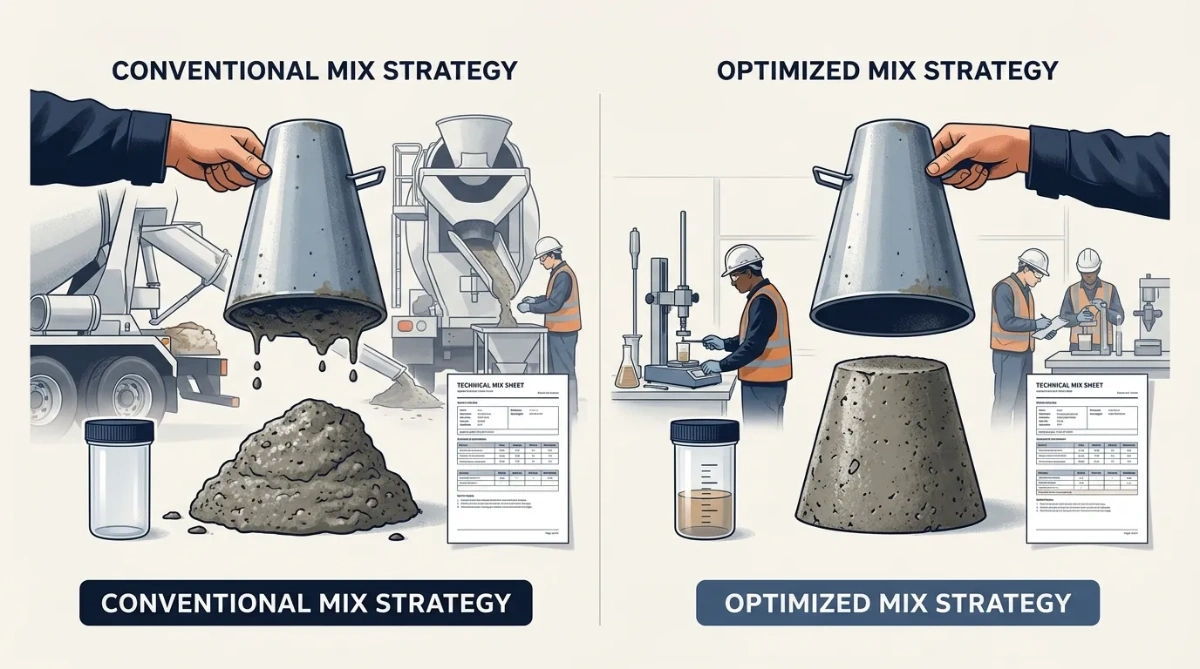
Plasticizers And Superplasticizers: How They Affect Concrete Slump
Related Checklists
Keep the workflow moving with nearby templates chosen from similar checklist content.