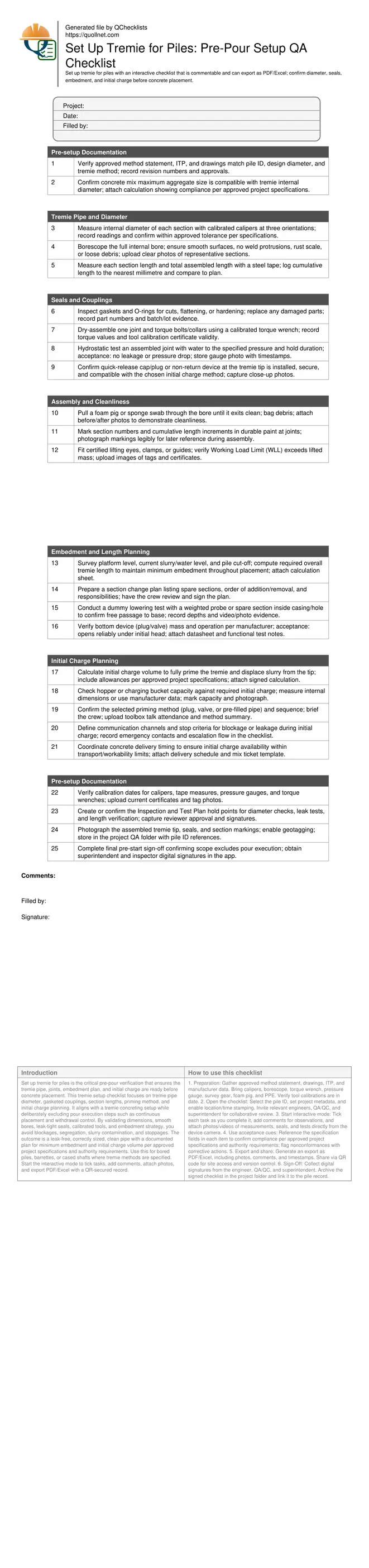
Set Up Tremie for Piles – Pre-Pour Setup QA Checklist
Definition: Set up tremie for piles is a focused pre-pour setup checklist for site engineers, covering pipe diameter, seals, embedment planning, and initial charge verification before concrete placement.
- Confirm approved tremie diameter against mix and aggregate limits.
- Leak-test couplings and seals before lifting into position.
- Plan embedded length and initial charge volume with records.
- Interactive, commentable, export options with QR code traceability.
Set up tremie for piles is the critical pre-pour verification that ensures the tremie pipe, joints, embedment plan, and initial charge are ready before concrete placement. This tremie setup checklist focuses on tremie pipe diameter, gasketed couplings, section lengths, priming method, and initial charge planning. It aligns with a tremie concreting setup while deliberately excluding pour execution steps such as continuous placement and withdrawal control. By validating dimensions, smooth bores, leak-tight seals, calibrated tools, and embedment strategy, you avoid blockages, segregation, slurry contamination, and stoppages. The outcome is a leak-free, correctly sized, clean pipe with a documented plan for minimum embedment and initial charge volume per approved project specifications and authority requirements. Use this for bored piles, barrettes, or cased shafts where tremie methods are specified. Start the interactive mode to tick tasks, add comments, attach photos, and export PDF/Excel with a QR-secured record.
- This checklist de-risks tremie concreting by confirming internal diameter suitability, smoothness, and cleanliness, then validating couplings, gaskets, and torque. It prevents leaks and blockages before any concrete is introduced into the pile.
- Embedment is planned using surveyed levels and section lengths to maintain minimum submergence beneath slurry. The method ensures the tremie reaches base elevation and stays embedded without relying on ad-hoc adjustments during placement.
- Initial charge calculations are documented to fully prime the tremie and displace slurry or water, with capacity checks on the hopper and compatible bottom devices. Crew roles, stop criteria, and calibration records are captured for accountability.
- Interactive online checklist with tick, comment, and export features secured by QR code.
Pre-setup Documentation
Tremie Pipe and Diameter
Seals and Couplings
Assembly and Cleanliness
Embedment and Length Planning
Initial Charge Planning
Pre-setup Documentation
Right-Sized, Clean Tremie Pipes Prevent Blockages
Choosing and verifying the correct tremie internal diameter is the foundation of reliable pile concreting. The ID must be compatible with the approved concrete mix and largest aggregate, and the bore must be free of internal defects that snag flow or trap slurry. Measure internal diameter at multiple orientations to catch ovality, then borescope the entire length for weld beads, rough patches, rust scale, or debris. A clean, smooth pipe reduces segregation risk and lowers the hydraulic head required to maintain continuous flow later. Marking section numbers and cumulative lengths simplifies rapid changes during operations without losing embedment. Finally, ensure the total assembled length can reach the pile base and accommodate the platform level and hopper elevation. Documenting these checks creates a traceable quality record before any concrete arrives on site.
- Measure ID with calibrated tools and record three orientations.
- Borescope for smoothness; remove rust scale and debris.
- Mark section numbers and cumulative lengths clearly.
- Confirm total length reaches base from platform level.
- Upload photos and measurement logs for traceability.
Leak-Tight Joints with Verified Seals and Torque
Leaks at couplings can entrain slurry and dilute the concrete during the initial charge, so seals and joints demand rigorous attention. Inspect gaskets for cuts, flattening, or aging, and replace questionable parts; record part numbers. Dry-assemble a representative joint and torque bolts or collars with a calibrated wrench, logging values against the specification. Hydrostatic testing with water validates both gasket seating and mechanical tightness—hold pressure for the required duration and photograph gauges with timestamps. Confirm the tip device—plug, cap, or non-return valve—is compatible with the chosen priming method and operates as intended. Keep tool calibrations current and attached to the record; a compliant joint today avoids costly remedial works later.
- Inspect gaskets; replace damaged or aged seals.
- Torque joints with calibrated tools; log values.
- Hydrostatic test joints; no seepage or pressure loss.
- Verify tip device suits the priming method.
- Attach calibration certificates and photos.
Embedment and Initial Charge Planning Before Pour
Proper embedment planning ensures the tremie tip stays submerged beneath the fresh concrete until continuous flow is established. Survey platform, cut-off, and current slurry levels, then compute the required assembled length and a section change plan so embedment is maintained throughout. Run a dummy lowering test to confirm the path is unobstructed. Calculate the initial charge volume to prime the pipe and fully displace slurry at the tip; check that hopper capacity and elevation can deliver the necessary head. Brief the team on the priming sequence, communication, and stop criteria for leaks or blockages. This stage ends with documentation: calculations, toolbox talk records, delivery timing, and final sign-off—leaving execution steps for placement crews.
- Survey levels; plan assembled length for embedment.
- Dummy test confirms unobstructed descent to base.
- Calculate initial charge and verify hopper capacity.
- Brief crew on sequence and stop criteria.
- Complete sign-off; exclude pour execution.
How to Use This Interactive Tremie Setup Checklist
- Preparation: Gather approved method statement, drawings, ITP, and manufacturer data. Bring calipers, borescope, torque wrench, pressure gauge, survey gear, foam pig, and PPE. Verify tool calibrations are in date.
- Open the checklist: Select the pile ID, set project metadata, and enable location/time stamping. Invite relevant engineers, QA/QC, and superintendent for collaborative review.
- Start interactive mode: Tick each task as you complete it, add comments for observations, and attach photos/videos of measurements, seals, and tests directly from the device camera.
- Use acceptance cues: Reference the specification fields in each item to confirm compliance per approved project specifications and authority requirements; flag nonconformances with corrective actions.
- Export and share: Generate an export as PDF/Excel, including photos, comments, and timestamps. Share via QR code for site access and version control.
- Sign-Off: Collect digital signatures from the engineer, QA/QC, and superintendent. Archive the signed checklist in the project folder and link it to the pile record.
Call to Action
- Start Checklist Tick off tasks, leave comments on items or the whole form, and export your completed report to PDF or Excel—with a built-in QR code for authenticity.
- Download Excel - Tremie Setup for Pile Concreting
- Download PDF - Tremie Setup for Pile Concreting
- View Image - Tremie Setup for Pile Concreting
Cite & Embed
“Tremie Setup for Pile Concreting by Quollnet”
with a link to
this source page.

FAQ
Question: How do I choose the correct tremie diameter for a given concrete mix?
Question: What’s the best way to verify tremie joint seals before use?
Question: How do I plan tremie embedment without covering the actual pour?
Question: What is the initial charge and how is it determined?
Question: Does this checklist include tremie pour execution steps?
Related Articles
Broader reading and guidance connected to this checklist topic.

How To Specify Concrete Slump For Slabs, Beams, Columns And Walls


How To Create Your First Sang In 4 Easy Steps
Related Checklists
Keep the workflow moving with nearby templates chosen from similar checklist content.