Re-grout pile shafts/micropiles: pressure, volume, lock-off
Definition: Re-grout pile shafts/micropiles is a practical checklist for contractors and inspectors to control staged shaft regrouting pressures, volumes, lock-off, and acceptance, explicitly excluding base grouting.
- Define stages, pressure limits, and target volumes before pumping.
- Monitor rate, returns, and hold periods to avoid damage and voids.
- Lock-off correctly and document acceptance per approved project specifications.
- Interactive, commentable, export, QR code for secure field records.
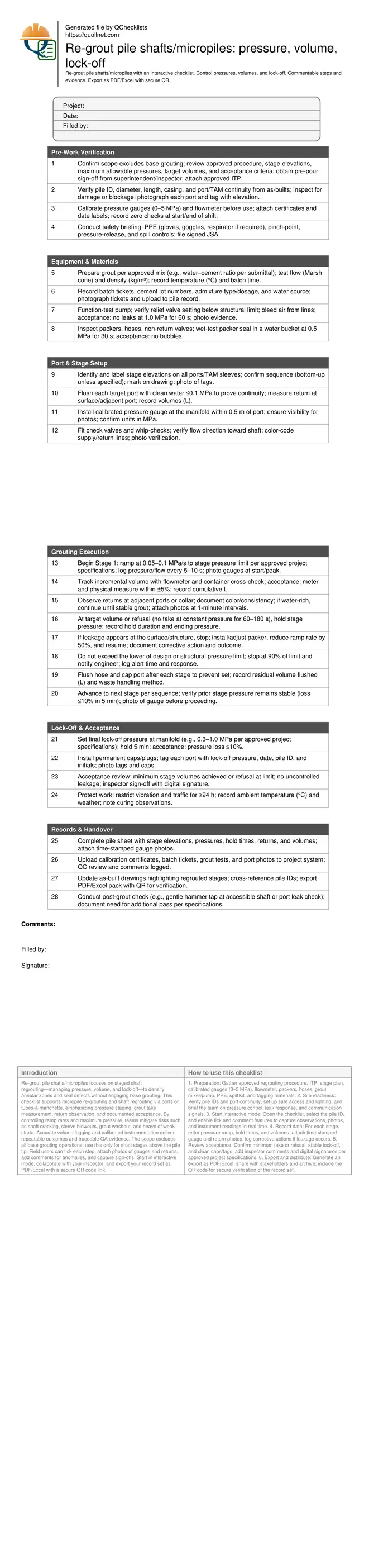
Re-grout pile shafts/micropiles focuses on staged shaft regrouting—managing pressure, volume, and lock-off—to densify annular zones and seal defects without engaging base grouting. This checklist supports micropile re-grouting and shaft regrouting via ports or tubes-à-manchette, emphasizing pressure staging, grout take measurement, return observation, and documented acceptance. By controlling ramp rates and maximum pressure, teams mitigate risks such as shaft cracking, sleeve blowouts, grout washout, and heave of weak strata. Accurate volume logging and calibrated instrumentation deliver repeatable outcomes and traceable QA evidence. The scope excludes all base grouting operations; use this only for shaft stages above the pile tip. Field users can tick each step, attach photos of gauges and returns, add comments for anomalies, and capture sign-offs. Start in interactive mode, collaborate with your inspector, and export your record set as PDF/Excel with a secure QR code link.
- Plan and execute staged shaft regrouting with calibrated gauges, controlled pressure ramps, and measured grout takes. The checklist helps avoid overpressure, leakage, and insufficient penetration while capturing hold periods and return behavior.
- Define elevation-based stages and sequence from lower ports upward or as specified. Log pressure versus time, incremental volumes, temperature, mix properties, and photographs of return grout to substantiate acceptance criteria for each stage.
- Set and verify lock-off pressure at the manifold, tag and cap valves, and document stabilization. Records include batch tickets, instrument calibrations, inspector approvals, and as-built updates for defensible quality assurance and future audits.
- Interactive online checklist with tick, comment, and export features secured by QR code.
Pre-Work Verification
Equipment & Materials
Port & Stage Setup
Grouting Execution
Lock-Off & Acceptance
Records & Handover
Control Stage Pressures and Volumes for Effective Shaft Regrouting
Shaft regrouting relies on disciplined pressure and volume control to fill annular defects without overstressing the pile or surrounding ground. Establish discrete stages by elevation and proceed bottom-up unless the engineer specifies otherwise. Ramp pressure gradually (0.05–0.1 MPa/s) to the allowable limit while tracking flow and incremental grout take. Watch return behavior: early water-rich returns usually stabilize as grout penetrates fissures. Refusal can be defined as negligible take at a steady pressure for a defined hold period. Avoid chasing excessive volumes; compare against expected take ranges and stop if abnormal. Use calibrated gauges near the manifold and validate flowmeter readings against container measurements to maintain accuracy. Document each stage with time-stamped photos of gauges and returns. This approach minimizes sleeve blowouts, casing uplift, and loss of ground, while ensuring uniform shaft improvement and verifiable quality.
- Define clear stage elevations and sequence before pumping.
- Ramp pressure slowly; do not exceed structural limits.
- Record volumes and cross-check meter versus container within ±5%.
- Observe and photograph returns to confirm stage behavior.
- Hold at refusal to verify stabilization before proceeding.
Lock-Off, Stabilization, and Practical Acceptance Cues
Lock-off consolidates gains from each stage and protects against backflow. After reaching target take or refusal, maintain the stage pressure for the specified hold duration to encourage grout set within fractures and sleeves. Set the final lock-off pressure at the manifold according to approved project specifications and authority requirements, typically within a defined band to balance sealing and structural safety. Monitor pressure decay over 5 minutes; a loss within a small threshold often indicates adequate sealing, while large drops suggest bypasses or leaks. Acceptance commonly combines minimum take, refusal at the allowed pressure, stable lock-off, and no uncontrolled leakage. Tag and cap the ports, then protect the area from vibration to avoid disturbance during early set. Thorough, consistent lock-off practice reduces rework and establishes a clear, defensible record for sign-off.
- Set lock-off within specified pressure band and hold time.
- Accept with minimum take or demonstrated refusal.
- Loss at lock-off should not exceed agreed threshold.
- Cap, tag, and protect from vibration post-grout.
Documentation, Traceability, and Field-Proven QA Practices
Traceability is essential for shaft regrouting acceptance and future audits. Build a complete pile packet: calibration certificates, batch tickets with cement lot numbers, mix properties, and real-time logs of pressure, flow, volume, and hold periods. Capture clear photos of gauges at key milestones (start, peak, hold, lock-off) and of return conditions. Maintain elevation-based stage logs to avoid confusion between ports. Cross-check flowmeter totals with physical measurements and reconcile against batched volumes. Use digital sign-offs for the foreman, inspector, and engineer where required. Finally, update as-built drawings with regrouted stages and archive all records in an accessible system. A consistent, well-documented process accelerates acceptance, supports change management, and helps diagnose anomalies should additional passes be requested.
- Keep elevation-based stage logs for every pile.
- Attach time-stamped photos of gauges and returns.
- Reconcile volumes: batched versus pumped within ±5%.
- Secure digital approvals and update as-builts.
How to use this re-grouting checklist effectively
- Preparation: Gather approved regrouting procedure, ITP, stage plan, calibrated gauges (0–5 MPa), flowmeter, packers, hoses, grout mixer/pump, PPE, spill kit, and tagging materials.
- Site readiness: Verify pile IDs and port continuity, set up safe access and lighting, and brief the team on pressure control, leak response, and communication signals.
- Start interactive mode: Open the checklist, select the pile ID, and enable tick and comment features to capture observations, photos, and instrument readings in real time.
- Record data: For each stage, enter pressure ramp, hold times, and volumes; attach time-stamped gauge and return photos; log corrective actions if leakage occurs.
- Review acceptance: Confirm minimum take or refusal, stable lock-off, and clean caps/tags; add inspector comments and digital signatures per approved project specifications.
- Export and distribute: Generate an export as PDF/Excel; share with stakeholders and archive; include the QR code for secure verification of the record set.
Call to Action
- Start Checklist Tick off tasks, leave comments on items or the whole form, and export your completed report to PDF or Excel—with a built-in QR code for authenticity.
- Download Excel - Micropile Shaft Re-grouting Checklist
- Download PDF - Micropile Shaft Re-grouting Checklist
- View Image - Micropile Shaft Re-grouting Checklist
Cite & Embed
“Micropile Shaft Re-grouting Checklist by Quollnet”
with a link to
this source page.

FAQ
Question: What is the difference between shaft regrouting and base grouting for micropiles?
Question: How should I select stage pressures and ramp rates?
Question: What defines refusal and acceptance during regrouting?
Question: How do I ensure accurate volume and pressure records?
Related Articles
Broader reading and guidance connected to this checklist topic.


Is It Important To Customize Your Qr Code And How To Do It?
Download Excel Format Snag List

Eot Claim Checklist | Free Extension Of Time Submission Guide
Related Checklists
Keep the workflow moving with nearby templates chosen from similar checklist content.