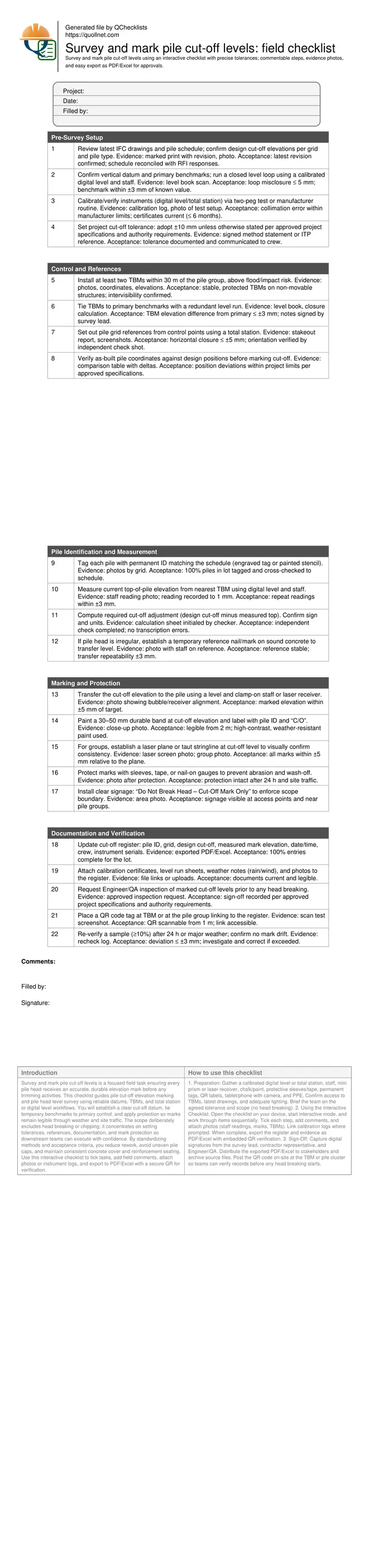
Survey and Mark Pile Cut-Off Levels Checklist
Definition: Survey and mark pile cut-off levels with defined tolerances, stable references, and durable protection controls for site engineers and surveyors, excluding head breaking and emphasizing accurate elevation documentation.
- Set practical tolerances and verify against stable datums and benchmarks.
- Measure pile head elevations with calibrated level or total station.
- Apply durable, weather-resistant cut-off marks and protect visibility.
- Interactive, commentable, export-ready checklist with QR code verification.
Survey and mark pile cut-off levels is a focused field task ensuring every pile head receives an accurate, durable elevation mark before any trimming activities. This checklist guides pile cut-off elevation marking and pile head level survey using reliable datums, TBMs, and total station or digital level workflows. You will establish a clear cut-off datum, tie temporary benchmarks to primary control, and apply protection so marks remain legible through weather and site traffic. The scope deliberately excludes head breaking or chipping; it concentrates on setting tolerances, references, documentation, and mark protection so downstream teams can execute with confidence. By standardizing methods and acceptance criteria, you reduce rework, avoid uneven pile caps, and maintain consistent concrete cover and reinforcement seating. Use this interactive checklist to tick tasks, add field comments, attach photos or instrument logs, and export to PDF/Excel with a secure QR for verification.
- Standardize how you establish vertical control: set a project cut-off tolerance, tie TBMs to known benchmarks, and confirm instrument calibration. This reduces measurement drift, ensures repeatable readings, and delivers reliable references for consistent pile cap formation without scope creep into head breaking.
- Improve visibility and durability of marks using bands, paint, and sleeves set with a level or laser plane. Clear labeling and weather-resistant protection prevent accidental loss of reference during subsequent reinforcement fixing, formwork, or concreting operations.
- Strengthen traceability with a complete cut-off register capturing pile IDs, design elevations, measured marks, instrument serials, photos, and approvals. Link documentation to QR codes at TBMs for quick field access, minimizing disputes and accelerating inspections.
- Interactive online checklist with tick, comment, and export features secured by QR code. Collaborators can capture readings, attach calibration certificates, and generate PDF/Excel deliverables for engineer sign-off, ensuring accountability and streamlined quality assurance on active sites.
Pre-Survey Setup
Control and References
Pile Identification and Measurement
Marking and Protection
Documentation and Verification
Establishing Reliable Datums and Practical Tolerances
Accurate pile cut-off marking starts with dependable vertical control. Tie temporary benchmarks to a known primary benchmark using a closed level loop; document misclosure and accept only small residuals. Calibrate the digital level or total station with a two-peg test before work and whenever the instrument is transported. Choose a realistic cut-off tolerance for the project—typically ±10 mm unless specified tighter—balancing constructability with structural needs. Record this tolerance in the method statement, and brief the crew so every reading and mark is validated against it. For congested sites, install at least two intervisible TBMs near each pile group, elevated above potential ponding and impact. This redundancy helps isolate errors and supports rapid rechecks after rain or vibration. With clear references and a documented tolerance, you can confidently transfer elevations, reduce rework, and give downstream teams a trustworthy datum for reinforcement placement and formwork setting.
- Tie TBMs to a primary benchmark with a closed loop.
- Calibrate instruments and document the two-peg test.
- Adopt and brief a practical ±10 mm tolerance.
- Use redundant, intervisible TBMs near each pile group.
- Record closure and acceptance in level books.
Durable Marking Methods and Protection
Transferring cut-off to the pile demands both precision and durability. Use a level with a clamp-on staff, mini prism, or a laser receiver to set the line, then paint a high-contrast band 30–50 mm wide at the exact elevation. For groups, a laser plane or taut stringline creates a visual cross-check to catch outliers instantly. Where pile heads are rough, set a small reference nail in sound concrete and transfer the elevation to the final band. Immediately protect marks with sleeves, tape, or nail-on gauges to survive rain, foot traffic, and reinforcement handling. Label every mark with pile ID and “C/O” for clarity. Crucially, this stage excludes head breaking; signage should make that boundary obvious. Robust, protected markings prevent confusion during subsequent works and keep your survey effort intact until inspection and sign-off.
- Set marks with level, prism, or laser receiver.
- Paint a clear, high-contrast band at cut-off.
- Use stringlines or laser planes for group consistency.
- Protect marks with sleeves or gauges immediately.
- Exclude head breaking; display clear signage.
Verification, Records, and Handover
Traceability underpins quality. Maintain a cut-off register that logs pile IDs, design elevations, measured mark elevations, instruments used, crews, dates, weather notes, and photos. Export to PDF/Excel for sharing and archive the native files for audits. Attach calibration certificates and level runs to support accuracy claims. Before any trimming starts, request inspection and obtain sign-off per approved project specifications and authority requirements. Add QR codes near TBMs or pile clusters to provide instant mobile access to records, reducing miscommunication and delays. Re-verify a sample of marks after 24 hours or after heavy rain; record any drift and correct immediately. This disciplined approach ensures the marks survive the realities of site work and that the entire team trusts the levels during pile cap construction.
- Maintain a complete, photo-backed cut-off register.
- Export deliverables to PDF/Excel for approvals.
- Attach calibration and level run evidence.
- Secure sign-off before any head breaking.
- Use QR codes for quick on-site access.
How to Use This Interactive Checklist
- Preparation: Gather a calibrated digital level or total station, staff, mini prism or laser receiver, chalk/paint, protective sleeves/tape, permanent tags, QR labels, tablet/phone with camera, and PPE. Confirm access to TBMs, latest drawings, and adequate lighting. Brief the team on the agreed tolerance and scope (no head breaking).
- Using the Interactive Checklist: Open the checklist on your device, start interactive mode, and work through items sequentially. Tick each step, add comments, and attach photos (staff readings, marks, TBMs). Link calibration logs where prompted. When complete, export the register and evidence as PDF/Excel with embedded QR verification.
- Sign-Off: Capture digital signatures from the survey lead, contractor representative, and Engineer/QA. Distribute the exported PDF/Excel to stakeholders and archive source files. Post the QR code on-site at the TBM or pile cluster so teams can verify records before any head breaking starts.
Call to Action
- Start Checklist Tick off tasks, leave comments on items or the whole form, and export your completed report to PDF or Excel—with a built-in QR code for authenticity.
- Download Excel - Pile Cut-Off Level Survey and Marking
- Download PDF - Pile Cut-Off Level Survey and Marking
- View Image - Pile Cut-Off Level Survey and Marking
Cite & Embed
“Pile Cut-Off Level Survey and Marking by Quollnet”
with a link to
this source page.
FAQ
Question: What tolerance should I use for pile cut-off marking?
Question: How do I protect cut-off marks from rain and site traffic?
Question: What if the pile top is below or above the design cut-off?
Question: Should I rely on GNSS for vertical control at piles?
Related Articles
Broader reading and guidance connected to this checklist topic.


How Bim Modeling Supports Prefabrication And Modular Construction

Master Construction Project Cashflow With Cashflowpot

How To Create Your First Sang In 4 Easy Steps
Related Checklists
Keep the workflow moving with nearby templates chosen from similar checklist content.