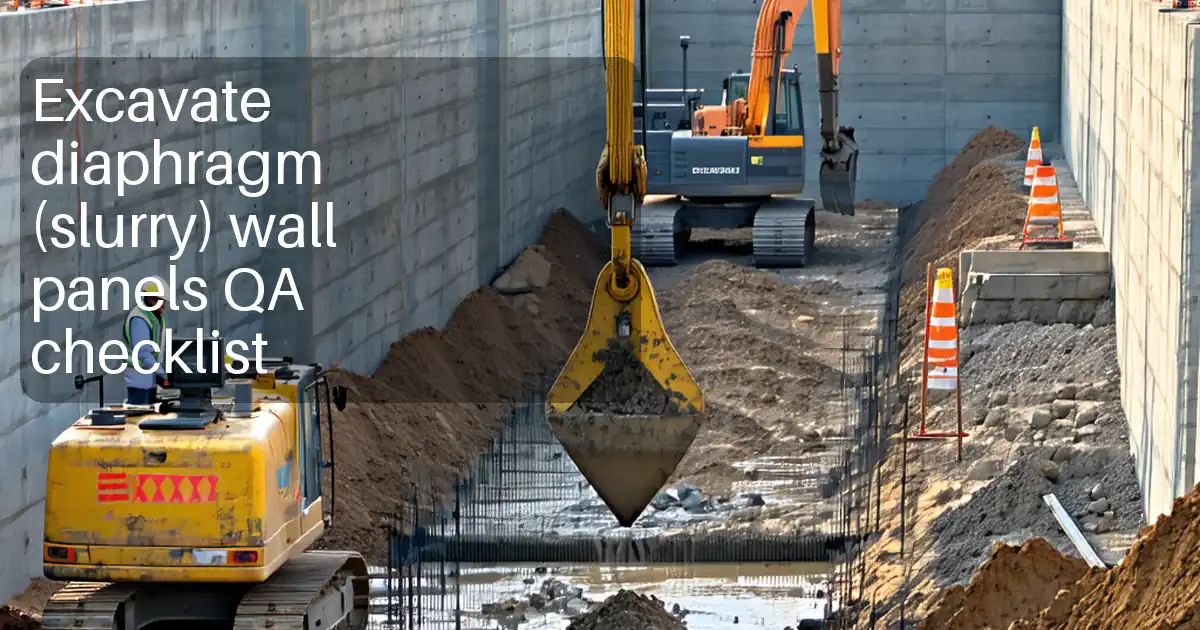
Control bentonite slurry: field tests and corrective actions
Definition: Control bentonite slurry in deep foundation operations by standardizing field tests for density, viscosity, sand content, pH, and filtrate loss, and documenting corrective actions without polymer additives.
- Why: maintain excavation stability and clean, uniform concrete interfaces.
- What: density, Marsh viscosity, sand content, pH, filtrate loss.
- How: standardized tools, calibrated kits, documented limits and corrective actions.
- Interactive, commentable, export to PDF/Excel with QR code verification.
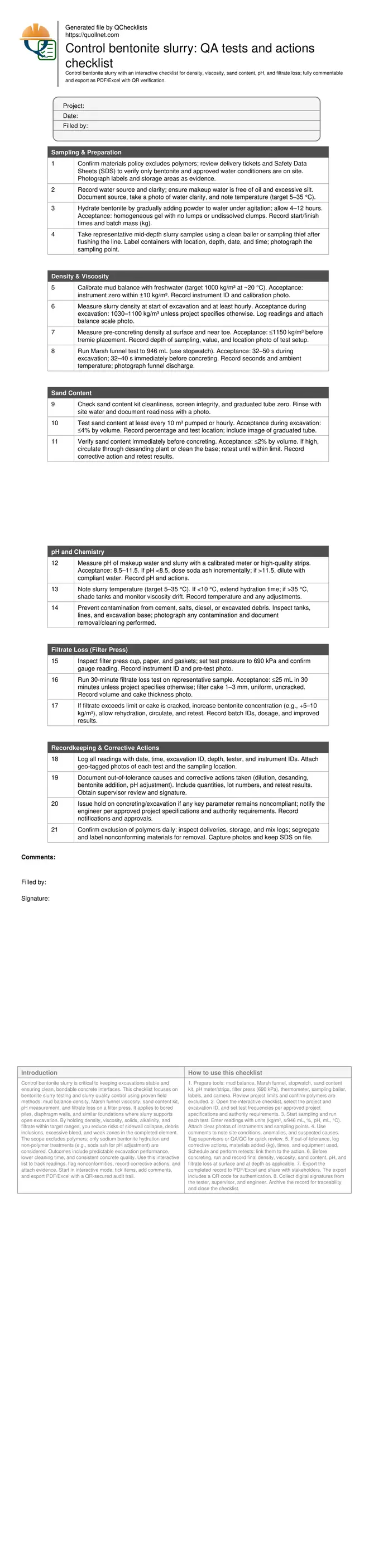
Control bentonite slurry is critical to keeping excavations stable and ensuring clean, bondable concrete interfaces. This checklist focuses on bentonite slurry testing and slurry quality control using proven field methods: mud balance density, Marsh funnel viscosity, sand content kit, pH measurement, and filtrate loss on a filter press. It applies to bored piles, diaphragm walls, and similar foundations where slurry supports open excavation. By holding density, viscosity, solids, alkalinity, and filtrate within target ranges, you reduce risks of sidewall collapse, debris inclusions, excessive bleed, and weak zones in the completed element. The scope excludes polymers; only sodium bentonite hydration and non-polymer treatments (e.g., soda ash for pH adjustment) are considered. Outcomes include predictable excavation performance, lower cleaning time, and consistent concrete quality. Use this interactive list to track readings, flag nonconformities, record corrective actions, and attach evidence. Start in interactive mode, tick items, add comments, and export PDF/Excel with a QR-secured audit trail.
- Practical, field-ready controls for bentonite slurry quality across density, Marsh funnel viscosity, sand content, pH, and filtrate loss. Includes acceptance cues, clear test frequencies, and specific corrective measures to restore compliance before concreting, reducing rework, instability, inclusions, and schedule risk.
- Interactive online checklist with tick, comment, and export features secured by QR code.
- Built for deep foundation operations where slurry supports excavations. Standardizes sampling, calibration, testing, and documentation so crews capture accurate readings, photo evidence, and sign-offs. Explicitly excludes polymer additives, preventing compatibility issues and keeping procedures aligned with bentonite-only specifications.
Sampling & Preparation
Density & Viscosity
Sand Content
pH and Chemistry
Filtrate Loss (Filter Press)
Recordkeeping & Corrective Actions
Why Bentonite Slurry Control Matters on Deep Foundations
Bentonite slurry supports excavation faces and keeps groundwater at bay while you construct bored piles or diaphragm walls. Tight control reduces instability, raveling, and inclusions that compromise concrete quality. When density is too low, walls can slough; too high and concrete displacement suffers. Excess sand content increases debris at the base, while off-spec viscosity impairs cuttings transport and filter cake formation. pH outside the preferred alkaline window can weaken bentonite yield and shorten slurry life. High filtrate loss may erode the bore sidewall and create thick, brittle cakes. This checklist standardizes field methods so crews collect repeatable data and take fast corrective actions before concreting. It also explicitly excludes polymer additives, avoiding compatibility risks and mixed procedures. Use it to align supervisors, QA/QC, and drilling teams on limits and actions, reducing rework and delays while protecting structural performance.
- Stable density and viscosity prevent sloughing and poor concrete displacement.
- Low sand and filtrate loss minimize base debris and sidewall erosion.
- Alkaline pH preserves bentonite yield and gel strength.
- Excluding polymers avoids procedure conflicts and material incompatibility.
Field Testing Methods, Frequencies, and Acceptance Cues
Reliable control starts with consistent sampling and calibrated instruments. Use a mud balance for density, a Marsh funnel and stopwatch for viscosity to 946 mL, a sand content kit for solids, a calibrated pH meter or strips, and a bench filter press at 690 kPa for 30 minutes. Typical targets include density 1030–1100 kg/m³ during excavation and ≤1150 kg/m³ before tremie placement; Marsh funnel 32–50 s (excavation) and 32–40 s (pre-concreting); sand content ≤4% during excavation and ≤2% pre-concreting; pH 8.5–11.5; filtrate loss ≤25 mL with a uniform 1–3 mm cake. Frequency should be hourly or per defined production volume and always before concreting, with additional tests after any correction. Photographs of instruments and sampling points strengthen traceability. When project specifications set tighter limits, adopt them and document the reference.
- Calibrate kits daily and record instrument IDs.
- Sample mid-depth after flushing for representative results.
- Test hourly and immediately before concreting.
- Adopt tighter project limits when specified.
Corrective Actions and Documentation that Stand Up to Review
Out-of-tolerance results demand quick, proportionate responses and clear documentation. High density calls for dilution and circulation through the desander; low density may need more hydrated bentonite. High sand content requires additional cleaning cycles and desanding. Viscosity outside limits suggests water adjustment, temperature consideration, or concentration changes. For low pH, dose soda ash; for high filtrate loss, increase bentonite yield and allow extra hydration time. Every action should be logged with batch IDs, dosages, times, and retest results, accompanied by photos. Hold points prevent concreting until parameters comply. Daily confirmation that polymer additives are excluded protects the bentonite-only procedure and avoids unintended chemistry. Structured, photo-backed records, signatures, and exports make audits straightforward and support approvals without delay.
- Tie every correction to cause, dosage, and retest.
- Pause work if key limits are not met.
- Use photos and geo-tags for traceability.
- Confirm polymer exclusion in materials control.
How to Use This Interactive Bentonite Slurry Control Checklist
- Prepare tools: mud balance, Marsh funnel, stopwatch, sand content kit, pH meter/strips, filter press (690 kPa), thermometer, sampling bailer, labels, and camera. Review project limits and confirm polymers are excluded.
- Open the interactive checklist, select the project and excavation ID, and set test frequencies per approved project specifications and authority requirements.
- Start sampling and run each test. Enter readings with units (kg/m³, s/946 mL, %, pH, mL, °C). Attach clear photos of instruments and sampling points.
- Use comments to note site conditions, anomalies, and suspected causes. Tag supervisors or QA/QC for quick review.
- If out-of-tolerance, log corrective actions, materials added (kg), times, and equipment used. Schedule and perform retests; link them to the action.
- Before concreting, run and record final density, viscosity, sand content, pH, and filtrate loss at surface and at depth as applicable.
- Export the completed record to PDF/Excel and share with stakeholders. The export includes a QR code for authentication.
- Collect digital signatures from the tester, supervisor, and engineer. Archive the record for traceability and close the checklist.
Call to Action
- Start Checklist Tick off tasks, leave comments on items or the whole form, and export your completed report to PDF or Excel—with a built-in QR code for authenticity.
- Download Excel - Bentonite Slurry Control Checklist
- Download PDF - Bentonite Slurry Control Checklist
- View Image - Bentonite Slurry Control Checklist
Cite & Embed
“Bentonite Slurry Control Checklist by Quollnet”
with a link to
this source page.

FAQ
Question: What are typical acceptance limits for bentonite slurry in deep foundations?
Question: How often should I test density, viscosity, sand content, pH, and filtrate loss?
Question: What should I do if sand content or filtrate loss is too high?
Question: Why exclude polymers from this checklist, and when might they be considered?
Related Articles
Broader reading and guidance connected to this checklist topic.




Related Checklists
Keep the workflow moving with nearby templates chosen from similar checklist content.